

Most employees with ADHD can get reasonable workplace accommodations once ADHD substantially limits a major life activity like concentrating, organizing, or regulating attention. Two legal frameworks anchor that right: the Americans with Disabilities Act (ADA) in the U.S. and the Equality Act 2010 in the U.K. Neither requires perfection from your employer, just a genuine, individualized attempt to remove the barriers getting in your way.
Before you request anything, know which changes tend to move the needle most:
- A quiet workspace or noise control (headphones, a private room, desk relocation)
- Protected blocks of uninterrupted focus time
- Flexible start times or modified scheduling around your natural energy patterns
- Written instructions and task breakdowns instead of verbal-only directions
- Assistive technology: task managers, timers, and reminder apps
If you're unsure where to start, a short structured self-assessment can help you name your specific barriers before you ever sit down with HR.
Key Takeaways
Reasonable accommodations for ADHD work best when they target a specific, named barrier and get reviewed on a fixed schedule rather than treated as permanent fixes.
| Point | Details |
|---|---|
| Know your legal footing | The ADA covers U.S. employers meeting the employee threshold set by law; the Equality Act 2010 covers UK employers of any size. |
| Start with high-impact changes | Quiet space, flexible scheduling, written instructions, and task breakdowns solve the most common barriers first. |
| Request in writing | Name the barrier, propose a specific fix, and suggest a trial period with a review date. |
| Document everything | Keep a short adjustment record so you don't have to re-explain your needs to every new manager. |
| Clarify needs before asking | A structured self-assessment like Omniprism can help you identify one to three accommodations worth proposing first. |
Table of Contents
- What Counts as a Workplace Accommodation for ADHD?
- Do You Have a Legal Right to ADHD Accommodations?
- Which Specific Accommodations Work Best?
- How Do You Actually Request an Accommodation?
- How Do You Figure Out Which Accommodations You Actually Need?
- Frequently Asked Questions
- Sources
What Counts as a Workplace Accommodation for ADHD?
ADHD shows up differently in every job, but the underlying friction points repeat across occupations: trouble starting tasks, difficulty sustaining attention through long meetings, poor time estimation, working-memory slips, emotional reactivity under pressure, and sensory overload in open offices. None of these are character flaws. They're the actual mechanics of an ADHD brain colliding with a workplace built around neurotypical defaults, and accommodations exist to close that gap.
Here's how specific limitations translate into real occupational consequences:
- Task initiation difficulty leads to procrastination on high-priority projects until deadlines create crisis mode.
- Sustained attention challenges cause missed details in long documents or dropped threads in hour-long meetings.
- Time blindness produces chronic underestimation of how long tasks take, which snowballs into missed deadlines.
- Working memory gaps mean verbal instructions get lost within minutes without a written record.
- Sensory sensitivity in open-plan offices drains cognitive bandwidth before the real work even starts.
Frame your needs around the barrier, not the diagnosis. You're not asking for special treatment because you have ADHD. You're asking for a fix to a specific, describable obstacle: "I lose track of verbal instructions" is a more useful sentence to your manager than "I have ADHD."
Do You Have a Legal Right to ADHD Accommodations?
Yes, in most cases, if you work for a covered employer and your ADHD substantially limits a major life activity such as concentrating or organizing tasks. The exact obligations differ by country, but both major frameworks land on the same core idea: employers must make reasonable changes unless doing so creates a genuine hardship.
In the United States, the ADA requires private employers with 15 or more employees to provide reasonable accommodations to qualified employees with disabilities, including ADHD, unless the change would cause "undue hardship." That term isn't a vague escape hatch. The EEOC's guidance on small employers defines undue hardship as significant difficulty or expense relative to that specific employer's size and resources, assessed case by case rather than against some fixed dollar figure.
In the United Kingdom, the Equality Act 2010 places a duty on employers, regardless of size, to make reasonable adjustments when a disabled worker faces substantial disadvantage compared to a non-disabled colleague. UK government guidance on this duty weighs cost, practicality, and the employer's resources when judging what counts as "reasonable." Unlike the ADA, there's no minimum headcount, so a five-person startup in London carries the same duty as a national chain.
Both systems rely on a back-and-forth conversation rather than a one-time form. The EEOC calls this the "interactive process," and its enforcement guidance makes clear that employers must engage with you individually to find something that actually works, not just approve or deny a single request.
An accommodation conversation isn't a one-shot negotiation. Experts note that the interactive process is meant to be ongoing, revisited whenever your role, manager, or workload changes significantly, rather than locked in place after the first meeting.
A few checkpoints worth knowing on both sides of the Atlantic:
- Your employer can ask for medical documentation if your need isn't obvious, but only enough to confirm the disability and connect it to the requested change.
- Medical information you disclose must be kept confidential and separate from your general personnel file.
- There's no fixed universal timeline, but unreasonable delay can itself become a legal problem.
- The Job Accommodation Network (JAN) offers free, practical guidance on almost every accommodation scenario imaginable, and it's worth bookmarking before your first conversation with HR.
Which Specific Accommodations Work Best?
Employers only have to provide an accommodation that is effective and reasonable, not necessarily the exact one you first ask for. That gives you room to negotiate, and it helps to walk in with options across five domains rather than a single fixed demand.
Environment. A quiet room, noise-cancelling headphones, a desk moved away from foot traffic, adjustable lighting, or a hybrid/remote arrangement for deep-focus days. The NHS's CNWL adult ADHD service lists a quiet workspace as one of the most commonly requested and granted adjustments in UK clinical practice.
Schedule and workload. Flexible start and end times, compressed or modified hours, protected focus blocks with no meetings, structured breaks, and deadlines set with input from you rather than imposed cold. The ADA's own regulatory framework explicitly recognizes modified schedules as a standard category of reasonable accommodation, so you're not asking for anything unusual.
Meetings and communication. Agendas circulated in advance, written summaries after verbal discussions, shorter or fewer meetings, permission to skip live verbal responses in favor of written follow-up, and tolerance for fidgeting or standing during long calls.
Task and time management. Written checklists instead of verbal task lists, breaking large projects into smaller checkpoints, visual timers, scheduled check-ins to reprioritize work, and, where available, a mentor or job coach for onboarding-heavy roles.
Assistive technology. Calendar apps with reminders, task managers like Todoist or Trello, text-to-speech tools for dense documents, and website blockers for focus sessions. Most of these cost nothing or close to it, which matters when undue hardship claims hinge on expense.
If your first request isn't feasible, an effective alternative usually satisfies the legal duty just as well. A private office might be impossible in a small office, but noise-cancelling headphones and a corner desk often solve the same problem for a fraction of the cost.
Pro Tip: Propose a 30-day trial period with a fixed review date attached to any new accommodation. It lowers the stakes for your employer, gives you both real data instead of guesswork, and makes it far easier to adjust something that isn't quite working.
How Do You Actually Request an Accommodation?
Put the request in writing, name the specific barrier, propose one or two concrete adjustments, and suggest a trial period with a review date. Verbal requests get forgotten. Written ones create a paper trail that protects you if anything gets contested later.
- Document the barrier first. Write down exactly where things break down: missed deadlines, lost verbal instructions, meeting overwhelm. Specifics beat generalities.
- Pick the right contact. Usually your direct supervisor or HR, depending on your workplace's structure. If you're unsure, HR is the safer starting point.
- Request a short meeting, framed around solving a work problem rather than disclosing a diagnosis.
- Bring one or two proposed solutions, not just a problem. Employers respond faster to concrete options.
- Agree on a trial period and a review date before the meeting ends, and get it in writing afterward, even if it's just a follow-up email summarizing what was agreed.
On disclosure: you generally don't need to share your full diagnosis, only enough for your employer to understand the connection between ADHD and the specific limitation you're describing. If the need isn't obvious, they can request supporting medical documentation, but it should be narrowly tied to confirming the disability and the requested change, not your entire medical history.
Sample email: "I'd like to request a short meeting to discuss a workplace adjustment related to a health condition that affects my concentration. I have a couple of specific ideas I'd like to propose and would appreciate 20 minutes on your calendar this week."
Sample follow-up after the meeting: "Thanks for meeting today. To confirm what we discussed: I'll trial [specific accommodation] starting [date], and we'll check in on [review date] to see how it's working. Let me know if I've missed anything."
Do keep every agreement in writing. Don't over-explain or apologize for asking. Do stay solution-focused. Don't wait until performance issues pile up before requesting help. Oregon Law Help's guide confirms this basic principle applies across most U.S. workplaces: you have the right to ask, your employer has to engage with the request, and retaliation for asking is not legal.
If your request stalls or gets denied outright, escalate through HR first, and ask specifically why the accommodation was deemed unreasonable. If that goes nowhere, U.S. employees can file a charge with the EEOC, and U.K. employees can pursue a claim through an employment tribunal after using Acas early conciliation.
How Do You Figure Out Which Accommodations You Actually Need?
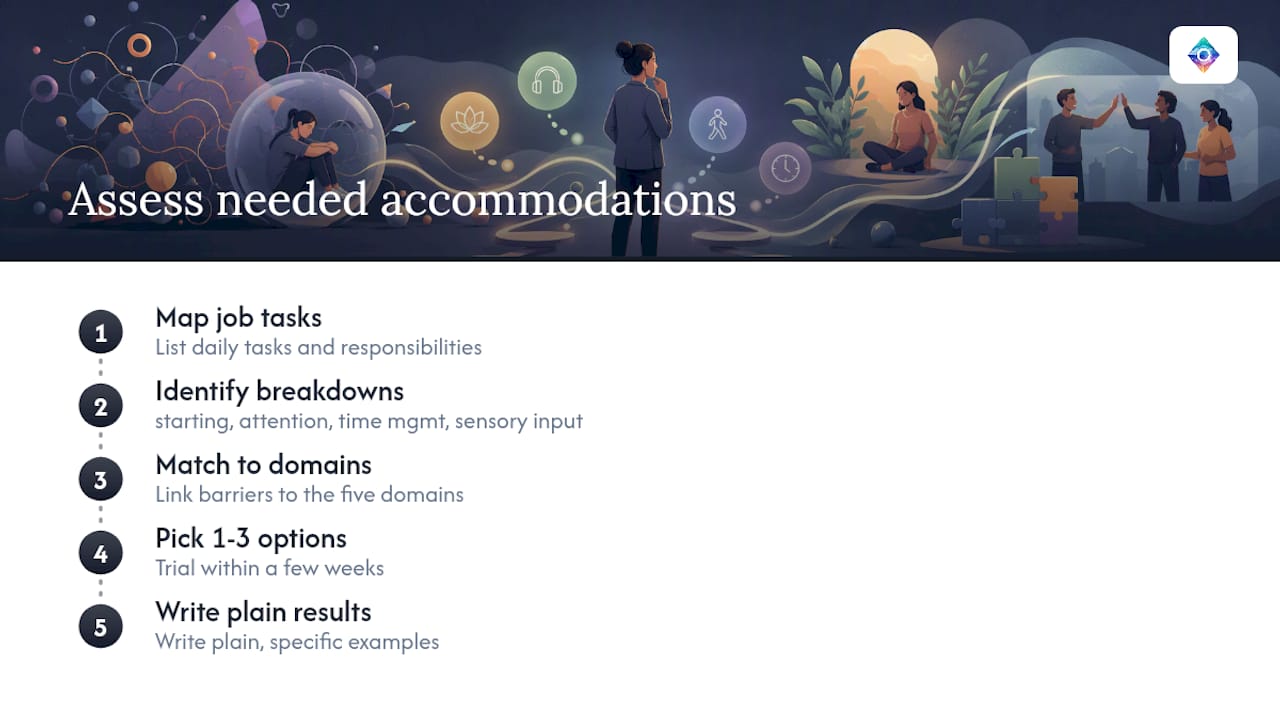
A short, structured self-assessment can help you prioritize the one to three accommodations most likely to make a real difference, instead of guessing your way through a long list. Start by mapping your actual job tasks, then identify where each one breaks down: is it starting tasks, sustaining attention, managing time, or filtering sensory input? Match each barrier to one of the five accommodation domains above, and pick options you can realistically trial within a few weeks.
An assessment like this isn't a medical diagnosis, and it won't replace documentation from a clinician if your employer asks for it. What it can do is organize your thinking, so you walk into a conversation with clear language instead of a vague sense that "work is harder than it should be."
Pro Tip: Write down your assessment results in plain language before your meeting. "I lose focus after 45 minutes in open-plan spaces" is far more actionable for your manager than "I struggle to concentrate."
A quick word of encouragement
If disclosure feels risky, that's a normal reaction, not a sign you're doing something wrong. You have real legal footing here, and most requests are far less dramatic in practice than they feel in your head beforehand. Keep a short written record of every accommodation you agree to, along with review dates, so you're not re-explaining your entire situation every time you get a new manager. If the conversation feels stuck, loop in HR, occupational health, a union rep, or a manager you trust. You don't have to navigate this alone.
Prepare Your Case with a Structured Self-Assessment
A structured self-assessment can cut down on the re-explaining that wears people out over time, surfacing one to three trialable accommodations you can bring straight into a conversation with HR or your manager. Omniprism's neurodivergence self-assessment gives you an instant profile across 14 domains, including ADHD-related traits like attention regulation and executive function, without requiring weeks of tracking or a formal clinical evaluation first.
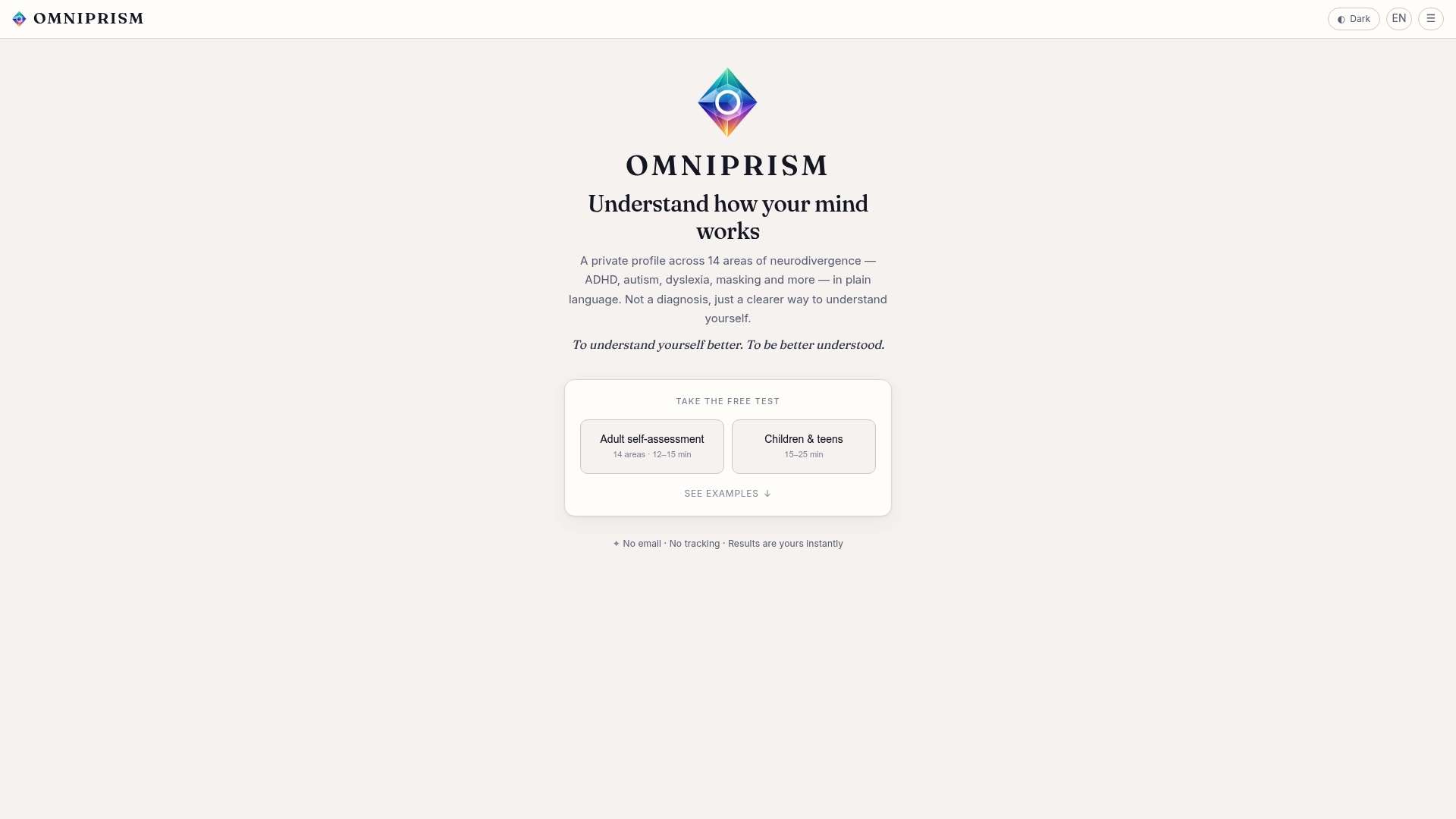
To be clear about scope: this isn't a diagnostic tool, and it won't replace an evaluation from a physician or psychologist if your employer requests formal documentation. What it does well is turn a vague sense of "something's not working" into concrete, plain-language observations you can use to prepare for a meeting or a follow-up conversation with a clinician. No data collection means your results stay private, and if you want a shareable summary for a doctor's appointment, the optional one-time Specialist Briefing report packages your results into something a clinician can act on quickly. If you're preparing on behalf of a younger employee or family member, Omniprism also offers guided assessments for children ages 7 to 10 and young people ages 11 to 13. Start with the free assessment, see what your profile shows, and decide from there whether the paid report is worth adding to your accommodation conversation.
Frequently Asked Questions
Does ADHD automatically qualify as a disability at work? Not automatically. It qualifies when it substantially limits a major life activity like concentrating, organizing, or regulating attention, which is true for many but not all employees with ADHD.
Can my employer ask for proof of my ADHD diagnosis? Yes, if your need for accommodation isn't obvious. They can request documentation connecting your ADHD to the specific limitation, but not your entire medical history.
What if my employer says an accommodation is too expensive? They have to show the cost creates genuine "undue hardship" relative to their specific size and resources, not just that it's an inconvenience. Many effective accommodations, like written checklists or flexible scheduling, cost nothing at all.
How long does my employer have to respond to my request? Neither the ADA nor the Equality Act sets a fixed deadline, but unreasonable delay can itself violate the interactive process requirement. Follow up in writing if you haven't heard back within a couple of weeks.
Can I be fired for requesting an ADHD accommodation? No. Retaliation for requesting a reasonable accommodation is illegal under both the ADA and the Equality Act 2010.
This article is general information, not a substitute for advice from a qualified lawyer. Consult a qualified legal professional about your own circumstances before acting on anything here.
Sources
- Small employers and reasonable accommodation (EEOC)
- Equality Act 2010 - Duty on employers to make reasonable adjustments (UK government guidance)
- Accommodating Employees with Attention-Deficit/Hyperactivity Disorder (ADHD) (JAN)
- Ada