

Time blindness in ADHD is a real, consistent difficulty sensing how time passes and estimating how long tasks will take. It's a brain difference, not a character flaw, and it's not the same thing as laziness.
If you recognize yourself in that sentence, here are three things you can do before you finish reading:
- Set a loud alarm for 25 minutes into whatever you're doing right now, even if you think you don't need it.
- Start a one-day time log. Just jot down what you did and when, hour by hour, and compare it to what you expected.
- Put a visible timer or clock somewhere you can't avoid seeing it in the room where you work or study most.
This guide walks through the different types of time blindness, what the research actually says about why it happens, daily strategies that hold up outside of a self-help article, and when it's worth talking to a professional. It also covers how a structured self-assessment can help you organize what you're noticing into something useful for that conversation.
Key Takeaways
Time blindness in ADHD is a documented difficulty estimating and tracking time that responds best to a mix of external tools, behavioral routines, and, for some people, medication.
| Point | Details |
|---|---|
| Not a character flaw | Time blindness stems from altered time perception tied to ADHD brain functioning, not laziness or unreliability. |
| Two distinct types | Short-term time-in-task blindness needs alarms and timers; future time blindness needs visual calendars and milestone maps. |
| Evidence is real but mixed | Studies consistently show impaired time estimation and reproduction in ADHD adults, though some subdomains show mixed results. |
| Hyperfocus transitions matter most | Difficulty shifting from absorbed to directed attention is a key trigger for lost time, and explicit transition cues help. |
| Start with a self-check | Track a one-day time log and answer a short symptom checklist before deciding whether to seek professional evaluation. |
| Omniprism can organize your patterns | The free self-assessment covers ADHD among 14 domains and can generate a Specialist Briefing to bring to a clinician. |
Table of Contents
- What Is Time Blindness in ADHD?
- How Does ADHD Change Time Perception?
- What Are the Signs of Time Blindness?
- What Causes Time Blindness in ADHD?
- When Should You Get Professional Help for Time Blindness?
- How Can You Manage Time Blindness Day to Day?
- What Does the Research Actually Show?
- A Note From Omniprism on Living With Time Blindness
- How Omniprism Can Help You Understand Your Patterns
- Frequently Asked Questions
- Sources
What Is Time Blindness in ADHD?
Time blindness isn't one single symptom. It's an umbrella term for several distinct ways the brain mishandles time, and knowing which one you're dealing with changes what actually helps.
Researchers and clinicians use a handful of related concepts. Time estimation is guessing how long a task will take before you start it. Time reproduction is trying to recreate a duration you experienced earlier, like tapping a button after "about 30 seconds." Time production is the reverse: trying to let exactly 30 seconds pass without a clock. Duration discrimination is telling whether one interval was longer or shorter than another. People with ADHD tend to struggle across several of these domains, though not always in the same way or to the same degree.
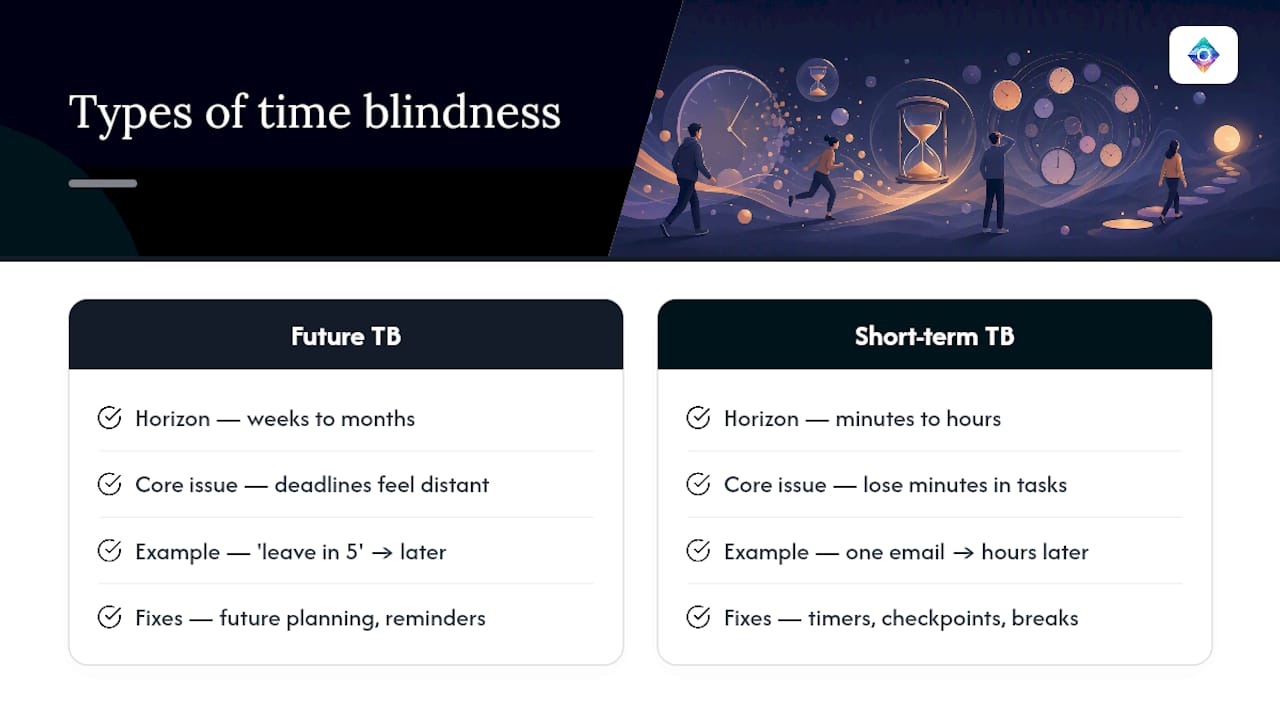
Clinicians also distinguish between two broad flavors. Future time blindness is trouble grasping distant deadlines. A due date three weeks out doesn't feel urgent until it's suddenly tomorrow. Short-term or time-in-task blindness is losing track of minutes while you're doing something engaging, so you glance up and two hours have vanished. These need different fixes, a point worth holding onto because so much generic advice treats time blindness as one problem with one solution.
This is different from ordinary forgetfulness, which usually means you didn't encode the information in the first place. It's also different from procrastination, which involves consciously delaying a task you know needs doing, and from poor planning, which is a skills gap you could close with a better system. Time blindness sits underneath all three: even with a perfect plan and full motivation, the internal clock still misreads the situation.
A few quick examples: someone told "call me back in ten minutes" who calls back in forty is likely experiencing time reproduction failure. Someone who says "I'll leave in five minutes" and means it, then leaves in thirty five, is living out future time blindness on a small scale. Someone who sits down to answer one email and looks up at 1 a.m. is dealing with time-in-task blindness during hyperfocus.
How Does ADHD Change Time Perception?
Some researchers argue that altered time perception deserves a more central place in how ADHD is understood, and possibly diagnosed, rather than being treated as a side effect of inattention. That's a meaningful shift in framing, and it's backed by a growing body of work looking directly at how ADHD brains process duration.
An explorative review of adults with ADHD found consistent problems across time estimation, reproduction, and time management, though the authors were candid about a catch: study protocols vary a lot, sample sizes are often small, and some individual domains showed mixed or contradictory results. That's an important caveat before anyone treats time blindness as a fully mapped, settled science.
What the evidence points to:
- Time estimation and reproduction tasks show the most consistent deficits across studies of adults with ADHD.
- Findings on time production and fine-grained duration discrimination are less consistent, with some studies finding no significant difference from neurotypical control groups.
- Researchers increasingly frame time perception as a core feature of ADHD in adults rather than a downstream consequence of distractibility.
The biological story centers on dopamine. Dopamine pathways run through regions involved in timing and executive control, including the prefrontal cortex and cerebellum, and lower dopamine availability appears to disrupt the internal signals the brain uses to track elapsed time. This lines up with a triple-pathway model some researchers use to explain ADHD, where timing deficits sit alongside inhibition problems and reward-processing differences as separate but related threads, rather than one symptom causing the others.
This matters practically. If dopamine availability is part of the mechanism, it explains why stimulant medication changes time perception for some people with ADHD and why purely behavioral tricks work better for some individuals than others. Neither medication nor a sticky-note system is a universal fix, because the underlying deficit isn't identical from person to person.
What Are the Signs of Time Blindness?
Some signs are obvious once you know to look for them. Others hide inside habits you've written off as personality quirks.
A practical checklist:
- You're chronically late, even to things you care about, despite leaving what feels like enough time.
- You consistently underestimate or overestimate how long tasks take, in either direction.
- You lose entire blocks of time during hyperfocus and have no clear memory of where it went.
- You miss appointments not because you forgot they existed, but because you misjudged when you needed to leave.
- You struggle to sequence multi-step tasks in a realistic order, so simple errands turn into a scramble.
Picture three ordinary moments. At work, a report due Friday feels distant on Monday, gets a passing thought on Wednesday, and turns into a Thursday-night crisis, not from lack of caring but because the deadline never registered as close until it was. At home, "dinner in twenty minutes" turns into forty because chopping vegetables absorbed more attention than the clock did. Socially, "I'll be there at seven" becomes 7:40, and the friend on the other end reads it as disrespect rather than what it usually is: a genuine miscalculation of how long getting ready actually takes.
A short self-check. Ask yourself, honestly:
- Do I regularly guess wrong about how long a task will take, in either direction?
- Have I lost track of two or more hours during something absorbing, more than once in the past month?
- Do people in my life describe me as unreliable about time, even when I don't feel unreliable?
- Do I need external reminders (alarms, other people, visual cues) to know when to stop or start something?
Answering yes to two or more suggests time blindness is playing a real role in your day, not just an occasional bad week.
What Causes Time Blindness in ADHD?
The short version: executive function deficits create the underlying vulnerability, and context decides how badly it shows up on any given day.
Attention shifting, working memory, and planning are the three executive functions most tied to time perception. Attention shifting lets you disengage from one task and redirect toward another, which is exactly what you need to notice a clock and act on it. Working memory holds the "I need to leave by 3:15" instruction in mind while you're doing something else. Planning breaks a vague goal into ordered steps with realistic time attached to each one. When any of these three is compromised, which is common in ADHD, time tracking becomes a background process instead of an automatic one.
Several everyday factors make this worse. Hyperfocus is the most disruptive: the ADHD brain has trouble shifting from automatic, absorbed attention back to directed, goal driven attention, and that transition failure is where whole afternoons disappear. Low dopamine availability compounds it. Tasks that carry strong emotional weight, whether exciting or dreaded, distort time perception further, stretching or compressing how long something feels. Poor sleep and elevated stress degrade the same executive resources needed to track time, so a bad night often means a worse day for time awareness.

One question comes up often: is this a dyslexia thing too? Time blindness and dyslexia share some executive-function overlap, particularly around working memory and sequencing, but they're driven by different primary mechanisms. Dyslexia centers on language processing; time blindness in ADHD centers on attention regulation and dopamine-linked timing circuits. The two can coexist, and if they do, they usually need separate assessment approaches rather than one combined test.
When Should You Get Professional Help for Time Blindness?
Self-management goes a long way, but some situations call for more structured support. Knowing what to bring to that conversation makes it far more productive.
Before an appointment, gather:
- A short time log, even just three days, showing planned versus actual time for key tasks.
- Two or three concrete examples of missed deadlines, appointments, or commitments, with specifics rather than generalities.
- Notes on sleep patterns and any medications, past or current, including whether they were ever tried for ADHD specifically.
- Examples of how this shows up at work or school: missed reviews, late assignments, feedback from supervisors or teachers.
Different clinicians serve different roles. A primary care doctor can screen initially and refer onward. A psychiatrist or developmental pediatrician can evaluate for ADHD and manage medication if it's appropriate. A psychologist can run more detailed cognitive and executive-function testing. An ADHD coach, while not a diagnostic professional, can help translate a diagnosis into daily systems that actually stick. A first evaluation typically involves a structured interview, standardized questionnaires, and a review of history going back to childhood, since ADHD symptoms usually predate adulthood even when they weren't recognized then.
Some signs mean don't wait: a sudden, severe drop in functioning at work or home, safety risks tied to missed medical appointments or medication schedules, or time blindness tangled up with serious depression or anxiety that's getting worse rather than better. In any of those cases, the conversation with a professional should happen sooner rather than after another month of trying to self-manage.
How Can You Manage Time Blindness Day to Day?
The right toolkit depends on whether you're fighting short-term time-in-task blindness or the future-time version, and most people need both sets of tools working together.
A few mini-plans to start with:
- Morning routine checklist. Write down the actual sequence you need, in order, with rough minutes attached to each step. The point isn't precision, it's giving your brain an external map instead of relying on internal time sense that isn't reliable yet.
- Single-task timeboxing. Pick one task, set a visible timer for a fixed block (25 to 45 minutes works for most people), and stop when it goes off, even mid-sentence. This trains the brain to notice the alarm as a real signal rather than background noise.
- Transition routines for hyperfocus. Build a deliberate exit ritual: an audible timer, a change in lighting, or standing up and moving to a different spot the moment an alarm sounds. Environmental triggers make the shift from absorbed to directed attention less of a cognitive fight.
- A pre-meeting or pre-deadline checklist. Fifteen minutes before anything time-sensitive, run through: what do I need, where am I going, how long will getting there actually take, plus a buffer.
External supports do a lot of the heavy lifting here. Visual timers, multiple clocks placed where you'll actually see them, alarms, and app blockers all work by making time visible instead of asking your brain to track it invisibly. For future time blindness specifically, a large-format calendar with milestones marked out beats a phone calendar buried three taps deep, because friction defeats the whole point. Clinics widely recommend the Pomodoro technique or a similar short work block of roughly a half hour, combined with visible schedules and buffer time built into every transition.
Behavioral supports round this out. Cognitive behavioral techniques can help challenge the all-or-nothing thinking that often follows a missed deadline ("I'm always late, why bother trying"). An ADHD coach or accountability partner adds a layer of external structure that's hard to replicate alone. Students managing testing deadlines or coursework timelines sometimes benefit from formal accommodations, and resources on extended time provisions for standardized testing are worth exploring if academic deadlines are a recurring pressure point. For anyone tracking study or work hours specifically, structured hour-logging methods built for demanding programs translate well to everyday time tracking too.
Pro Tip: Use a playlist as an implicit timer. If you know an album runs 40 minutes, hitting play and finishing the album becomes a built-in duration cue that doesn't require you to check a clock at all.

On medication: stimulant medication increases dopamine availability and, for many people with ADHD, improves time perception alongside its more familiar effects on attention and impulse control. It's one tool, not a replacement for the routines above, and whether it's appropriate is a conversation for a prescribing clinician, not a blog post.
What Does the Research Actually Show?
The honest summary: there's a real, consistently replicated association between ADHD and impaired time perception, but the fine details are still being worked out.
What holds up well: adults with ADHD show measurable difficulty with time estimation and time reproduction compared to neurotypical control groups. That pattern shows up across multiple independent studies rather than a single outlier finding.
What's murkier: results on time production and duration discrimination are inconsistent, with some studies finding significant deficits and others finding none. Part of the problem is methodological: researchers use different tasks, different time intervals, and different comparison groups, which makes it hard to line studies up against each other cleanly. Sample sizes tend to be modest, and adult-focused research is thinner than research on children with ADHD, even though time blindness is arguably more consequential in adult life, where nobody is structuring your day for you the way a school schedule does.
The practical takeaway: treat time blindness as a well-supported, real phenomenon worth taking seriously, but hold any specific claim about "the ADHD brain always does X" a little loosely. If one strategy doesn't work for you, that's consistent with the mixed data, not a sign you're doing it wrong.
A Note From Omniprism on Living With Time Blindness
Losing track of hours, showing up late to things that matter to you, or getting told you're careless when you know you're trying, none of that means something is wrong with your character. It means your brain processes duration differently, and that difference has been documented, studied, and named. Reframing it that way isn't a comforting slogan. It's the accurate description.
What helps most people isn't a single insight but a clearer picture of their own patterns: which situations trigger time blindness, which strategies actually stick, and how to describe all of that to a clinician without it turning into a vague "I'm just bad with time." A structured self-assessment can pull those patterns into something concrete you can look at and share, rather than a fuzzy sense that something's off.
How Omniprism Can Help You Understand Your Patterns
Reading about time blindness is useful. Seeing your own patterns laid out clearly is more useful.

Omniprism's free self-assessment covers 14 domains, including ADHD, and gives you an instant profile in plain language, no waiting room, no data collection, no weeks-long intake process. If time blindness has been a recurring thread in your life, the assessment can help you see how it connects to attention patterns, working memory, and other traits you might not have linked together before. For anyone preparing for a clinical evaluation, the optional Specialist Briefing turns your results into a clear, shareable summary you can bring straight into that appointment, saving you from trying to explain years of scattered experience in a ten-minute intake conversation. Families can also start with guided assessments built for children ages 7 to 10 or for young people ages 11 to 13, designed around how younger people actually experience and describe these patterns.
One thing worth being direct about: this is a self-assessment tool, not a diagnosis. It's built to organize what you're noticing and make it easier to talk about, and it works best alongside, not instead of, an evaluation from a qualified clinician. You can read more about how the scoring works on the Omniprism methodology page.
Start the free assessment today and see what patterns show up across your results.
Frequently Asked Questions
Is time blindness a real diagnosis? No. Time blindness isn't a formal diagnosis in the DSM-5, but it's a widely recognized and commonly discussed feature of ADHD and other conditions affecting executive function.
Can time blindness happen without ADHD? Yes, though it's especially common and well-studied in ADHD. Other conditions affecting attention or executive function can produce similar time-perception difficulties.
Does medication fix time blindness? Stimulant medication can improve time perception for some people with ADHD by increasing dopamine availability, but it works best combined with external tools like timers and visual schedules, not as a standalone fix.
How is time blindness different from being disorganized? Disorganization is usually a planning or systems problem you could solve with better tools. Time blindness persists even with a good system in place, because the underlying issue is how time itself is perceived, not how tasks are arranged.
What's the fastest way to start managing it today? Set a visible timer for your next task and log what you expected versus what actually happened. That single comparison usually reveals your specific pattern faster than any general advice.
This article is general information, not a substitute for advice from a qualified doctor. Consult a qualified healthcare professional about your own circumstances before acting on anything here.
Sources
For deeper technical grounding, the explorative review of time perception in adult ADHD works well as a clinical reference, while Cleveland Clinic's explainer on time blindness and Healthline's overview offer accessible, patient-friendly summaries. For hands-on strategies, Stanford's guide to managing time blindness and Health.com's practical breakdown are worth bookmarking.