

ADHD task paralysis is an involuntary freeze response that blocks you from starting or continuing a task, even when you genuinely want to finish it. It's not a motivation problem. It's an executive-function breakdown, driven largely by underactive dopamine signaling in the brain circuits responsible for initiating action, according to a peer-reviewed review of ADHD neurobiology.
Right now, before reading another paragraph, try this: stand up and do one physical thing connected to the task. Put one dish in the sink. Open the document and set a timer for two minutes. Pick up the phone and dial the first three digits. The goal isn't progress. It's proof that the freeze can break.
This article covers:
- What causes the freeze (executive dysfunction, dopamine, working memory, emotional load)
- The different types of paralysis and how to tell them apart
- How paralysis differs from ordinary procrastination or depression
- A prioritized toolkit of tactics that actually lower the cost of starting
- When it's time to bring in a professional
Key Takeaways
ADHD task paralysis is an involuntary executive-function freeze driven by dopamine and working-memory limits, and it responds best to strategies that lower the cost of starting rather than demands for more willpower.
| Point | Details |
|---|---|
| It's neurological, not lazy | Underactive dopamine signaling in initiation circuits, not a lack of discipline, drives the freeze. |
| Identify your freeze type | Mental, choice, initiation, and transition paralysis each respond to different tactics. |
| Shrink the first step | A two-minute physical action bypasses the decision-making that triggers the freeze. |
| Use the fallback ladder | Move from micro-start to movement to body doubling to timers before giving up on a task. |
| Map your patterns first | Omniprism's free self-assessment profiles 14 domains to help target which strategies fit you before or alongside a clinical visit. |
Table of Contents
- What Is Task Paralysis in ADHD, and What Types Exist?
- Why Does ADHD Task Paralysis Happen?
- How Is Task Paralysis Different From Procrastination?
- What Actually Works to Break Task Paralysis?
- When Should You Get Professional Help for Task Paralysis?
- How Can a Self-Assessment Help You Understand Your Patterns?
- What Should You Actually Believe About Your Own Paralysis?
- Ready to Understand Your Own Patterns?
- Frequently Asked Questions
- Sources
What Is Task Paralysis in ADHD, and What Types Exist?
Not all freezing looks the same, and figuring out which type you're dealing with matters, because the fix for one type can be useless against another.
Mental paralysis happens when your thoughts loop without producing a plan. You sit with a work project due Friday, and your brain just spins on where to begin instead of landing anywhere.
Choice paralysis hits when there are too many valid starting points and none feels obviously correct. Standing in a closet unable to pick an outfit, or staring at five open browser tabs for "the right approach" to an email, are both choice paralysis in disguise.
Task-initiation paralysis is the most literal version: you know exactly what to do and still can't make your body do it. This is the laundry that's been folded in the basket for four days because carrying it upstairs feels, somehow, impossible.
Transition or shutdown paralysis occurs when moving from one activity to another. You finish a video and suddenly can't summon the energy to open your homework, even though the video wasn't especially engaging.
To figure out which type is running the show, ask yourself:
- Do I know the steps but can't move my body? That's task-initiation paralysis.
- Am I stuck comparing options that all seem equally valid or equally wrong? That's choice paralysis.
- Is my mind just blank or looping with no plan forming at all? That's mental paralysis.
- Did this start right after finishing something else? That's a transition freeze.
Most people with ADHD experience all four at different times. A Tuesday morning might bring transition paralysis after breakfast, and a Wednesday afternoon might bring task-initiation paralysis staring at a tax form.
Why Does ADHD Task Paralysis Happen?
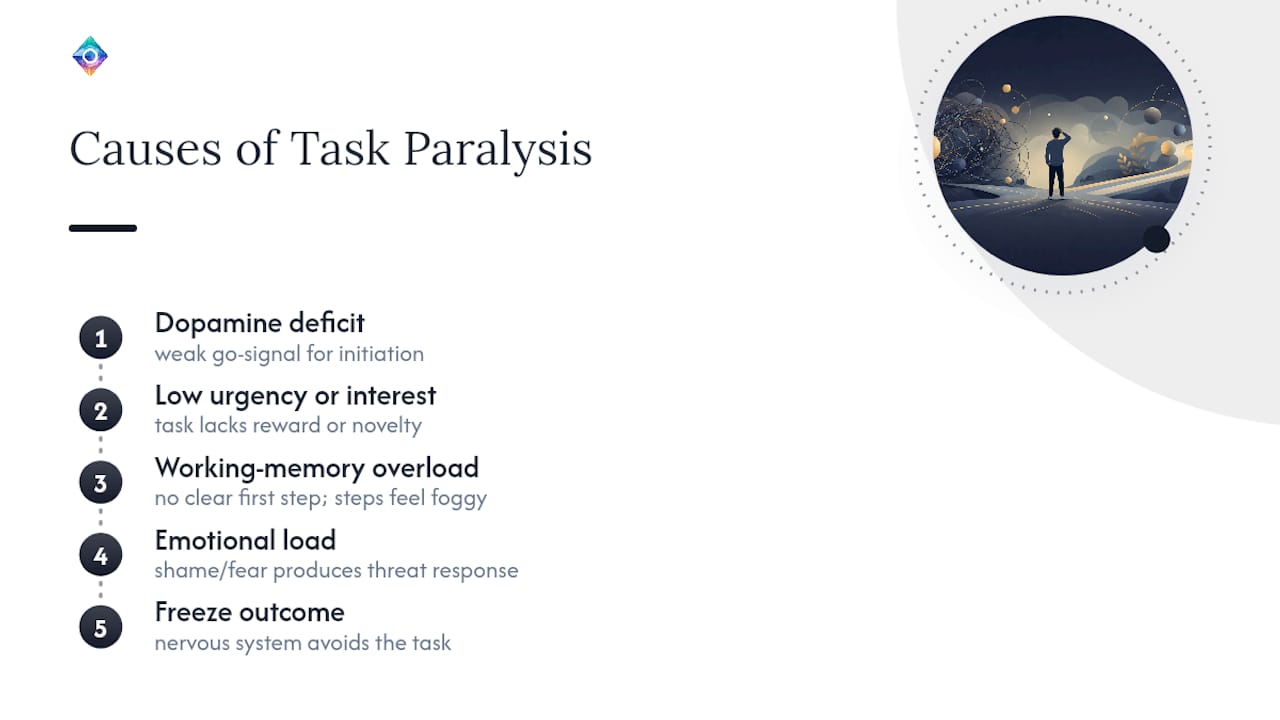
Task initiation is a specific executive function, the mental machinery that decides when to act, not just what to do. In ADHD brains, that machinery often runs on an underpowered dopamine supply, and dopamine acts as a kind of go-signal for behavior, according to a health-education summary on dopamine's role in motivation.
When a task carries no built-in urgency, novelty, or personal interest, the go-signal often just doesn't fire strongly enough to move you off the couch. This is why someone with ADHD can spend six focused hours on a hobby project and then sit paralyzed for two hours in front of a five-minute chore. The chore isn't harder. It just doesn't generate enough dopamine to trigger the initiation circuit.
Working memory adds a second layer to the problem. Working memory is what holds a task's steps in your mind long enough to act on them, and when it's overloaded, a task that has ten implied steps but zero explicit ones turns into fog. You know you need to "deal with the insurance paperwork," but that instruction has no first move attached to it, so your brain can't grab onto anything concrete.
Then there's emotional load. A task tied to shame, fear of failure, or past criticism can trigger something closer to a threat response than a simple lack of motivation.
When a task has been avoided long enough to become emotionally loaded, the freeze stops being about the task itself and starts being about the feeling attached to it. The brain treats it less like a chore and more like a threat to avoid.
That reframes a lot of "laziness" as something closer to a nervous system doing exactly what nervous systems do when they sense danger: freeze first, ask questions later.
A quick statistic worth sitting with: dopamine differences aren't a minor footnote in ADHD, they're central to why movement, novelty, or an unexpected reward can snap someone out of a freeze almost instantly, per Healthdirect's clinical summary on dopamine. That's not a willpower trick. It's a chemical one.
How Is Task Paralysis Different From Procrastination?
The behaviors can look identical from the outside. A pile of unopened mail is a pile of unopened mail whether it's procrastination or paralysis. The difference is what's happening underneath.
Ordinary procrastination is a choice, even a semiconscious one. You decide the deadline is far enough away, or the task is unpleasant enough, that delay feels acceptable. Task paralysis has no decision in it at all. You want to start. You may be actively distressed that you haven't started. Your body simply won't cooperate, which is why clinical explanations of ADHD paralysis describe it as involuntary, often layered with shame that regular procrastination rarely produces.
| Feature | Task paralysis | Ordinary procrastination |
|---|---|---|
| Sense of control | Feels involuntary, like being frozen | Feels like a choice, even a bad one |
| Emotional tone | Shame, panic, self-blame | Mild guilt, sometimes none |
| Underlying driver | Executive dysfunction, dopamine gap | Preference for short-term comfort |
| Response to deadlines | Urgency may still fail to trigger action | Urgency usually forces action eventually |
| Pattern | Happens across low-stakes and high-stakes tasks alike | Tends to target specifically unpleasant tasks |
A few signals point specifically to paralysis rather than run-of-the-mill delay:
- You've tried "just doing it" repeatedly and it hasn't worked, even for tasks you care about.
- The freeze applies to tasks you enjoy in theory, not just chores.
- You feel physically stuck, almost like your limbs won't respond to the instruction.
- The shame afterward is disproportionate to the task's actual importance.
Watch for overlap with depression or anxiety, too. If the freeze comes with persistent low mood, loss of interest in things you used to enjoy, or a sense of hopelessness that outlasts any single task, mood assessment should come before, or alongside, ADHD-specific strategies. Anxiety-driven freezing often centers on fear of a specific bad outcome, while ADHD paralysis tends to show up even when the stakes are low and the fear is minimal.
What Actually Works to Break Task Paralysis?
The strategies that work share one design principle: they lower the cost of starting instead of trying to manufacture more willpower. Every tactic below targets a specific missing switch, whether that's structure, urgency, novelty, or reward, borrowed from outside your own brain until the task carries enough momentum to continue on its own.
1. Make the first step absurdly small
Very short starts work because they bypass the decision-making step entirely. Instead of "clean the kitchen," the instruction becomes "put one cup in the dishwasher." This works because it removes a decision rather than just shrinking a task, according to clinical guidance on decision paralysis. A tiny physical action doesn't require working memory to hold a plan. It just requires your hands to move.
Pro Tip: Pick a physical action, not a cognitive one. "Think about where to start the report" is still a decision. "Open the document and type one sentence" is a movement. Your brain treats these very differently.
2. Use implementation intentions instead of vague plans
"I'll do it later" gives your brain nothing to grab onto. "At 9:00 AM, at my desk, I will open the budget spreadsheet" gives it a specific trigger tied to a specific location and time. Research on decision paralysis finds that these when/where statements outperform vague intentions specifically for people with executive-function deficits, because the plan doesn't depend on remembering to decide later. It's already decided.
Try scripting it out loud: "When I finish my coffee, I will walk to the laundry room and start the machine." Say it once, and you've effectively pre-loaded the instruction so your brain doesn't have to generate it from scratch under pressure.
3. Borrow someone else's presence: body doubling
Body doubling means having another person present, in the room or on a video call, while you work, without them necessarily helping at all. The mechanism appears to work through external activation and mild accountability, and it holds up whether the other person is a friend, a coworker, or a stranger in a virtual co-working session, per the same ADHD neurobiology review that explains the initiation circuit itself.
Setting it up doesn't require coordination logistics. Options include:
- A scheduled video call where you both work silently, cameras on
- Free virtual co-working rooms designed specifically for this purpose
- Simply texting a friend "starting X now, checking in in 20 minutes"
- Working at a coffee shop or library where ambient presence does the job
4. Move your body before you move the task
Physical movement changes your arousal state fast, often faster than any cognitive strategy can. A short walk, ten jumping jacks, or even standing up and stretching for thirty seconds can shift enough physiology to make the next step possible. This is an underused, high-value technique precisely because it doesn't feel like it should work, and people skip it in favor of trying to think their way out of a freeze that isn't a thinking problem in the first place.
5. Manufacture urgency with timers and locked attention
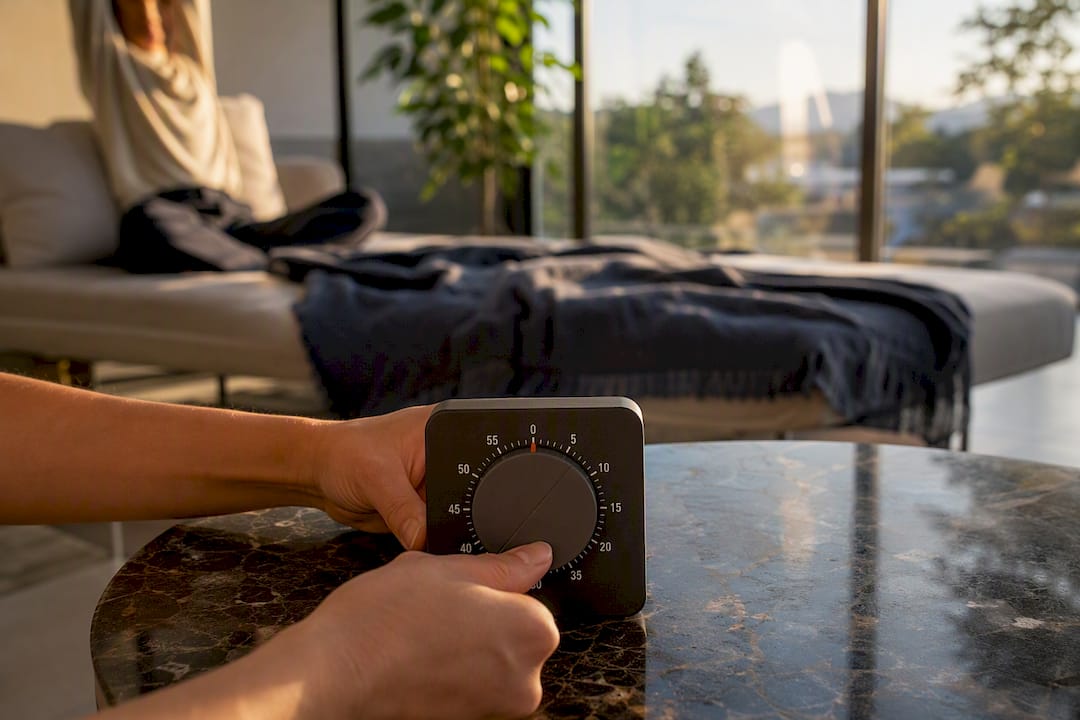
The Pomodoro technique (25 minutes on, 5 minutes off) works for some people, but a countdown timer set for just 10 minutes can be more effective for pure initiation, since 25 minutes can feel like too large a commitment while you're still frozen. Locking your attention with a single repeated playlist, one you associate specifically with "task mode," can also create a Pavlovian cue that shortcuts the initiation process over time.
6. Reduce the environment's decision load
Choice paralysis thrives on options. If getting dressed is a daily freeze point, laying out one outfit the night before removes the choice entirely. If starting work depends on which app or notebook to use, pick one in advance and stick with it for a week. Environmental scaffolding isn't about organization for its own sake. It's about pre-deciding so your depleted brain doesn't have to decide again later.
7. Externalize the first three steps
Vague tasks feel foggy because your working memory can't hold an entire multi-step project at once. Writing down just the first three concrete steps, on paper, in a notes app, anywhere outside your head, converts fog into a sequence you can follow one line at a time. A brain-dump approach recommended by behavioral health practitioners works the same way for larger projects: get everything out of your head and onto a page, then pull just the next physical action off the list.
8. Build in novelty or reward on purpose
Since dopamine responds to novelty and reward, engineer some in. Work in a new location. Use a specific pen you only use for tasks you're avoiding. Promise yourself a specific small reward tied to the completion of the first step, not the whole task. None of this is manipulation. It's working with your actual neurochemistry instead of against it.
The fallback ladder
When one tactic doesn't work, don't repeat it five more times. Move down the ladder instead:
- Try a two-minute micro-start.
- If that fails, move your body for 60 seconds, then try again.
- If that fails, text or call someone for a body-doubling session.
- If that fails, set a 10-minute countdown timer and commit to stopping when it rings.
- If that fails, change your physical location entirely.
- If that fails, ask someone directly for help starting the task with you.
This sequence matters because cycling through the same failed tactic repeatedly is what generates the shame spiral that makes the next attempt even harder. A ladder gives you somewhere to go instead of somewhere to stall.
When Should You Get Professional Help for Task Paralysis?
Most people with ADHD can manage day-to-day freezing with the tactics above. Professional support becomes worth pursuing when the pattern starts costing you something significant and repeatable.
Watch for these signals:
- Missed deadlines are affecting your job security or income.
- Bills go unpaid not from lack of funds but from inability to open the mail or log in.
- Relationships are strained by chronic unfinished commitments.
- The shame cycle itself has become as disruptive as the original task backlog.
Medication, including stimulants, often improves task initiation directly by addressing the underlying dopamine signaling gap, and clinical guidance generally recommends pairing it with behavioral support such as ADHD-adapted cognitive behavioral therapy or ADHD coaching, according to clinical treatment summaries. Medication alone tends to lower the initiation barrier; the behavioral piece is what builds the habits that stick once the barrier is lower.
Occupational therapy can also help, particularly for translating executive-function challenges into concrete daily routines. Before an appointment, track a few specific examples: what tasks you freeze on, how long the freeze typically lasts, and what you've already tried. Bringing three or four concrete examples gives a clinician far more to work with than a general description of "trouble getting things done."
How Can a Self-Assessment Help You Understand Your Patterns?
Before or alongside a clinical appointment, a structured self-assessment can help you see your own patterns clearly instead of guessing at them in the middle of a freeze. Omniprism's free self-assessment maps traits across 14 domains, including ADHD, executive-function patterns, and emotional regulation, giving you an instant profile without tracking symptoms for weeks first.
That profile can help you figure out which type of freeze shows up most for you, whether your paralysis leans toward dopamine-driven initiation gaps or emotionally loaded avoidance, and which tactics from the toolkit above are worth trying first. If your paralysis is tangled up with sensory overwhelm or masking, for instance, the assessment surfaces that alongside the ADHD-specific results instead of treating ADHD as an isolated data point.
- The results are plain-language and immediate, with no data collection required.
- Families can use guided assessments for children ages 7 to 10 or young people ages 11 to 13 who show similar freezing patterns at school or home.
- Results can be shared directly with a clinician, or upgraded through an optional Specialist Briefing report for a more structured summary heading into an appointment.
What Should You Actually Believe About Your Own Paralysis?
If you've spent years assuming task paralysis meant you were lazy or undisciplined, that belief is wrong, and it's worth sitting with how wrong it is. The freeze is a wiring issue, not a character flaw, and the tactics that work are the ones that stop fighting your brain's actual chemistry and start working with it.
The one thing I'd push back on: most advice tells you to "just break it into smaller steps," as if the sizing were the whole problem. Sizing matters, but sequencing matters more. A ten-step plan with the first three steps written down beats a two-step plan with nothing written down, because the fog isn't really about task size. It's about not knowing where your hand goes first.
Start today with the smallest version of the ladder above: one physical action, no plan attached, no judgment about whether it's "enough."
Ready to Understand Your Own Patterns?
If task paralysis has you wondering how much of it is ADHD, anxiety, masking, or something else entirely, guessing isn't the most useful next step, a structured self-assessment is. Omniprism gives you an instant profile across 14 domains, including ADHD, dyspraxia, sensory processing, and emotional regulation, so you can see the actual shape of your patterns instead of piecing it together from freeze to freeze.
You get results in plain language, immediately, with no account tracking or weeks of symptom logging required. If you're a parent noticing the same freezing behavior in a child or teen, Omniprism offers guided assessments for children ages 7 to 10 and options for young people built for that developmental stage specifically. For readers who want the technical detail behind how each domain is measured, the assessment methodology breaks down what each of the 14 areas actually evaluates.
Once you have your profile, you can decide whether to stop there or purchase an optional Specialist Briefing report to bring into a clinical conversation. Either way, the free self-assessment takes a few minutes and gives you something concrete to work from instead of another week of guessing.
Frequently Asked Questions
Is ADHD task paralysis the same as executive dysfunction? Task paralysis is one visible symptom of executive dysfunction. Executive dysfunction covers a broader set of skills, including planning, working memory, and emotional regulation, and initiation is just one of the functions that can break down.
Can task paralysis happen with tasks you actually enjoy? Yes. Since the freeze is tied to dopamine signaling and executive function rather than interest level, even hobbies and enjoyable projects can trigger a freeze, especially after a break in routine or during emotional overload.
Does caffeine help with ADHD task paralysis? Caffeine can provide a mild, temporary boost to alertness and dopamine activity for some people, but it's not a substitute for targeted strategies or, where appropriate, prescribed medication, and effects vary widely from person to person.
How long does an ADHD freeze typically last? It varies widely, from a few minutes to several hours or even days for a specific task, depending on the emotional load attached to it and whether any initiation tactic gets applied.
Should I try to push through the freeze with willpower? Pushing through rarely works because the freeze isn't a willpower deficit. Lowering the initiation cost with a tiny physical first step, movement, or borrowed structure from another person tends to work far better than forcing yourself to try harder.
Sources
- Peer-reviewed review on ADHD neurobiology and initiation (PMC9821724)
- Don't know where to begin? How to navigate decision paralysis — URMC Behavioral Health Partners (Sept 2025)
- Healthdirect summary on dopamine and behavior