

Spoon theory is a metaphor that treats daily energy as a limited number of "spoons," giving people with chronic illness, disability, or neurodivergence a concrete way to plan their day and explain invisible fatigue to others. It is not a medical test or a diagnosis. It is a communication and pacing tool, one that chronic illness, mental health, and neurodivergent communities have adapted for two decades because it puts language around something doctors' charts rarely capture.
TL;DR:
- The variability of spoon costs depends heavily on factors like sensory sensitivity, masking efforts, and executive function, which can drastically change daily energy needs.
- Tracking specific patterns over time helps identify what activities, environments, or mental loads deplete spoons faster, allowing for targeted pacing and boundary setting.
- External assessments like Omniprism's free profile tool can clarify personal energy drains, improving pacing strategies and conversations with healthcare providers.
- Rigid schedules often fail because they ignore the shifting nature of task costs, making flexibility and pattern awareness essential for effective energy management.
- Comparing similar diagnoses reveals significant differences in daily spoon costs due to overlapping patterns, emphasizing individualized pacing rather than generic advice.
Table of Contents
- What Is Spoon Theory? The Basic Idea
- How Spoon Theory Works in Practice
- Who Uses Spoon Theory and Why the Community Calls Themselves 'Spoonies'
- What Spoon Theory Gets Right, and Where It Falls Short
- How to Apply Spoon Theory to Your Own Energy
- Mapping the Patterns That Change Your Spoon Costs
- Why Most Spoon Theory Advice Stops One Step Short
- Want to Understand Your Own Spoon Costs Better? Start Here
- Sources
What Is Spoon Theory? The Basic Idea
Christine Miserandino coined the concept in a 2003 essay, grabbing a handful of spoons from a diner table to show a friend what living with lupus actually felt like. Each spoon represented one unit of energy for the day. As she narrated a normal morning, showering, getting dressed, making breakfast, she took spoons away one by one until her friend understood the trade-offs a healthy body never has to make.
The story spread fast through blogs, forums, and eventually social media, becoming shorthand across chronic-illness and disability spaces. A few things explain why it stuck:
- It gives a physical, countable object to an abstract experience (fatigue, pain, brain fog).
- It shows opportunity cost: spend spoons on a shower, and there may be none left for dinner.
- It works in conversation without requiring a medical explanation.
The origin matters because Miserandino built the metaphor around lupus specifically. It was never meant to model every condition perfectly, and knowing that origin helps explain both its power and its limits.
How Spoon Theory Works in Practice
Picture waking up with a fixed number of spoons for the day. Some mornings you have 12. On a flare day, you might have 4. Every task, physical, mental, or emotional, draws from that pool, and once it hits zero, functioning gets significantly harder.
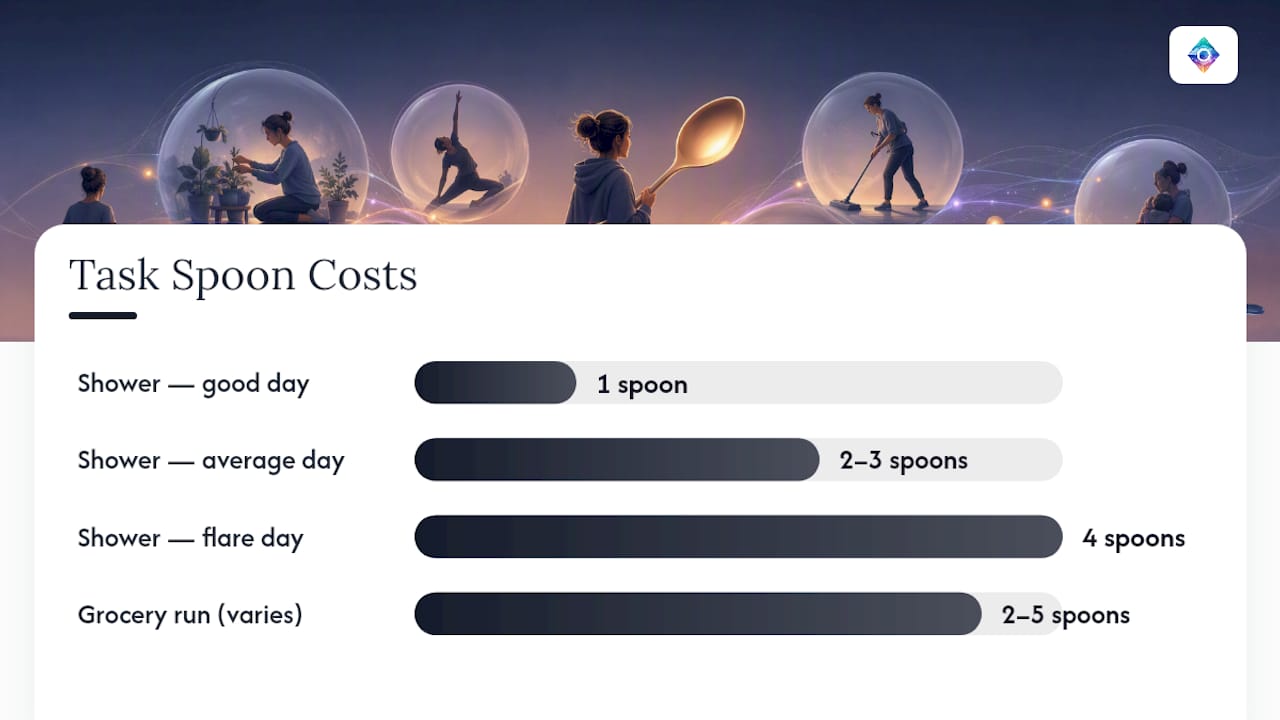
Task costs are not fixed numbers on a chart. They shift based on symptoms, sleep, medication, and sensory load. A shower might run:
- 1 spoon on a good day with no pain and decent sleep.
- 2 to 3 spoons on an average day with mild fatigue.
- 4 spoons on a flare day, when standing that long triggers dizziness or joint pain.
A grocery run follows the same pattern, often landing anywhere from 2 to 5 spoons depending on store layout, crowd noise, and how much decision-making the trip requires. The Cleveland Clinic notes this variability directly: what costs one spoon on a good day can cost four on a bad one, using showering as its own example.
The spoon count on any given task can vary greatly between a good day and a bad one, which is exactly why rigid daily schedules fail so many people managing chronic conditions.
The riskiest move in spoon theory is borrowing: pushing through an activity you don't have spoons for, betting on tomorrow's supply to cover today's debt. Borrowing works occasionally. Do it repeatedly and you create a deficit that doesn't resolve with one good night's sleep. This shows up as a crash, days of amplified fatigue, pain, or brain fog that outlasts the original activity. The Wikipedia entry on spoon theory points to this subjectivity as central to the metaphor: two people with the same diagnosis, or the same person on two different days, can assign wildly different costs to the identical task.
Who Uses Spoon Theory and Why the Community Calls Themselves 'Spoonies'
People who identify with the metaphor often call themselves "spoonies," a term born inside chronic-illness forums that turned a private struggle into a shared identity. It shows up on hashtags, in pins and merchandise, and in shorthand phrases like "I'm low on spoons today" that spare someone from re-explaining their whole medical history.
The metaphor started in autoimmune and chronic-pain communities but didn't stay there. Its reach now includes:
- Chronic illness groups (lupus, fibromyalgia, ME/CFS, multiple sclerosis)
- Mental health communities managing depression, anxiety, or PTSD-related fatigue
- Neurodivergent communities, including ADHD and autism, where sensory load and masking drain energy in ways that look identical to physical fatigue from the outside
The WebMD overview of spoon theory documents this spread beyond autoimmune conditions, noting the metaphor's flexibility for describing invisible limitations generally. That flexibility is exactly why a parent, a coworker, or a rheumatologist can hear "I only have two spoons left" and immediately grasp the tradeoff being described, even without understanding the underlying diagnosis.
What Spoon Theory Gets Right, and Where It Falls Short
The strongest case for spoon theory is what it does in a conversation nobody else can quite replicate. It hands someone a way to say "no" without a lengthy medical justification, and it gives the person living with the condition a framework for planning instead of just reacting to crashes after they happen.
Documented benefits include:
- Faster, less exhausting communication with family, friends, and coworkers
- A structure for prioritizing tasks instead of pushing through everything at once
- Increased self-compassion, replacing guilt over "not doing enough" with a concrete resource limit
The criticisms are just as real. Critics argue the metaphor oversimplifies conditions where energy doesn't function as one clean, countable resource, some days feel less like "low spoons" and more like the spoons themselves are the wrong material. That gap produced offshoot metaphors like fork, knife, and matchstick theory, each trying to capture a different texture of limitation, as Verywell Mind documents. There's also a real risk of people outside these communities using the term casually, stripping it of the specificity that made it useful in the first place.
Clinical voices tend to land in the same place: use it, but don't lean on it alone.
Pro Tip: Bring the spoon language into a doctor's appointment directly. Saying "I had zero spoons left by 2pm three days this week" gives a clinician something concrete to act on, more useful than "I've been tired."
How to Apply Spoon Theory to Your Own Energy
Turning the metaphor into a routine takes more than nodding along with the concept. Here's a practical sequence:
- Track for one week before you plan anything. Write down your rough spoon count each morning and what drained you by evening. Patterns show up fast, bad sleep, certain foods, sensory-heavy environments.
- Sort tasks into three tiers. Essential (medication, meals, hygiene), important (work obligations, appointments), and optional (social events, errands that can wait). When spoons run low, optional goes first.
- Batch similar tasks. Group errands into one outing instead of three separate trips; each transition, driving, parking, walking, costs its own spoon on top of the task itself.
- Build in rest windows before you need them, not after you crash. Scheduled recovery time is cheaper than emergency recovery time.
- Set borrowing rules in advance. Decide what you're willing to trade a bad tomorrow for, and what's never worth it, before you're in the moment making that call under pressure.
The Cleveland Clinic frames this kind of pacing as most effective alongside actual clinical care: physical therapy, medication management, and psychotherapy where relevant, not as a replacement for any of it.
Scripts help too. To an employer: "I manage a chronic condition that limits my energy some days. I can be fully productive with flexibility on when I do certain tasks." To family: "Today's a low-spoon day. I can do dinner or the errand, not both." Short, specific, and it doesn't demand a debate.

Pro Tip: Keep three go-to scripts saved in your phone, one for work, one for family, one for canceling plans last minute. Writing them when you're calm means you're not improvising an explanation while already running on empty.
Mapping the Patterns That Change Your Spoon Costs
Two people can have identical diagnoses and wildly different daily spoon costs, and the real driver is usually a set of overlapping patterns nobody's named yet. Sensory sensitivity can turn a grocery run into a 5-spoon task. Undiagnosed executive-function differences can make a simple errand cost double because of the planning behind it. Masking, the effort of appearing "fine" in social or work settings, is exhausting in a way that rarely gets counted at all.
Omniprism's self-assessment maps 14 domains, including sensory processing, masking, and executive function, that often explain why certain tasks quietly drain more than they should. Someone who scores high on sensory processing might find that noise-canceling headphones or shopping during off-hours cuts a task's real cost. Someone whose profile flags masking fatigue might realize that social recovery time deserves its own line item, not an afterthought. The assessment is nonclinical by design, a mapping tool, not a diagnosis, built to sit alongside conversations with an actual clinician rather than replace them.
Why Most Spoon Theory Advice Stops One Step Short
Most explainers do a fine job describing what spoon theory is and stop there, as if naming the metaphor were the whole solution. It isn't. The metaphor tells you that your energy is finite and variable. It says almost nothing about which specific triggers are draining your particular pool faster than they should, and that's the piece most people never get to.
The conventional advice, track your spoons, rest when empty, treats every drained spoon as equally mysterious. In practice, a handful of recurring factors usually explain 80 percent of the variance: sensory overload, unaccommodated executive-function friction, and the invisible labor of masking. Chasing symptoms without naming those underlying patterns just means repeating the same crash cycle with better vocabulary for it.
If there's one place to start, it's pattern identification before pacing technique. Figure out what specifically inflates your costs, not just that costs fluctuate, and pacing strategies suddenly get a lot more targeted. Rest matters. Boundaries matter. But rest without knowing what you're recovering from is a slower version of the same guesswork.
— Valerio
Want to Understand Your Own Spoon Costs Better? Start Here
Spoon theory tells you energy is finite. It doesn't tell you why your particular spoons disappear faster on some days than others, and that's where a structured look at your own patterns can help. Omniprism's free assessment gives you an instant profile across 14 areas, including sensory processing, masking, and executive function, without requiring weeks of symptom tracking or a clinical referral to get started.
The free self-assessment takes roughly the same time as one low-spoon-day rest break, and the results come back in plain language, not clinical jargon you need a translator for. If you want to bring findings into a conversation with a doctor or therapist, the optional Specialist Briefing report summarizes your profile in a format built for that exact purpose. Read through the methodology first if you want to understand how the 14 domains are scored before you commit. None of this replaces a clinical diagnosis; it's a starting point for the conversation. Take the assessment, see what patterns surface, and bring what's useful to your next appointment.
Sources
- What Is the Spoon Theory Metaphor for Chronic Illness? — Cleveland Clinic
- Spoon theory — Wikipedia
- Living With Chronic Disease: What Is the Spoon Theory? — WebMD
This article is general information, not a substitute for advice from a qualified doctor. Consult a qualified healthcare professional about your own circumstances before acting on anything here.