

A spiky profile is an uneven pattern of cognitive strengths and weaknesses, where some abilities sit far above average while others fall well below, and that unevenness changes how test scores, school reports, and workplace performance should be read.
For autistic people, this pattern is the rule, not the exception. A student who reads at a college level but can't organize a backpack isn't being inconsistent. A professional who solves complex engineering problems but misses every deadline isn't being difficult. The profile explains both.
Three things to watch for:
- Reasoning peaks: High ability in areas like pattern recognition, visual-spatial thinking, or factual recall
- Efficiency valleys: Lower scores in processing speed, working memory, or task initiation
- Adaptive skill mismatch: A gap between what someone can do cognitively and what they manage independently in daily life
Key Takeaways
A spiky cognitive profile in autism means large gaps between cognitive strengths and weaknesses, and those gaps require targeted supports rather than uniform expectations.
| Point | Details |
|---|---|
| Spiky profile defined | Uneven peaks and valleys in cognitive ability, not a diagnosis but a pattern that shapes support needs. |
| Why it's common in autism | Meta-analytic research shows consistent index scatter in autistic samples, with reasoning strengths and processing speed or working memory valleys. |
| Self-mapping first | Collect history, compare domains, and note life impact before pursuing formal testing to make clinical appointments more efficient. |
| Targeted accommodations work | Match each adjustment to a specific valley: written instructions for working memory, extended time for processing speed, quiet space for sensory load. |
| Omniprism next step | Omniprism's free 14-domain self-assessment maps your profile instantly and produces an optional Specialist Briefing to support clinical conversations. |
Table of Contents
- What does a spiky profile in autism actually look like?
- Why are spiky profiles so common in autism?
- What strengths commonly appear as peaks?
- Where do valleys typically appear in spiky profiles?
- How can you map your own spiky profile?
- How do spiky profiles translate into workplace and school accommodations?
- Practical strategies you can start using now
- What are your assessment options?
- Common myths about spiky profiles and autism
- What it actually feels like to live with a spiky profile
- Mapping your spikes with Omniprism's self-assessment
- Sources
What does a spiky profile in autism actually look like?
The term "spiky profile" describes large disparities between areas of ability, where autistic people commonly show bright peaks and deep troughs across skills. Think of it as a mountain range rather than a plateau. On a standard cognitive test, one index score might land at the 90th percentile while another sits at the 20th.
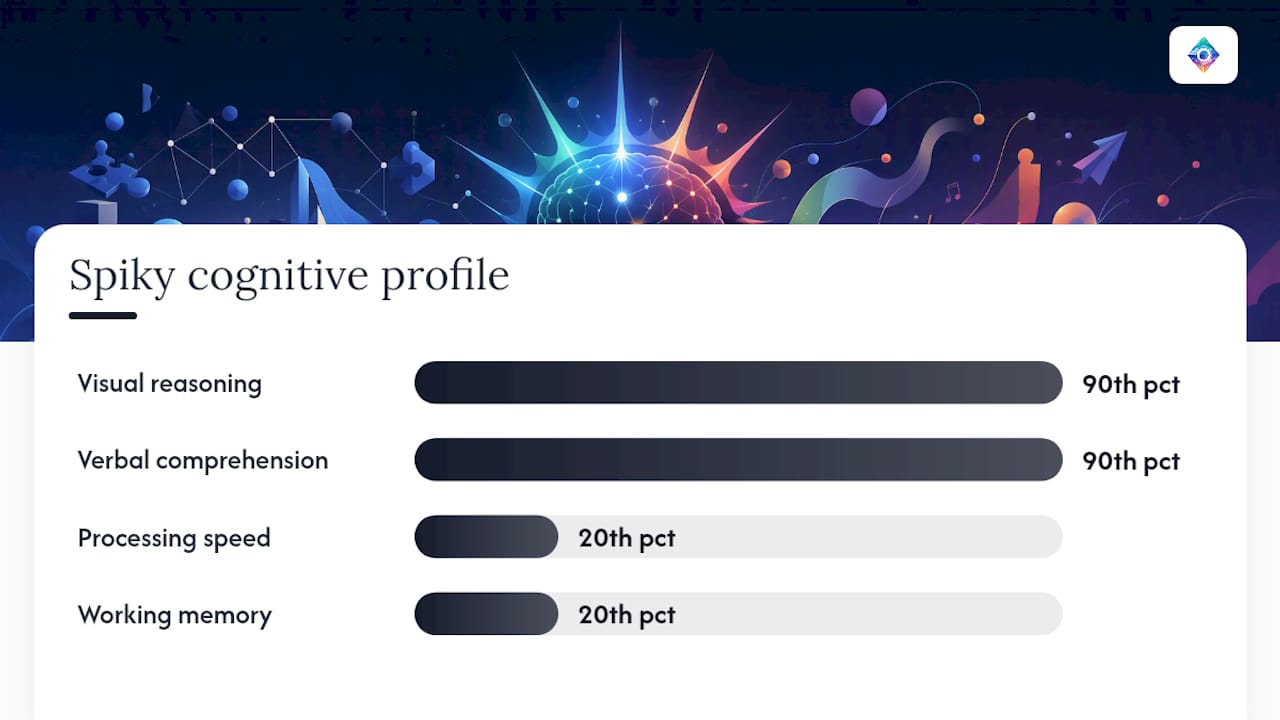
This is where a single composite score becomes a problem. A Full-Scale IQ (FSIQ) averages across all index scores, so a very high reasoning score combined with a very low processing speed score can produce an intermediate number that doesn't reflect the individual's true profile. The General Ability Index (GAI) strips out processing speed and working memory and focuses on verbal and visual reasoning, which often gives a much more accurate picture of intellectual potential when those efficiency scores are selectively low.
Three concrete examples of what this looks like in practice:
- High visual reasoning, low processing speed: Solves spatial puzzles quickly but takes twice as long as peers to copy notes from a board
- Strong factual knowledge, poor task initiation: Can recall detailed information about a topic but struggles to start a report without external prompting
- Excellent verbal comprehension, weak working memory: Understands complex instructions when read but loses the sequence when asked to hold and execute multiple steps mentally
Pro Tip: When you receive a psychoeducational report, look at the four or five index scores separately before reading the composite. A large spread between any two indices is clinically meaningful and worth discussing with the evaluator.
Why are spiky profiles so common in autism?
The short answer is that autism involves differences in how the brain processes and integrates information, and those differences don't affect all cognitive systems equally. Meta-analyses of WAIS and WISC performance in autistic samples show a consistent pattern: relative strengths in reasoning indices alongside weaker processing speed and working memory, producing characteristic index-level scatter rather than uniform shifts across all scores.
Several mechanisms contribute:
- Processing speed differences: Many autistic people process information more slowly under timed conditions, even when their underlying knowledge is strong
- Working memory variability: Holding and manipulating information in real time is often harder than storing it long-term, which creates the classic "knows it but can't show it" gap
- Executive function differences: Planning, task switching, and initiation are frequently affected, creating valleys in areas that require coordination across cognitive systems
- Sensory processing: Sensory overload during testing or daily tasks can suppress performance in ways that don't reflect true ability
- Focused interests: Deep, sustained engagement with specific topics can produce peaks of knowledge and skill that far outpace same-age peers in those areas
Comorbidities sharpen the spikes further. When ADHD, dyslexia, or dyspraxia co-occur with autism, which they frequently do, the profile becomes more scattered. A person with both autism and ADHD may show strong reasoning alongside particularly low working memory and processing speed, producing a wider gap between peaks and valleys than either condition alone would create.
Assessment conditions themselves also matter. Fatigue, anxiety, and low motivation during testing can suppress scores in ways that make profiles appear spikier than they are on a good day. Older Wechsler-scale reviews caution that index scatter requires clinical context, not just numeric cutoffs, to interpret accurately.
Statistic callout: Meta-analytic summaries of autistic cognitive profiles consistently find index-level scatter, with reasoning indices tending to outperform processing speed and working memory indices, a pattern robust enough across test editions and age groups to be considered a characteristic feature of autism rather than a testing artifact.
What strengths commonly appear as peaks?
Autistic people's cognitive peaks tend to cluster in specific areas, and knowing where those peaks typically fall can help with career planning, learning design, and self-advocacy.
- Pattern recognition: Detecting regularities, anomalies, and structures in data, code, language, or visual fields, often faster and more accurately than neurotypical peers
- Deep factual recall: Retaining large amounts of detailed information within areas of interest, sometimes with near-encyclopedic accuracy
- Visual-spatial reasoning: Strong ability to mentally rotate objects, read maps and diagrams, and think in three dimensions
- Systemizing: Understanding how systems work, from mechanical to social to mathematical, and building or improving those systems
- Attention to detail: Noticing errors, inconsistencies, or fine-grained features that others miss
- Specialized memory: Exceptional recall within a specific domain, whether that's train schedules, historical dates, or musical scores
Two short examples show how these peaks translate into real life. A high-school student with strong pattern recognition and visual reasoning struggles with written expression but excels in geometry and computer science. When her teacher stops grading her on essay format and lets her demonstrate understanding through diagrams and code, her performance reflects her actual knowledge. A software developer who finds social communication draining uses his systemizing strength to build internal documentation so thorough that his team rarely needs to ask him questions directly, reducing his social load while making his expertise visible.
Intense interest is its own amplifier. When an autistic person's focused interest aligns with a skill domain, the combination of deep motivation and sustained practice can produce what clinicians sometimes call splinter skills, abilities that sit dramatically above the person's overall profile. These aren't tricks or savant anomalies. They're what happens when someone spends thousands of hours on something they genuinely love.

Pro Tip: If you're helping a student or employee identify their peaks, ask them what they do when no one is watching. Unsupervised, intrinsically motivated activity is usually where the real strengths live.
Where do valleys typically appear in spiky profiles?
The same profile that produces remarkable peaks tends to create real difficulties in specific areas. These aren't character flaws or motivational failures, and treating them as such is one of the most damaging misreads of a spiky profile.
Common areas where valleys appear:
- Processing speed: Tasks that require quick responses, rapid copying, or timed output often produce scores and performance well below reasoning ability
- Working memory: Following multi-step verbal instructions, holding a phone number while dialing, or tracking a conversation while formulating a response can all be genuinely hard
- Social cognition: Reading implicit social cues, inferring others' intentions, and navigating unwritten social rules are frequently affected
- Adaptive skills: The gap between cognitive ability and independent daily functioning, managing finances, keeping appointments, maintaining routines, can be wide and confusing to outside observers
- Motor skills: Handwriting, coordination, and fine motor tasks are often affected, particularly when dyspraxia co-occurs
In daily life, these valleys show up as missed deadlines despite good intentions, difficulty following verbal instructions in meetings, handwriting that doesn't reflect intelligence, and social missteps that damage relationships the person genuinely values. A person who can write a technically brilliant report but consistently submits it late isn't disorganized by choice. Their processing speed and task initiation valleys are doing the work.
The mental health knock-on is real and underappreciated. Autistic people have varying support needs, and when those needs go unmet because the peaks make the valleys invisible to others, anxiety and low self-esteem accumulate. Being told you're "so smart" while repeatedly failing at things that seem easy to everyone else is a specific kind of exhausting. Naming the profile doesn't fix the valleys, but it does change the story from "I'm broken" to "I have a shape."

How can you map your own spiky profile?
You don't need a formal assessment to start building a picture of your profile. Self-mapping won't replace clinical evaluation, but it gives you a working hypothesis to test and a set of observations that make any future clinical conversation far more efficient.
- Collect your history. Pull together old school reports, performance reviews, and any previous test results. Look for patterns across time and settings, not just single data points.
- Compare domains side by side. Rate yourself honestly across reasoning, memory, processing speed, language, motor skills, and social cognition. Use a simple 1–5 scale for each.
- Note life impact. For each domain, write one or two examples of how it shows up in daily life, both where it helps and where it creates friction.
- Look for the gaps. The most informative part of a spiky profile isn't the peaks or the valleys individually. It's the distance between them.
- Track across contexts. Performance in a quiet, low-pressure environment often looks different from performance under time pressure or sensory load. Note both.
A quick checklist of observable signs worth recording:
- Consistently strong in one subject or skill type while struggling in another of similar complexity
- Frequently described as "inconsistent" or "not working to potential" by teachers or managers
- Able to explain complex ideas verbally but struggling to write them down
- Excellent long-term memory for specific topics, poor memory for recent conversations or instructions
- Noticeably slower at tasks requiring speed even when accuracy is high
- Strong performance in calm, structured settings; significant drop in noisy or unpredictable ones
High intra-individual variability is a characteristic feature of neurodivergent people and can be informative for self-understanding even before formal testing. Self-mapping gives you a framework to interpret your own experience rather than waiting for an external authority to name it.
Pro Tip: When reading any cognitive test report, ask for the index scores, not just the composite. A 25-point spread between your highest and lowest index scores is a clinically significant finding that a single number will never show you. If your evaluator only reports the FSIQ, ask specifically about the GAI and what the index spread looks like.
How do spiky profiles translate into workplace and school accommodations?
The practical value of knowing your profile shape is that it maps directly onto specific adjustments. Vague accommodations ("extra support") don't help much. Targeted ones, built around actual peaks and valleys, do.
| Challenge | Practical adjustment | Why it helps |
|---|---|---|
| Slow processing speed | Extended time on tests and written tasks | Removes the speed penalty from a score that should reflect knowledge |
| Weak working memory | Written instructions instead of verbal; checklists | Offloads the holding-and-tracking burden to paper |
| Task initiation difficulty | Structured start prompts; body-doubling | Provides the external trigger the brain's initiation system needs |
| Sensory overload | Quiet workspace; noise-canceling headphones permitted | Reduces the cognitive cost of filtering irrelevant input |
| Social cognition differences | Explicit written expectations; regular check-ins | Removes reliance on implicit cues the person may not read reliably |
Questions worth asking an employer, teacher, or clinician:
- "Can I receive instructions in writing as well as verbally?"
- "Is extended time available for assessments or reports?"
- "Can I have a quiet space available when I need to focus?"
- "What's the process for requesting a formal accommodation plan?"
- "Can we review my workload structure together to identify where I'm losing time?"
Educational psychologists typically report index profiles and target lower indices when writing provision, which means a good school report should already point toward specific accommodations. If yours doesn't, that's the first thing to ask for.
Practical strategies you can start using now
The most effective supports for a spiky profile work by either reducing the demand on a valley or routing around it using a peak.
Task design:
- Break multi-step tasks into single-step written instructions
- Use graphic organizers or mind maps to plan before writing
- Set a visible timer (a Time Timer works well for this) to make abstract time concrete
- Chunk longer projects into named milestones with specific due dates, not just a final deadline
Environmental adjustments:
- Reduce sensory input during high-demand cognitive work: dim lighting, noise-canceling headphones, a consistent workspace
- Use a standing desk or movement breaks if sustained sitting reduces focus
- Keep the physical workspace organized with labeled containers so working memory isn't spent on locating things
Cognitive supports:
- External memory aids: a daily planner, a whiteboard to-do list, or a note app like Notion or Apple Notes for capturing thoughts before they disappear
- Voice-to-text tools for people whose verbal reasoning outpaces their writing speed
- Checklists for recurring routines so initiation doesn't require rebuilding the sequence from scratch each time
For students, individualized tutoring that adapts to uneven skill profiles can make a significant difference, particularly when the tutor understands how to scaffold weaker areas using the student's stronger ones. A student with strong verbal reasoning but weak written expression, for example, benefits from a tutor who lets them talk through their thinking before putting it on paper.
Numbered implementation steps for a working memory support system:
- Choose one external memory tool (a physical notebook, a whiteboard, or a phone app).
- Commit to capturing every task or instruction there immediately, not later.
- Review it at two fixed points in the day: morning and end of workday.
- Add a "next action" note to each item so you're not relying on memory to reconstruct what "finish report" actually means tomorrow morning.
Ongoing support between sessions matters as much as the strategies themselves. A plan that exists only in a clinician's office or a tutoring session won't transfer to daily life without deliberate follow-through.
What are your assessment options?
Self-checks, screening tools, and full clinical evaluations serve different purposes, and knowing which one you need saves time and money.
Self-assessment tools are a good starting point. They don't produce a diagnosis, but they help you identify patterns, build vocabulary for describing your experience, and prepare for clinical conversations. They're accessible, immediate, and low-pressure.
Screening tools (brief standardized questionnaires administered by a clinician or psychologist) give a more structured picture and can flag whether a full evaluation is warranted. They're faster and less expensive than full assessments but produce less detailed information.
Full clinical evaluations typically include:
- Developmental history (interview with the person and, where possible, a parent or partner)
- Standardized cognitive testing (WISC-V for children, WAIS-IV or WAIS-5 for adults)
- Adaptive behavior measures (Vineland, ABAS)
- Direct observation and clinical interview
- Review of school records, work samples, or previous reports
Useful documents to bring to a clinical assessment:
- Old school reports, especially those noting inconsistency or "potential not met"
- Any previous test results, even informal ones
- A written summary of your self-mapping observations
- Examples of work that shows both your peaks (something you're proud of) and your valleys (something that took far longer than it should have)
Pro Tip: A self-assessment completed before a clinical appointment isn't just preparation. It's data. Clinicians can use your domain-by-domain self-ratings to focus the evaluation on areas of greatest uncertainty, which makes the session more efficient and the report more useful.
For children ages 7–10, guided child assessments can help families identify patterns before pursuing formal evaluation. For young adolescents, an age-appropriate assessment pathway provides a structured starting point that translates into school accommodation conversations.
Common myths about spiky profiles and autism
Myth: A spiky profile means someone isn't really autistic. A spiky profile is one of the most consistent features of autism across research samples. Uneven ability is not evidence against autism. It's one of its characteristic patterns.
Myth: High ability in one area means no support is needed. A peak in reasoning doesn't offset a valley in processing speed or adaptive skills. Someone can be genuinely gifted and genuinely struggle at the same time. The support need is real regardless of the peak.
Myth: A spiky profile is a diagnosis. It isn't. It's a description of a cognitive pattern, one that can appear in autism, ADHD, dyslexia, giftedness, and other conditions. Identifying a spiky profile is a starting point for understanding, not a clinical label.
Myth: "High-functioning" means a mild or easy profile. The term "high-functioning" is widely criticized by autistic people and clinicians alike because it conflates verbal ability or IQ with overall support needs. Someone labeled "high-functioning" may have severe anxiety, significant adaptive skill deficits, and a profile that demands substantial support. The label obscures more than it reveals.
Myth: The profile is fixed. Profiles shift across life stages, contexts, and with the right supports. Processing speed differences may become less limiting when someone has the right tools. Peaks can deepen with practice and aligned work. The profile isn't a ceiling.
What it actually feels like to live with a spiky profile
There's a particular kind of confusion that comes with a spiky profile, and it's not the confusion of not knowing yourself. It's the confusion of knowing yourself very well and watching others consistently misread you. You finish a crossword in ten minutes and then spend forty-five minutes trying to write a three-sentence email. You remember every detail of a conversation from three years ago and forget what you were doing thirty seconds ago. The people around you see the peaks and assume the valleys don't exist. Or they see the valleys and assume the peaks are exaggerated.
Personal narratives and clinical commentary both point to the same experience: spiky profiles are a source of both advantage and misunderstanding, and the misunderstanding is often the harder part. Simply naming the profile, putting language to the shape, tends to reduce the internal shame that builds up when you've spent years being told you're inconsistent, lazy, or not trying hard enough.
Consider an autistic adult who works as a data analyst, a role that sits squarely on her pattern-recognition and systemizing peaks. She uses a detailed task management system, written agendas for every meeting, and noise-canceling headphones at her desk. Her valleys are real and present. Her supports are real and present. The profile doesn't disappear, but it stops being the obstacle it was when no one, including her, had a name for it.
Mapping your spikes with Omniprism's self-assessment
If you've recognized your profile in these pages, the next practical step is putting structure around it. Omniprism's free self-assessment maps your traits across 14 domains, including autism, ADHD, dyslexia, sensory processing, masking, and working memory, and returns an instant domain-by-domain profile in plain language. No waiting lists, no clinical pressure, no data collected.
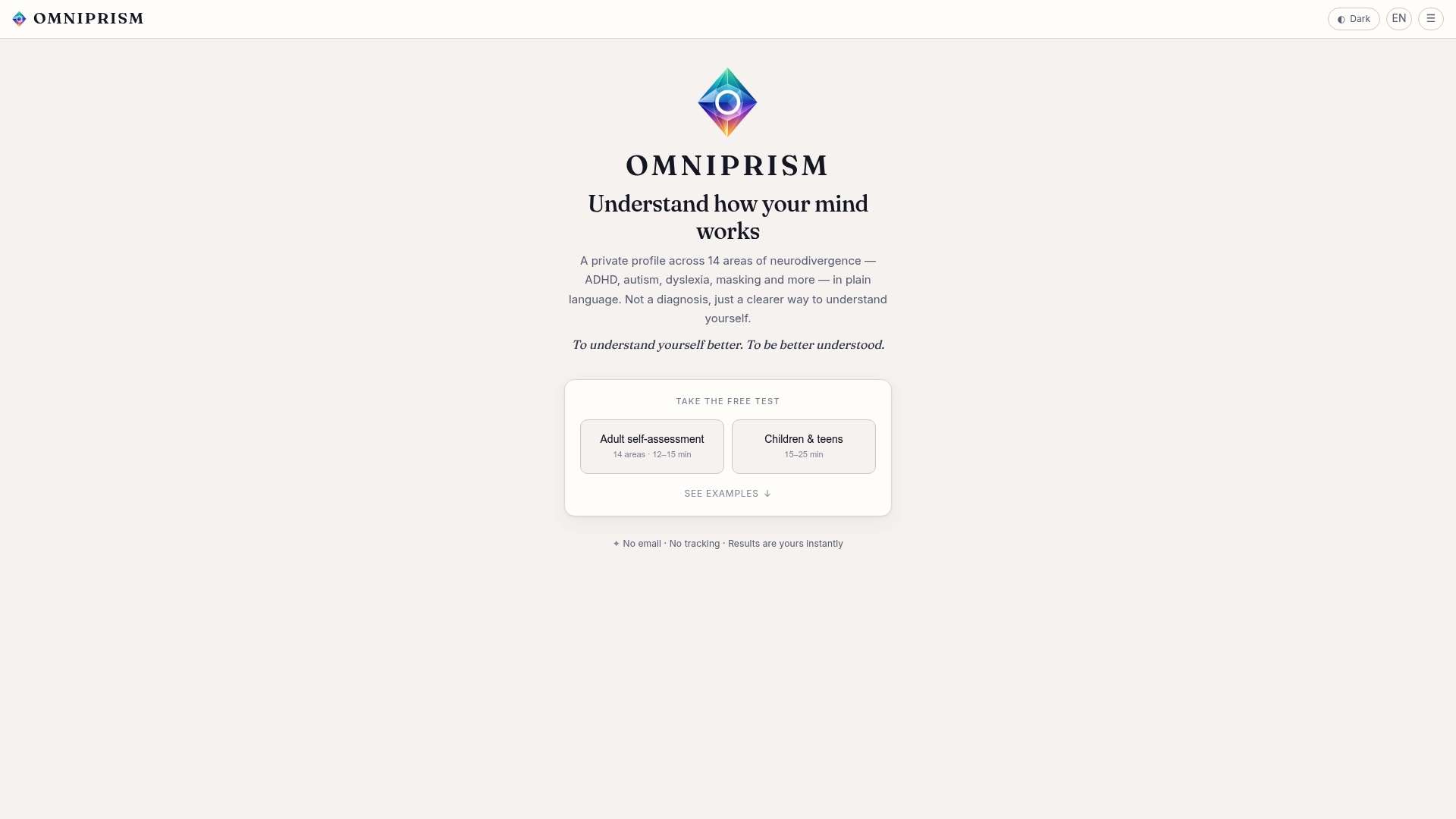
The assessment isn't a diagnosis, and it doesn't replace clinical evaluation. What it does is give you a structured, domain-specific picture you can bring into a conversation with a clinician, an employer, or a school. The optional Specialist Briefing report summarizes your results in a format clinicians can actually use, which makes that first appointment more focused and more productive. For families, guided pathways are available for children and teens alongside the adult tool.
Start your free self-assessment at Omniprism and see your profile mapped across every domain, not averaged into a single number that tells you nothing useful.
Sources
- Cognitive Profile in Autism and ADHD: A Meta-Analysis ... - PMC
- Varying support needs
- Spiky Profiles - Autism Understood
- Spiky Profile | Remarkable Minds
This article is general information, not a substitute for advice from a qualified doctor. Consult a qualified healthcare professional about your own circumstances before acting on anything here.