
Special interests are intense, identity-linked, often lifelong passions common in autistic people; hobbies are optional recreational pursuits most people can set aside without much distress. The DSM-5-TR lists "highly restricted, fixated interests that are abnormal in intensity or focus" as a diagnostic feature of autism, not a personality quirk. Autism charities describe these interests as commonly long-lasting and identity-forming, while CDC guidance notes they can support daily functioning even when they occasionally cause friction with routines or relationships.
Here's what separates the two in practice:
- Emotional stakes: losing access to a special interest can trigger real distress; skipping a hobby rarely does.
- Time horizon: special interests often persist for years or decades; hobbies rotate as life changes.
- Function: special interests regulate mood and nervous system state; hobbies entertain or relax.
The sections ahead cover how to spot the difference, when an interest needs professional attention, and how to support someone without shutting the interest down.
Key Takeaways
Special interests function as identity-linked, regulatory forces that persist for years, while hobbies stay optional, flexible, and easy to set aside.
| Point | Details |
|---|---|
| Core distinction | Special interests regulate emotion and identity; hobbies entertain without that same emotional weight. |
| Watch the interruption | Genuine distress when an interest is blocked signals something deeper than a hobby. |
| Hyperfixation differs | Hyperfixations burn fast and fade, often linked to ADHD; special interests tend to last years. |
| Support beats suppression | Scheduled time and genuine participation reduce conflict more than trying to shut an interest down. |
| Know the red flags | Missed basic needs, safety risks, or persistent impairment warrant a professional conversation. |
Table of Contents
- Special Interests vs Hobbies: The Core Definitions
- How Do You Actually Tell a Special Interest From a Hobby?
- What Special Interests and Hobbies Look Like Day to Day
- The Real Impact: Wellbeing, Learning, and Relationships
- How to Support Someone With a Special Interest
- When a Special Interest Needs More Than Home Support
- Where a Self-Assessment Fits Into This Picture
- Why the "Just a Phase" Framing Misses the Point
- Sources
Special Interests vs Hobbies: The Core Definitions
A hobby is an activity someone does by choice, for enjoyment, with room to walk away when life gets busy. Gardening on weekends, casual guitar practice, weekend hiking. All fit the pattern: pleasant, flexible, replaceable.
A special interest, in clinical and community usage, describes something closer to an organizing force in someone's life. The DSM-5-TR frames it clinically as a restricted, fixated interest unusual in its intensity or narrowness. Many autistic adults prefer softer community terms like "intense interest" or "SPIN" (special interest), partly because "special interest" can sound clinical or even a little patronizing when used carelessly.
An interest, by contrast, is closer to curiosity: you like something, you follow it loosely, you don't necessarily act on it. Interest is passive; hobby is active engagement; special interest is active engagement plus depth, duration, and emotional weight that hobbies don't usually carry.
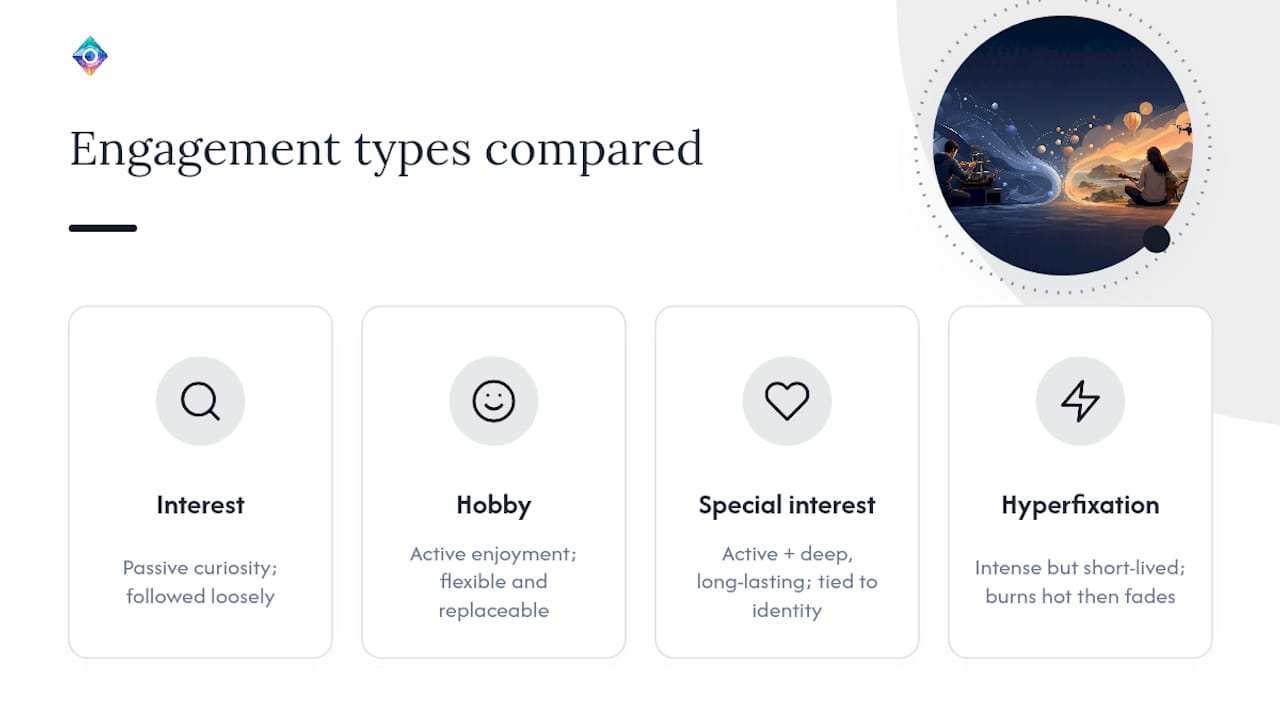
Then there's hyperfixation, a term that gets used almost interchangeably with special interest online, though they aren't the same thing. Research reviewing restricted and repetitive behaviors in autism distinguishes the two: special interests tend to be long-lasting and tied to identity, while hyperfixations, more commonly associated with ADHD, tend to burn hot and fast, sometimes for days or weeks, then fade as suddenly as they arrived. Someone can experience both. An autistic ADHDer might carry a decade-long special interest in astronomy alongside a two-week hyperfixation on sourdough baking that vanishes once the novelty wears off.
How Do You Actually Tell a Special Interest From a Hobby?
Five criteria do most of the work when you're trying to sort one from the other.
- Intensity. A hobby feels good; a special interest can feel necessary. Blocking access to a hobby causes mild annoyance. Blocking access to a special interest can trigger genuine anxiety, meltdown, or shutdown because the interest often serves a regulatory function, calming an overstimulated nervous system the way stimming does.
- Duration. Hobbies rotate with seasons, jobs, and moods. Special interests frequently persist for years, sometimes resurfacing after dormant stretches rather than disappearing for good. Someone might have loved trains at age seven and still know locomotive specs at forty.
- Knowledge depth. Hobbyists learn what's useful. Someone with a special interest tends toward exhaustive, encyclopedic knowledge collected for its own sake, not because a task demanded it.
- Social calibration. This is the one people miss most. Special interests often show up in conversation as infodumping, sharing detailed information enthusiastically, sometimes without checking whether the listener wants it. That's not rudeness; it's a different wiring for social reciprocity. A hobbyist chats about their hobby to bond; someone with a special interest may talk about it because sharing the information itself is the reward, regardless of audience reaction.
- Function under stress. Watch what someone reaches for during a hard week. A hobby gets dropped when life gets stressful. A special interest often gets used more, because it's doing regulatory work, not just filling time.
Pro Tip: If you're not sure whether something is a hobby or a special interest, ask what happens when it's interrupted. Mild irritation points to hobby. Genuine distress, difficulty focusing on anything else, or a felt need to "fix" the interruption points to special interest.
What Special Interests and Hobbies Look Like Day to Day
Special interests show up in wildly different flavors: transit systems, weather patterns, a specific historical war, marine biology, a video game's lore, sorting and categorizing systems, a particular musician's entire discography down to bootleg recordings. Hobbies look more familiar: casual cooking, recreational sports, scrapbooking, weekend photography.

One pattern deserves more attention than it gets: some special interests look "typical" enough to hide in plain sight, and this happens disproportionately with autistic girls and women. An intense fixation on horses, a specific pop star, or fictional characters reads as an ordinary girlhood phase to most observers, so the intensity gets missed, sometimes for decades, contributing to later diagnosis. A special interest in trains gets flagged; a special interest in a boy band, expressed with the same intensity and knowledge depth, usually doesn't.
That depth is not wasted energy. Peer-reviewed research has found that some autistic adults work in fields connected directly to a childhood special interest, turning years of self-directed, obsessive learning into professional expertise other people spend a whole career trying to build.
The Real Impact: Wellbeing, Learning, and Relationships
Special interests do genuine work for the people who have them, and the research backs that up. Engagement with a special interest is linked to improved wellbeing and expanded employment opportunities among neurodivergent adults, and peer-reviewed research connects special interests to better learning outcomes when educators build lessons around them instead of around them.
The benefits break down like this:
- Emotional regulation: a reliable, predictable focus point during sensory overload or anxiety.
- Motivation for learning: reading comprehension, math, and writing skills improve when tied to a topic someone already cares about deeply.
- Career pathways: deep, self-taught expertise sometimes becomes a genuine professional edge.
- Social connection: shared special interests can anchor real friendships, especially online, where infodumping is often welcomed rather than tolerated.
None of that erases the friction. A special interest can crowd out sleep, meals, schoolwork, or work deadlines when it isn't balanced against daily responsibilities. It can also strain relationships when a partner or friend feels like every conversation loops back to the same topic. CDC guidance frames this plainly: intense interests are common and often supportive, but they can also create functional challenges that deserve honest attention rather than either dismissal or shame.
How to Support Someone With a Special Interest
Supporting a special interest well takes more than tolerance. It takes structure and a genuine willingness to engage.
- Schedule interest time instead of fighting it. A negotiated block, say, thirty minutes after homework, works far better than an open-ended ban. Suppression tends to increase distress rather than reduce it; scheduled time gives the interest a place to live without swallowing the whole day.
- Use the interest as a teaching tool. A kid obsessed with dinosaurs can practice fractions by calculating fossil measurements. A teen fixated on a video game can write essays analyzing its narrative structure. Adapted assignments built around an existing passion tend to land better than generic ones.
- Participate without faking enthusiasm. You don't need to love trains to ask one good follow-up question. Genuine curiosity, even brief, communicates respect better than a polite nod ever does.
- Set boundaries without shaming the interest itself. "I've got fifteen minutes to hear about this before my meeting" respects both the interest and your own limits. "You're obsessed, it's not normal" does not, and it tends to push the conversation underground rather than end it.
Pro Tip: Try validating the function, not just the topic. Saying "I can tell this helps you unwind" lands differently than "that's nice," because it acknowledges what the interest is actually doing for that person.
When a Special Interest Needs More Than Home Support
Most special interests don't need intervention. They need room. But a few signs suggest it's time to loop in a professional rather than manage things solo.
- Missed bills, meals, or sleep on a regular basis because the interest consistently overrides basic needs.
- Safety risks, financial overspending, or dangerous behavior tied directly to pursuing the interest.
- Severe distress, meltdown, or shutdown whenever the interest is interrupted, even briefly.
- Persistent difficulty functioning at school or work that doesn't improve with scheduling or accommodations.
If you're bringing concerns to a clinician, bring specifics: how long the pattern has lasted, what a typical day looks like, and concrete examples of interference. Cleveland Clinic notes that a special interest alone isn't a diagnosis; it's one feature among several that a qualified clinician weighs during a full evaluation.
Where a Self-Assessment Fits Into This Picture
Before a clinical conversation, it helps to see your own patterns laid out clearly. Omniprism's self-assessment generates an instant profile across 14 domains, including autism traits, without tracking or lengthy evaluations.
- Useful for noticing how an interest functions: regulation, social impact, time use.
- Guided versions exist for children and young teens, built for families navigating this early.
- It's a reflection tool, not a diagnosis. Treat it as a starting point for a clinical conversation, not a replacement for one.
Why the "Just a Phase" Framing Misses the Point
Most advice on special interests still treats them as something to manage or minimize, a problem to negotiate down to a manageable size. That framing gets the direction backward. The research actually supports treating the interest as infrastructure, something a person's regulation and identity are built on, not a distraction competing with "real" priorities.
The bigger gap is in how families and schools respond. Plenty of guidance tells you to set time limits, which is fine advice as far as it goes, but it skips the harder, more useful step: figuring out what function the interest is actually serving before you touch the boundaries around it. A special interest used to unwind after a hard sensory day needs different handling than one crowding out sleep.
If you take one thing from this, let it be this: don't start with limits. Start with observation. Notice when the interest intensifies, what it replaces, and what happens when it's interrupted. That pattern tells you more than any generic script ever will, and it's exactly the kind of self-reflection a structured self-assessment can help organize before you ever sit down with a clinician.
— Valerio
Sources
- PMC article on restricted and repetitive behaviors (review) — PMC9126999
- Autism UK — Focused and dedicated interests
- Peer-reviewed study on autism, special interests, and outcomes — DOI 10.1007/s10803-020-04743-6
- Cleveland Clinic — Autism overview and focused interests