

Slow processing speed means the brain takes longer than typical to take in information, make sense of it, and act on it. That gap between input and output has nothing to do with intelligence. Someone with slow processing speed can be brilliant, insightful, and sharp. Their circuits just run at a different tempo.
If this sounds like you or your child, the immediate next step is simple: try one accommodation today, like giving extra time on a task or breaking instructions into single steps, and watch what changes. If the pattern is significant, consistent, and getting in the way of school, work, or relationships, a formal assessment can tell you whether something specific is driving it.
Key Takeaways
Slow processing speed is a difference in how fast the brain takes in, interprets, and responds to information, and it responds well to accommodation and targeted practice rather than a single cure.
| Point | Details |
|---|---|
| Speed is not intelligence | Slow processing speed reflects timing in the brain's intake and response cycle, not cognitive ability. |
| Signs shift with age | Kids show slow homework and handwriting; adults show delayed replies and missed deadlines. |
| Testing needs context | Wechsler subtests like Coding and Symbol Search mix speed with motor and memory skills. |
| Accommodations beat brain training | Extra time, visual cues, and simplified instructions help more reliably than general drills. |
| Start with a self-assessment | Omniprism offers a free, 14-domain profile that can guide conversations with schools or clinicians. |
This article is general information, not a substitute for advice from a qualified doctor. Consult a qualified healthcare professional about your own circumstances before acting on anything here.
Table of Contents
- What Is Slow Processing and How Does It Actually Work?
- Signs by Age: What Slow Processing Actually Looks Like
- What Causes Slow Processing Speed?
- How Is Processing Speed Assessed, and When Should You See a Professional?
- Practical Strategies That Help, and What "Brain Training" Can't Promise
- The Emotional Side, and How to Advocate for Support
- Why Slower Doesn't Mean Worse
- Getting a Clearer Picture of Your Own Processing Pattern
- Sources
What Is Slow Processing and How Does It Actually Work?
Every task you do, from reading a text message to catching a ball, runs through the same basic loop: perceive, process, respond. You take in information through your senses, your brain interprets what it means, and then you act. Processing speed is how fast that entire loop completes. When people talk about slow processing, they're describing a bottleneck somewhere in that chain, not a single broken part.
The loop doesn't run through one channel. Visual processing speed governs how fast you scan a page or recognize a face. Auditory processing speed governs how fast you follow spoken instructions or keep up in a fast conversation. Motor processing speed governs how fast your hands and body execute what your brain has already decided to do. A person can be quick with visual information and slow with auditory information, or vice versa. That's why two people who both "process slowly" can look completely different day to day.
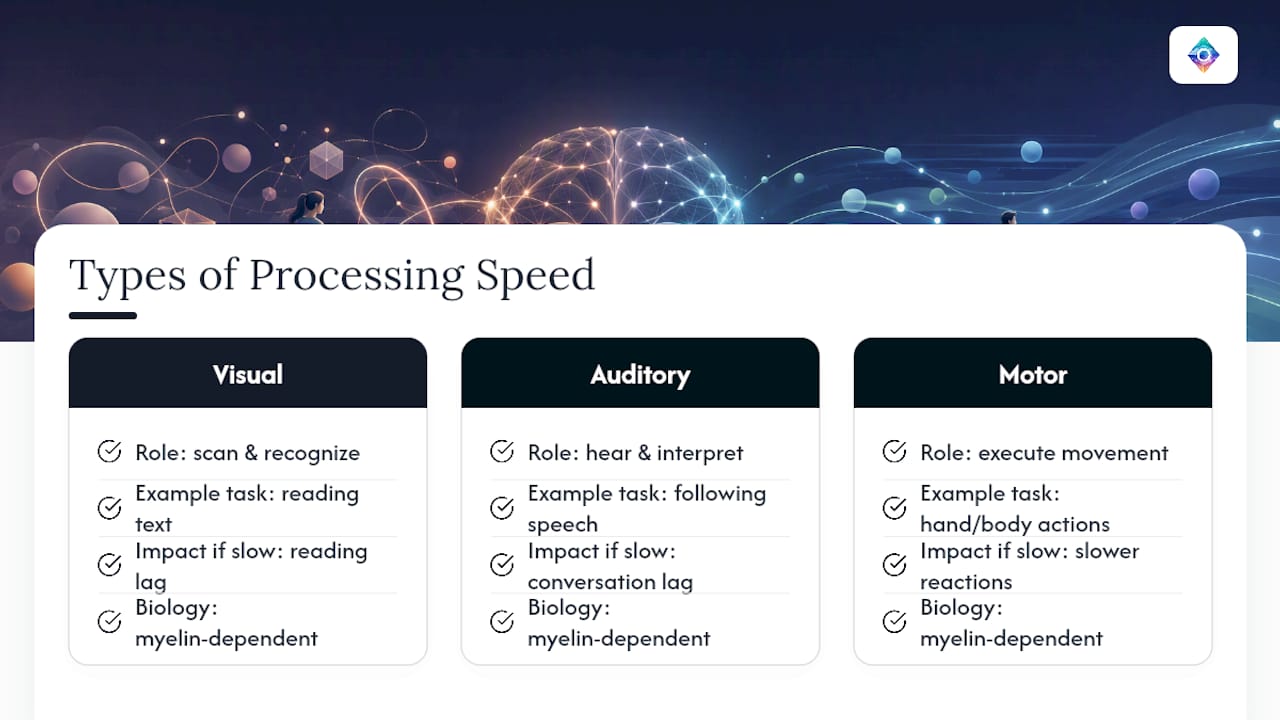
This matters far beyond a classroom. Reading comprehension depends on decoding words fast enough that you don't lose the thread of a sentence by the time you reach the end. Conversation depends on parsing what someone said quickly enough to respond before the topic moves on. Timed tests punish slow processing directly, regardless of how well you actually know the material. Even everyday safety tasks, like reacting to a car braking ahead of you, lean on this same system.
The biological mechanics are not exotic. Processing speed reflects how quickly the brain takes in, interprets, and responds to information, and that pace depends heavily on myelin, the fatty sheath wrapped around nerve fibers that lets electrical signals travel faster. Thinner or less efficient myelin means slower signal transmission. Add in how efficiently different neural networks talk to each other, and you get a system where speed varies not just between people, but between different types of thinking in the same person.
Signs by Age: What Slow Processing Actually Looks Like
Slow processing speed rarely announces itself with a label. It shows up as a pattern of small frictions that, over time, start to look like a story about someone being careless, lazy, or checked out. It's usually none of those things.

In children, the signs tend to show up around schoolwork and instructions. A child might take twice as long as classmates to finish handwriting assignments, not because the ideas aren't there but because getting them onto paper takes longer. Homework that should take twenty minutes stretches into an hour. Multi-step directions, like "get your shoes, grab your backpack, and meet me by the door," get lost somewhere between step one and step three.
Teens and school-age kids in more demanding academic settings show it differently:
- Leaving test questions blank not from lack of knowledge but from running out of time.
- Re-reading the same paragraph three or four times before it sinks in.
- Falling behind during lectures because note-taking can't keep pace with speech.
- Needing far longer than peers to switch between subjects or tasks.
Adults often mistake their own slow processing for a personality flaw. Common patterns include a noticeable pause before answering in conversation, which can come across as disinterest or confusion when it's really just the brain doing its interpretation work. Missed deadlines pile up not from poor planning but from underestimating how long each task actually takes. In open-plan offices or fast-moving meetings, this can create real strain, especially when colleagues equate a quick reply with competence.
Signs vary meaningfully across developmental stages, and one signature sign shows up at every age: needing to re-read or re-hear information that others absorb the first time.
Older adults require a different lens entirely. Some slowing in processing speed is a normal part of aging, similar to how reflexes slow gradually over decades. The distinction that matters is trajectory. A gradual, mild slowing that doesn't affect daily independence is common and often not concerning. A sharp, noticeable decline, especially paired with memory loss, disorientation, or trouble managing familiar tasks, is different and worth a medical conversation, since it could point toward a condition like dementia rather than typical aging.
What Causes Slow Processing Speed?
Processing speed is not one gene or one brain region working alone. It emerges from a network, and several biological and clinical factors can slow it down.
On the biological side, three mechanisms tend to matter most:
- Myelin integrity. Less efficient or thinner myelin slows the electrical signals nerves send to each other, which slows everything downstream.
- Neurotransmitter signaling. Chemical messengers like dopamine and norepinephrine help regulate attention and the speed of neural firing; disruptions here affect processing pace.
- Neural network efficiency. How well different brain regions coordinate, not just how fast any single region fires, shapes overall speed.
Slow processing speed also shows up frequently alongside other diagnoses rather than as a standalone issue. It's commonly seen with ADHD, autism, dyslexia, anxiety, epilepsy, and dementia. In children with ADHD specifically, slower processing speed has been shown to mediate the link between inattention and lower academic achievement in reading, spelling, and math, and the effect gets more pronounced as task demands increase. A child's basic reaction time might look completely typical on a simple task, then fall noticeably behind once the task gets cognitively loaded.
This is where measurement gets tricky. The standard neuropsychological subtests used to measure processing speed, like Coding and Symbol Search, are not pure speed measures. They also draw on fine motor control and short-term memory, so test interpretation requires real caution, since two people can land on the same score through very different strategies, one fast with more errors, one slow but accurate.
That distinction shapes treatment. If ADHD or anxiety is the underlying driver, treating that condition directly often improves functional speed as a side effect. If processing speed looks like a standalone trait unconnected to another diagnosis, the more useful path is usually accommodation and skill-building rather than searching for a single condition to treat.
How Is Processing Speed Assessed, and When Should You See a Professional?
Assessment usually starts long before anyone sits down for formal testing. It starts with pattern recognition: a parent noticing homework consistently runs long, a teacher flagging incomplete tests, or a manager noting that someone needs extra time on every project. That informal screening phase is worth taking seriously, because it's often what triggers the referral to a professional in the first place.
- Gather concrete examples. Note specific instances, how long a task took, what instructions were missed, rather than vague impressions of "slowness."
- Collect outside observations. Teachers, employers, or coaches often notice patterns the person themselves hasn't connected yet.
- Consider formal testing if patterns are consistent. A neuropsychologist can administer instruments like the Wechsler Processing Speed Index, which typically includes Coding (matching symbols to numbers quickly and accurately) and Symbol Search (scanning for target symbols under time pressure).
- Interpret results in context, not isolation. A trained clinician looks at processing speed scores alongside the rest of the cognitive profile, since subtests conflate speed with motor skills and memory and a raw number rarely tells the full story on its own.
Certain red flags should push you toward professional evaluation sooner rather than later: a sudden or steep decline in speed (especially in an older adult), safety concerns like slowed reaction time while driving, academic or job performance dropping sharply enough to threaten a grade level or a role, or emotional deterioration where frustration and shame are compounding the original problem.
Once results come back, they become the foundation for something practical: a documented basis for classroom accommodations, workplace adjustments, or targeted therapy. Without that paperwork, requests for extra time or modified workloads often get treated as preference rather than need.
Practical Strategies That Help, and What "Brain Training" Can't Promise
The honest starting point here is that no intervention fully rewires processing speed into a different gear. What works reliably is a combination of environmental changes, targeted skill practice, and formal accommodations that reduce the real-world cost of a slower pace.
Environmental strategies are the fastest to implement and often the most immediately effective:
- Simplify the amount of information delivered at once, one instruction instead of four stacked together.
- Slow down speech pace when giving directions, and pause between steps.
- Use visual cues (written checklists, diagrams) to supplement spoken information.
- Reduce multitasking demands. Single-tasking consistently outperforms split attention for anyone with a processing speed bottleneck.
Skill-building approaches work on a narrower promise: repeated, structured practice can build automaticity in a specific task, like sight-reading common words or running through multiplication facts, which frees up mental bandwidth elsewhere. Reading practice and domain-specific drills (typing, math facts, route familiarity) tend to show the clearest gains because the task stays consistent each time.
Accommodations close the gap between ability and demand. Extra time on tests and assignments, a reduced overall workload, assistive technology like text-to-speech or speech-to-text tools, and formal testing accommodations (separate room, extended time) all reduce the functional penalty of a slower processing pace without asking someone to somehow become faster.
Lifestyle supports matter more than people expect. Sleep deprivation slows processing speed even in people with no underlying condition. Poor nutrition and chronic stress do the same. None of these fixes the root mechanism, but neglecting them stacks an avoidable slowdown on top of an existing one.
Now for the harder truth: structured brain-training programs and repeated puzzle practice may improve performance on that specific task, but the evidence for broad transfer to general processing speed is thin. Get faster at a memory app, and you'll likely get faster at that memory app. Whether that translates to faster reading, faster conversation, or faster reaction time elsewhere is a separate question, and current research doesn't support a strong "yes." The bulk of the real-world benefit tends to come from redesigning tasks and environments, not from training the brain to run at a fundamentally different speed.
Pro Tip: Pick one accommodation and test it for two weeks before adding another. Layering five changes at once makes it impossible to tell which one is actually helping.
The Emotional Side, and How to Advocate for Support
Slow processing speed carries an emotional weight that gets underestimated constantly. The relationship runs both directions: slow processing can raise anxiety and erode self-esteem, and that anxiety then slows performance further, creating a loop that's hard to break without outside support.
Coping starts with naming what's happening instead of absorbing it as a character flaw. Acceptance isn't resignation. It's the foundation that lets someone pace their work realistically, use assertive language ("I process information carefully; give me a moment before I respond") instead of apologizing constantly, and seek therapy when anxiety or depression has taken hold alongside the processing differences.
For parents, advocacy has a practical shape:
- Document specific examples: how long homework actually took, which instructions got missed, when tests weren't finished.
- Request a school meeting and come with that documentation rather than a general concern.
- Understand the basics of an IEP or 504 plan before the meeting, so you know what accommodations are realistically on the table.
- Teach your child self-advocacy language early, so they can describe their own needs rather than being labeled "lazy" by a teacher who doesn't have the full picture.
Workplace advocacy follows a similar logic. A simple, direct request, like asking for written follow-ups after verbal meetings or a slightly extended deadline on complex projects, often gets granted without needing to disclose a diagnosis at all. The key is framing it as a request for a specific adjustment, not an apology for how you work.
Why Slower Doesn't Mean Worse
There's a version of this conversation that treats slow processing speed purely as a deficit to manage. I think that framing misses something real. Slower processing often comes paired with depth: more careful weighing of information, more original connections, less impulsive error. Plenty of people who describe themselves as "slow thinkers" are actually thorough thinkers who've been measured against a stopwatch that was never built for them.
Consider someone who spent years assuming they just weren't quick enough for fast-paced meetings, until an assessment showed a specific processing speed pattern alongside strong reasoning ability. Once that was named, the fix wasn't to become faster. It was requesting agendas in advance so processing could happen before the meeting, not during it. That's a small structural change that came directly from having language for the actual pattern.
Getting that kind of clarity doesn't require years of appointments. A structured self-assessment, the kind Omniprism offers across 14 cognitive domains, can be a reasonable starting point for understanding your own pattern before deciding whether to pursue anything further.
— Valerio
Getting a Clearer Picture of Your Own Processing Pattern
Formal evaluation takes time, costs money, and often requires a referral just to get on a waiting list. Omniprism exists for the space before that: a free, self-directed way to understand where slow processing speed might intersect with traits like ADHD, autism, or dyslexia, without months of waiting or a stack of paperwork.

The Omniprism assessment delivers an instant profile across 14 domains, including processing-related traits, attention patterns, and sensory processing, in plain language you can actually use, not clinical jargon that needs a translator. For families, the guided assessment for children ages 7 to 10 and the version built for young people ages 11 to 13 walk kids through the process in age-appropriate language, so the experience itself doesn't add to the frustration.
If you're heading toward a school meeting or a clinical appointment, the optional Specialist Briefing report turns your results into a summary designed to be shared directly with a teacher, pediatrician, or psychologist, giving you documented language for exactly the kind of advocacy conversation described above. Start with the free assessment and see what your own profile actually shows.
Sources
- Processing Speed: What It Is, Conditions & How To Improve It (Cleveland Clinic)
- Signs of slow processing speed at different ages (Understood)
- Processing speed research article (PMC)
- Intro to processing speed (MGH Clay Center)
- Slow processing speed: cross-disorder phenomenon (European Child & Adolescent Psychiatry DOI)