

Rejection sensitive dysphoria (RSD) is an intense, often overwhelming emotional response to perceived or actual rejection, criticism, or failure — and if you recognize it in yourself, the most useful next step is tracking your episodes for two to four weeks before speaking with a clinician. If you are currently experiencing suicidal thoughts or feel unsafe, stop and contact the 988 Suicide and Crisis Lifeline by calling or texting 988, or go to your nearest emergency room.
Key Takeaways
Rejection sensitive dysphoria is a pattern of intense, near-instantaneous emotional pain triggered by perceived rejection, most commonly reported in people with ADHD, and best managed through emotional regulation therapy, ADHD treatment, and structured self-monitoring.
| Point | Details |
|---|---|
| Not a formal diagnosis | RSD is not in the DSM-5-TR or ICD-11; clinicians assess it through history-taking and functional impact. |
| Strong ADHD link | RSD is most commonly reported in people with ADHD and is widely viewed as a manifestation of ADHD-related emotional dysregulation. |
| Therapy and medication help | CBT, DBT, ACT, and ADHD medications can reduce episode frequency and intensity; no single cure exists. |
| Track before your appointment | Two to four weeks of trigger, intensity, and bodily-sign logs give clinicians the concrete evidence they need. |
| Omniprism for structured self-check | Omniprism's free 14-domain assessment helps organize neurodivergent traits, including emotional sensitivity, before a clinical visit. |
Table of Contents
- What is rejection sensitive dysphoria, and how is it different from normal rejection sensitivity?
- What does RSD feel like, and what happens during an episode?
- What causes RSD, and who is most at risk?
- How does RSD relate to ADHD, and how is it different from social anxiety or BPD?
- How do clinicians assess RSD, and what should you expect?
- What treatments and management strategies actually help?
- Practical coping strategies you can start using today
- How to talk with someone who has RSD
- Can RSD improve, and what does realistic progress look like?
- A self-check you can use right now
- RSD is not a character flaw — and you don't have to manage it alone
- Omniprism can help you organize your experience before a clinical conversation
- Sources
What is rejection sensitive dysphoria, and how is it different from normal rejection sensitivity?
Most people feel stung by criticism or left out when a friend cancels plans. Rejection sensitive dysphoria is something categorically different: a sudden, physiologically intense wave of emotional pain that can feel like the floor has dropped out from under your identity. The Cleveland Clinic describes it as a descriptive term, not an official diagnosis. It does not appear in the DSM-5-TR or ICD-11, which means no clinician can formally diagnose you with RSD the way they would diagnose major depression or ADHD.
That distinction matters practically. Because RSD lacks a standardized definition in diagnostic manuals, there is no validated prevalence rate and no single test. What clinicians do instead is listen for a pattern: triggers that seem disproportionate to the situation, intensity that spikes within seconds, and distress that feels less like sadness and more like a wound to the self.
The table below shows where ordinary rejection sensitivity ends and RSD-level responses begin.
| Feature | Typical rejection sensitivity | Rejection sensitive dysphoria |
|---|---|---|
| Trigger | Clear social rejection or loss | Perceived slight, delayed text, neutral tone of voice |
| Onset | Gradual, over minutes to hours | Near-instantaneous, within seconds |
| Intensity | Proportionate to the event | Described as unbearable, identity-level pain |
| Duration | Resolves within hours | Can persist for hours; residual shame may last days |
| Bodily symptoms | Mild sadness, disappointment | Chest tightness, racing heart, nausea, physical heaviness |
| Diagnostic status | Normal human experience | Not in DSM-5-TR or ICD-11; descriptive term only |
Two quick examples show the contrast. Someone with ordinary rejection sensitivity hears critical feedback on a work project, feels deflated for an afternoon, and moves on. Someone experiencing RSD hears the same feedback and within seconds feels a surge of shame so acute it reads as physical pain, replays the moment obsessively, and may withdraw from the project entirely or lash out at a colleague. The second person is not being dramatic. Their nervous system is genuinely registering the event as a threat.
What does RSD feel like, and what happens during an episode?
The emotional and physical profile of an RSD episode is specific enough that many people recognize it immediately when they read a description.
Core emotional and behavioral symptoms:
- Sudden, intense shame or humiliation that feels disproportionate to the trigger
- Rage directed inward (self-criticism, self-blame) or outward (snapping at others)
- Deep sadness or a sense of worthlessness that arrives without warning
- Desperate urge to fix, apologize, or over-explain to restore the relationship
- Withdrawal from the person or situation that triggered the response
- Avoidance of future situations where rejection might occur
Physical symptoms reported in qualitative research on lived experience include chest tightness, a racing or pounding heart, a sudden drop in the stomach, nausea, and a feeling of physical heaviness or numbness.
A typical episode sequence: You send a message and the other person leaves it on read. Within seconds, your chest tightens. Your mind immediately generates a story: They're angry with me. I said something wrong. They don't want to be my friend anymore. The story feels like fact. You feel a wave of shame or rage, and you either fire off an anxious follow-up message or go completely silent and withdraw. The episode may last minutes or hours. Afterward, even when the other person responds normally, a residue of shame or hypervigilance lingers.

How RSD affects work and relationships is where the real-world cost becomes visible. People with frequent RSD episodes often avoid applying for promotions because the risk of rejection feels unbearable. They may people-please compulsively, agreeing to things they don't want to do because disagreement might trigger disapproval. Some drop out of creative projects, social groups, or romantic relationships preemptively, before rejection can happen. ADDitude describes this as RSD shaping personality and identity over time, not just producing isolated emotional spikes.
What causes RSD, and who is most at risk?
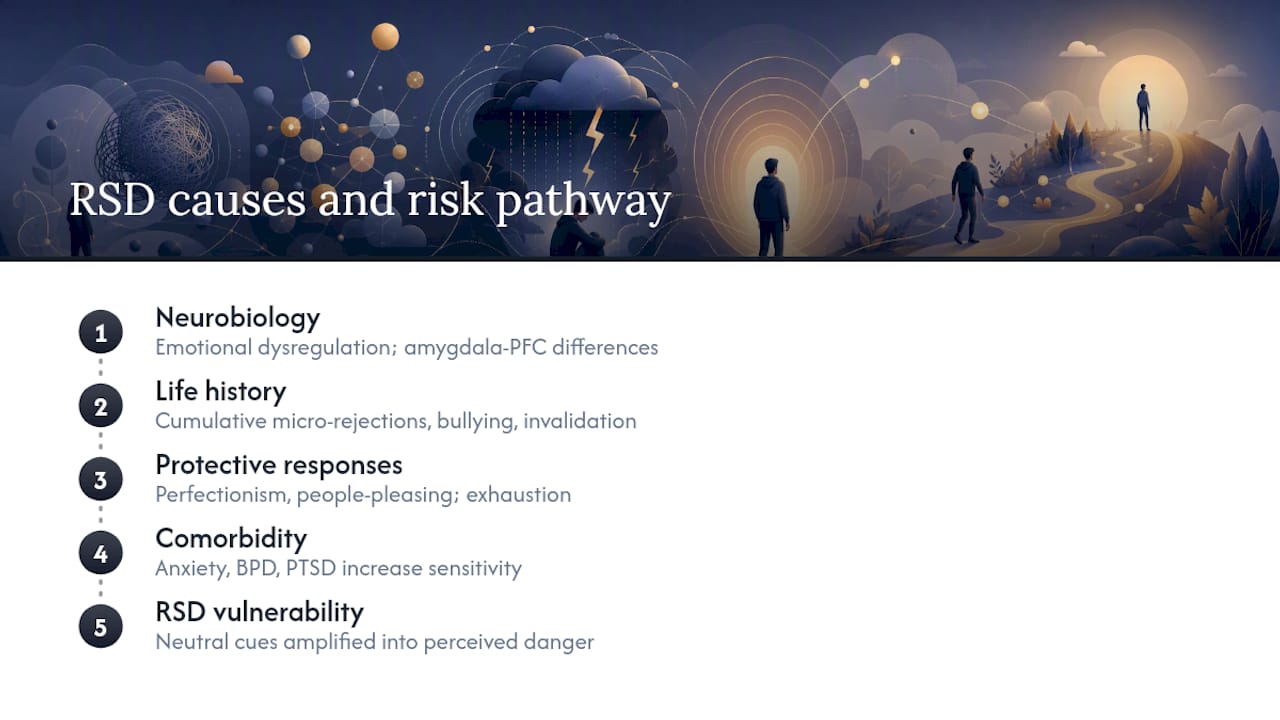
No single cause explains RSD, and researchers are careful not to overclaim. The leading framework treats it as a product of neurobiological differences interacting with life history.
The neurobiological piece centers on emotional dysregulation. The brain's threat-detection and emotional-inhibition systems, particularly circuits involving the amygdala and prefrontal cortex, appear to process social threat signals differently in people with ADHD. The result is that a neutral or mildly negative social cue gets amplified into something that feels like a genuine danger. Clinicians like William Dodson have framed this as the ADHD brain's signal filters making rejection feel like a physiological, identity-level threat rather than a manageable social event.
ADHD-related neurobiology is the most consistently cited risk factor. Research on ADHD documents significant difficulty with emotional regulation across the lifespan, and many researchers view RSD as a specific expression of that broader difficulty rather than a separate condition. The ADHD brain's challenges with inhibition extend to emotional impulses, not just behavioral ones.
Cumulative micro-rejections play a significant role in shaping vulnerability. Many people with ADHD accumulate years of critical feedback: teachers who called them lazy, peers who excluded them for being "too much," employers who passed them over. Add that chronic interpersonal invalidation, childhood bullying, and trauma can heighten rejection sensitivity over time, essentially lowering the threshold at which the nervous system sounds the alarm.
Perfectionism and people-pleasing often develop as protective responses to that history. If you learned early that being perfect or agreeable kept rejection at bay, those patterns become deeply ingrained. They also become exhausting, and the exhaustion itself can make emotional regulation harder.
Overlap with other conditions adds complexity. Anxiety disorders, borderline personality disorder (BPD), and post-traumatic stress can all produce heightened rejection sensitivity. RSD is not unique to ADHD, but the ADHD connection is the most studied and most commonly reported.
How does RSD relate to ADHD, and how is it different from social anxiety or BPD?
The ADHD connection is central to how most clinicians and researchers discuss RSD. Psychology Today's review of the empirical literature notes that research on ADHD documents significant emotional regulation difficulties across the lifespan, with some studies finding that a substantial proportion of people with ADHD struggle with emotional regulation measures. Many researchers position RSD as a specific manifestation of that broader pattern rather than a distinct disorder.
Proposed mechanisms tying RSD to ADHD:
- Executive-function differences make it harder to pause between a trigger and a response, so emotional reactions escalate before any regulation strategy can engage
- Emotional inhibition difficulties mean the brain cannot easily dampen an initial emotional spike the way a neurotypical nervous system might
- Working memory limitations can make it hard to hold onto contradictory evidence ("she's probably just busy") when the emotional story ("she hates me") is already running
- Dopamine and norepinephrine dysregulation, central to ADHD, also affect reward and threat processing, which shapes how social signals are interpreted
Similarities and differences with social anxiety and BPD:
- RSD vs. social anxiety: Both involve fear of negative evaluation, but social anxiety tends to be anticipatory, building before a social event. RSD is typically reactive, arriving in seconds after a perceived slight. Social anxiety responds well to exposure therapy; RSD often responds better to emotional regulation work and, for those with ADHD, medication.
- RSD vs. BPD rejection sensitivity: BPD also involves intense fear of abandonment and rejection, but it is typically accompanied by identity instability, impulsivity across multiple domains, and a chronic pattern of unstable relationships. RSD in ADHD tends to be episodic rather than pervasive, and the person's core identity is generally stable between episodes.
- Clinical signpost: If rejection sensitivity is accompanied by chronic identity disturbance, self-harm, or a persistent pattern of idealization and devaluation in relationships, a clinician should evaluate for BPD or complex trauma rather than treating RSD as the primary frame.
How do clinicians assess RSD, and what should you expect?
Because RSD is not in the DSM-5-TR or ICD-11, you cannot walk into a psychiatrist's office and receive an RSD diagnosis. Psychology Today's review notes that the empirical literature is still early-stage and largely qualitative, with researchers calling for validated measures to better define prevalence and differentiate RSD from other constructs. That means clinical assessment currently relies on careful history-taking rather than a standardized instrument.
What a thorough clinical evaluation typically includes:
- Trigger history: A clinician will ask about specific situations that provoke intense emotional responses, how quickly they onset, and how long they last.
- Standardized ADHD evaluation: Since RSD is most commonly discussed in the context of ADHD, a full ADHD assessment (rating scales, developmental history, functional impact) is usually part of the picture.
- Mood disorder screening: Because RSD can look like rapid-cycling mood episodes, clinicians screen for bipolar disorder and major depression.
- Functional impact questions: How often do these episodes occur? Have you avoided opportunities, relationships, or situations because of them? How much distress do they cause?
When to see whom: A primary care provider is a reasonable first stop if you have no existing mental health care. They can rule out medical contributors and provide referrals. A psychologist is well-positioned to conduct a comprehensive ADHD evaluation and provide therapy. A psychiatrist is the right referral if medication is being considered.
What to bring: Concrete examples of episodes, including triggers, physical sensations, and what you did afterward, are far more useful than asking for an RSD diagnosis by name. Because the term is not universally recognized, describing your experience in plain language produces better clinical reception than leading with the label.
What treatments and management strategies actually help?
WebMD's clinical overview is direct: there is no single cure for RSD. The goal is improved emotional regulation, not elimination of sensitivity. That framing matters because it shifts the target from "fix this" to "build skills and reduce the impact."
Therapy options:
- Cognitive Behavioral Therapy (CBT): Targets the thought patterns that amplify rejection signals. CBT helps identify the automatic story ("they hate me") and test it against evidence. It is well-supported for emotional dysregulation broadly.
- Dialectical Behavior Therapy (DBT): Originally developed for BPD, DBT's distress tolerance and emotion regulation modules are highly applicable to RSD. Skills like "opposite action" (acting against the emotional urge) and "check the facts" directly address RSD escalation patterns.
- Acceptance and Commitment Therapy (ACT): Rather than challenging thoughts, ACT teaches defusion from them. You notice the story your mind is telling without treating it as literal truth, which reduces the urgency of the emotional response.
- Mindfulness-based approaches: Regular mindfulness practice builds the pause between trigger and reaction that RSD tends to eliminate. Even brief daily practice can widen that window over time.
Medication: For people with ADHD, stimulant medications (amphetamine salts, methylphenidate) often reduce emotional reactivity as a secondary benefit alongside their primary effects on attention and impulse control. Non-stimulant options like guanfacine and clonidine, which act on norepinephrine pathways, are sometimes used specifically for emotional dysregulation. Monoamine oxidase inhibitors (MAOIs) have been discussed in the ADHD literature in relation to rejection sensitivity, but their use is limited by dietary restrictions and interaction risks. Any medication decision requires a prescribing clinician who knows your full history.
Pro Tip: When talking to a prescriber about RSD, describe the physical sensations and functional impact rather than using the term "RSD." Say something like: "Within seconds of perceived criticism, I feel my heart racing and a wave of shame that makes me want to either lash out or disappear, and it's affecting my ability to stay in relationships and take on new projects." That level of specificity gets taken seriously.
Safety guidance: If an RSD episode produces thoughts of self-harm or suicide, treat it as a medical situation. Call or text 988 (Suicide and Crisis Lifeline), contact a trusted person immediately, or go to an emergency room. Having a written safety plan before a crisis, created with a therapist, is one of the most effective protective measures available.
Practical coping strategies you can start using today
These techniques are drawn from DBT, ACT, and clinical advocacy writing, including strategies recommended by ADDitude for reducing RSD escalation.
Grounding and regulation sequence (use in order during an episode):
- Notice the body first. When you feel the chest tightening or the stomach dropping, name it aloud or in writing: "My chest is tight. My heart is racing." This activates the observing part of your brain and creates a tiny gap.
- Breathe to slow the alarm. Inhale for four counts, hold for four, exhale for six. The extended exhale activates the parasympathetic nervous system and begins to reduce the physiological spike.
- Name the feeling, not the story. "I feel shame" rather than "I am worthless." The distinction keeps you from fusing with the narrative.
- Check the facts. Ask: What actually happened? What is one alternative explanation? You don't need to believe the alternative fully. Just introducing it interrupts the certainty of the threat story.
- Choose opposite action. If the urge is to withdraw, send one brief, neutral message. If the urge is to over-explain, wait 20 minutes before responding. Acting against the emotional impulse, even slightly, breaks the escalation cycle.
- Anchor with sensory input. Hold something cold or textured, step outside, or splash water on your face. Sensory input redirects the nervous system's attention away from the threat signal.
Communication scripts for common RSD moments:
- Pausing before reacting: "I want to respond thoughtfully to this. Can I come back to you in 20 minutes?"
- Requesting clarification without shame: "I want to make sure I understood your feedback correctly. Did you mean [X], or was there something else?"
- Asking for reassurance without over-explaining: "I'm feeling a bit uncertain about where we stand. Are we okay?"
Trigger tracking worksheet (use for 2–4 weeks):
Keep a simple log with four columns: Trigger (what happened), Intensity (1–10), Bodily signs (what you felt physically), and Response (what you did). Patterns become visible within two weeks and give you concrete material to bring to a clinician.
How to talk with someone who has RSD
If someone you care about has RSD, your instinct to reassure them is correct. The execution matters.
Do's and don'ts:
- Do offer specific, concrete reassurance: "I'm not upset with you. We're fine." Vague reassurance ("don't worry about it") often doesn't land.
- Do give feedback in writing when possible, so the person can process it without the added pressure of reading your facial expression in real time.
- Don't say "you're overreacting" or "it's not a big deal." The person knows the reaction feels disproportionate. Naming it doesn't help; it adds shame to the pile.
- Don't withdraw or go silent after a conflict. Silence reads as rejection and prolongs the episode.
- Do ask what they need: "Do you want me to help you think through this, or do you just need me to listen?"
- Don't give critical feedback immediately after a stressful event. Timing matters enormously for people with RSD.
Example scripts for giving feedback:
- Written note approach: "I wanted to share some thoughts on the project in writing so you have time to read them when you're ready. Overall, the work is strong. Here's one area I'd like us to revisit..."
- After a conflict: "I know that conversation was hard. I want you to know I'm not going anywhere, and I'd like to talk about it when you feel ready."
Workplace accommodations that reduce RSD triggers include: receiving performance feedback in writing before any in-person discussion, having a private channel for corrections rather than public group feedback, and access to a brief delay before responding to critical messages (a "processing window" that some managers can informally grant). None of these require a formal ADA accommodation request, though that option exists for those with documented ADHD.
Can RSD improve, and what does realistic progress look like?
RSD does not have a cure in the conventional sense. What changes with treatment is the pattern: episodes become shorter, less frequent, and less disruptive. That is a meaningful shift, even if the underlying sensitivity never fully disappears. (No validated quantitative prevalence or frequency data is available.)
Measurable markers of improvement include:
- Shorter episode duration. An episode that used to last four hours now resolves in 45 minutes because regulation skills kick in earlier.
- Fewer work and relationship disruptions. You stop avoiding opportunities preemptively and stay in difficult conversations longer before withdrawing.
- Better self-compassion. The internal narrative after an episode shifts from "I'm broken" to "that was hard, and I got through it."
- Earlier recognition of bodily warning signs. You notice the chest tightening before the story takes over, which gives you time to apply a grounding technique.
Therapy and, where appropriate, medication both contribute to these changes. Social support matters too. People who have at least one relationship where they feel genuinely accepted without conditions tend to show faster progress in therapy, likely because that relationship provides repeated evidence against the rejection narrative.
Progress is rarely linear. A stressful period at work or in a relationship can temporarily intensify RSD episodes even after months of improvement. That is not regression. It is how emotion regulation works: skills are available but not automatic, and high-stress conditions reduce access to them temporarily.
A self-check you can use right now
This is not a diagnostic tool. It is a structured way to gather language and evidence before a clinical conversation.
Self-check questions (answer yes/no, then note frequency):
- Do you experience sudden, intense emotional pain in response to criticism or perceived rejection, even when you know the reaction seems disproportionate?
- Does the onset feel near-instantaneous, arriving within seconds of the trigger?
- Do you notice physical symptoms during these episodes (racing heart, chest tightness, stomach drop, nausea)?
- Do you avoid opportunities, relationships, or situations because the risk of rejection feels unbearable?
- Do you spend significant time after an episode replaying what happened or feeling residual shame?
- Have these experiences affected your work performance, relationships, or daily functioning?
Two-to-four-week tracking template:
Fill in one row per episode. After two weeks, look for patterns: Are certain people or situations consistent triggers? Does intensity vary by time of day or stress level? Does your response tend toward withdrawal or toward over-explaining?
Before a clinical visit, record:
- Three to five specific episodes with dates, triggers, and what you felt physically
- How often episodes occur per week or month
- Which situations you have avoided because of RSD
- Any medications you are currently taking
When to seek urgent care: If an episode produces thoughts of self-harm, suicidal ideation, or a feeling that you cannot keep yourself safe, contact 988 or go to an emergency room. Do not wait for a scheduled appointment.
This article provides general information and is not a substitute for professional medical or mental health advice. Confirm current clinical guidance with a qualified provider.
RSD is not a character flaw — and you don't have to manage it alone
Living with rejection sensitive dysphoria can feel profoundly isolating, partly because the reactions feel so out of proportion that many people hide them rather than risk being told they are too sensitive. That hiding is its own exhaustion. The PLOS One qualitative research on lived experience describes masking and withdrawal as adaptive survival strategies that become maladaptive over time, which is an accurate description of what many people with RSD are doing every day without realizing it.
The intensity of what you feel is not evidence of weakness or instability. It reflects a nervous system that processes social threat signals differently, shaped by both neurobiology and experience. That is not a moral failing. It is a pattern that can shift with the right support.
If your episodes are frequent, severe, or affecting your ability to work or maintain relationships, please bring your tracking notes to a clinician. If you are in crisis right now, contact 988.
Omniprism can help you organize your experience before a clinical conversation
Before you can get useful clinical support for RSD-related experiences, you need language for what is happening. That is harder than it sounds when the experiences feel chaotic and hard to describe.
Omniprism's free neurodivergence self-assessment covers 14 domains including ADHD traits, emotional sensitivity, sensory processing, and masking, producing an instant profile in plain language with no data collection. It does not diagnose RSD or any other condition, but it gives you a structured picture of your neurodivergent traits that you can bring to a clinician as a starting point. For parents, age-appropriate pathways are available for children ages 7–10 and young people ages 11–13. An optional Specialist Briefing report summarizes your results in a format designed for clinical conversations. Read Omniprism's full methodology to understand how the assessment is built. Start the free assessment at Omniprism.
Sources
- Rejection Sensitive Dysphoria (RSD) — Cleveland Clinic
- Rejection Sensitive Dysphoria (RSD) — WebMD
- The lived experience of rejection sensitivity in ADHD - A qualitative exploration | PLOS One
- Rejection sensitive dysphoria shapes personality, identity — ADDitude