

Pathological demand avoidance (PDA) is an anxiety-driven profile, most often seen in autistic people, where everyday requests trigger a fight, flight, freeze, or fawn response rather than simple defiance. The practical move that actually works isn't discipline. It's lowering the felt weight of the demand and handing back a sense of control.
That single shift, done consistently, changes how a child, teen, or adult responds to requests that otherwise spiral into panic and refusal.
A few things to hold onto before anything else:
- PDA is a profile, not a standalone diagnosis in the DSM or ICD
- Research on PDA remains limited, with prevalence estimates below 0.2% in a single regional study that has measured it
- The behavior looks like control, but the driver is almost always anxiety
Pro Tip: Before you try any strategy in this guide, drop the word "no" from your first response to a refusal. Try "okay, what would make this easier" instead. That one substitution defuses more standoffs than any reward chart ever will.
Key Takeaways
PDA is an anxiety-driven demand-avoidant profile, most often linked to autism, that responds better to lowered demand and increased autonomy than to reward or punishment systems.
| Point | Details |
|---|---|
| PDA is a profile, not a diagnosis | It isn't listed in the DSM or ICD; clinicians typically record it alongside an autism diagnosis. |
| Depersonalize demands | Frame requests as external rules or schedules rather than personal commands to reduce defensive reactions. |
| Avoid reward and punishment systems | Behaviorist approaches like sticker charts and time-outs often increase anxiety rather than resolve it. |
| Research remains limited | One regional study found under 0.2% prevalence in a narrow age group, too small to generalize. |
| Structured self-assessment helps preparation | Tools like Omniprism organize traits across 14 domains into plain language for clinical conversations, without replacing diagnosis. |
Table of Contents
- Understanding PDA: Core Traits and Common Signs
- What Causes PDA, and How Does It Overlap With Autism and ADHD?
- How Is PDA Assessed and Identified?
- Practical Strategies for Parents: Lowering the Temperature at Home
- Supporting PDA at School: What Actually Helps in the Classroom
- Meltdowns, Shutdowns, and PDA Burnout: What Recovery Actually Requires
- PDA in Adults: Masking, Relationships, and Work
- What the Research Actually Shows, and Where Tools Like Omniprism Fit
- When to Seek Professional Help and What That Process Looks Like
- Resources Worth Reading Next
- Sources
Understanding PDA: Core Traits and Common Signs
PDA doesn't look the same in every person, but a cluster of traits shows up again and again across the research literature. The foundational study on this, O'Nions et al. (2015), used the Diagnostic Interview for Social and Communication Disorders to pin down three core features: extreme avoidance of everyday demands, social strategies used specifically to dodge those demands, and emotional lability, meaning moods that swing fast and hard.
That second trait, social strategies, is the one most parents miss at first. A child with PDA rarely just says no. They negotiate, distract, delay, make excuses, or turn the request into a joke. Some go further and physically collapse to the floor, a behavior often called "flopping." Others become the class clown, using humor and charm to steer attention away from the task at hand, sometimes nicknamed the "funster" strategy in PDA circles.
Here's what tends to show up across a PDA presentation:
- Resistance to ordinary demands, including ones the person actually wants to do (an invitation to a birthday party can trigger the same avoidance as a request to brush teeth)
- Excessive need to direct or control interactions, including with peers and adults
- Fast, intense mood shifts with little warning
- Surface-level social skills that mask deeper social confusion or exhaustion
- Comfort in role-play or pretend scenarios, sometimes as an escape from real-world demands
The threat response underneath all of this typically falls into fight, flight, freeze, or fawn. Fight looks like shouting or aggression. Flight is literal, running from the room or the situation. Freeze is shutting down, going quiet, or appearing to ignore the request entirely. Fawn is people-pleasing on the surface while internally overwhelmed, often the hardest presentation to spot because the person seems compliant.
Pro Tip: If a child or adult seems to "get away with" avoidance through charm or humor, resist framing it as manipulation. That funster strategy is usually a nervous system trying to survive a demand it cannot process in the moment.
Presentation shifts with age. A young child might refuse to get dressed, then dissolve into tears when a parent insists, then flop onto the kitchen floor rather than walk to the car. A teenager might mask at school, holding it together for six hours, then explode the moment they get home, a pattern many parents describe as the "coming home to fall apart" cycle. An adult might procrastinate on tasks they genuinely want to complete, not from laziness but because the internal demand of "I should do this now" feels identical to being ordered around by someone else.
That last point trips up a lot of well-meaning adults. A PDA profile doesn't spare activities the person enjoys. Wanted things carry demand too, the moment they become an expectation rather than a spontaneous choice.
What Causes PDA, and How Does It Overlap With Autism and ADHD?
No single cause explains PDA, and the honest answer is that researchers are still working out the mechanism. The leading hypotheses cluster around anxiety regulation, intolerance of uncertainty, and heightened neurosensitivity, meaning a nervous system that registers ordinary requests as bigger threats than they are.
PDA is widely understood as a profile that occurs within autism rather than a separate condition. PDA North America's clinical guidance frames it this way explicitly, describing demand avoidance as one expression of autistic anxiety rather than a distinct diagnostic category. That framing matters because it shapes how professionals approach support: not as a behavior problem to correct, but as an anxiety profile layered on top of autistic processing differences.
ADHD complicates the picture further. Clinicians and researchers frequently note co-occurring attention and impulsivity traits in people who show strong demand avoidance, though the research connecting PDA specifically to ADHD (as opposed to autism) remains thinner and less settled than the autism link.
Here's where the evidence gets genuinely limited, and where readers deserve a straight answer instead of false confidence:
- A regional study from the Faroe Islands found PDA with autism affected fewer than 0.2% of a 15 to 24 year old sample, one of the only prevalence estimates available
- That figure comes from a single geographic population and cannot be generalized to broader groups
- Larger, more diverse studies simply haven't been done yet, which is why most clinicians describe PDA as an emerging area of research rather than settled science
Recognition also varies sharply by country. PDA is discussed far more often in the United Kingdom, where the term originated through Elizabeth Newson's work decades ago, than in the United States, where many clinicians remain unfamiliar with it as a distinct profile. That gap explains a lot of the confusion American parents run into when they bring the term to a pediatrician who has never encountered it. It doesn't mean the traits aren't real. It means the vocabulary hasn't caught up everywhere yet.
How Is PDA Assessed and Identified?
There's no blood test or brain scan for PDA, and no single questionnaire that hands you a diagnosis. What exists instead is a screening tool called the Extreme Demand Avoidance Questionnaire, known as the EDA-Q for children (an 8-item short form, the EDA-8, is also in use), with an adapted version for adults sometimes referred to as the EDA-QA.
These tools were built for research and identification purposes, not as standalone diagnostic instruments. A high score flags a pattern worth investigating further with a qualified clinician. It doesn't confirm PDA on its own, and no reputable practitioner will tell you otherwise.
Here's roughly how the identification process tends to unfold:
- Initial screening. A parent, teacher, or adult self-report using the EDA-Q or EDA-8 flags demand avoidance traits that look more extreme or more socially strategic than typical oppositional behavior.
- Clinical interview. A clinician familiar with autism and PDA, often using structured tools like the DISCO that O'Nions and colleagues applied in their foundational research, gathers detailed developmental and behavioral history.
- Profile, not separate label. Because PDA sits outside the DSM and ICD as a formal diagnosis, many clinicians record it as a descriptive profile within an autism diagnosis, sometimes phrased as "autism with a PDA profile," rather than issuing PDA as a standalone code.
- Support planning. Whether or not a formal profile gets written down, the useful output is a shared understanding of triggers and effective supports.
Before any of this, documentation helps enormously. Keep a simple log of:
- What the demand was (a request, a transition, an unexpected change)
- What the response looked like (negotiation, flopping, shutdown, meltdown)
- What helped, if anything, in the moment
- Patterns across settings (home versus school versus with grandparents)
That log becomes the single most useful thing you bring to a first appointment, far more useful than a memory of "it happens a lot."
Practical Strategies for Parents: Lowering the Temperature at Home
The single most effective lever available to parents is reducing how a demand feels, not necessarily reducing what actually needs to happen. Sheffield Children's NHS guidance recommends depersonalizing demands, meaning you attribute the request to an external rule rather than your own authority. Instead of "I need you to put your shoes on now," try "the bus schedule says we leave in five minutes." The task hasn't changed. The felt sense of being controlled by another person has.
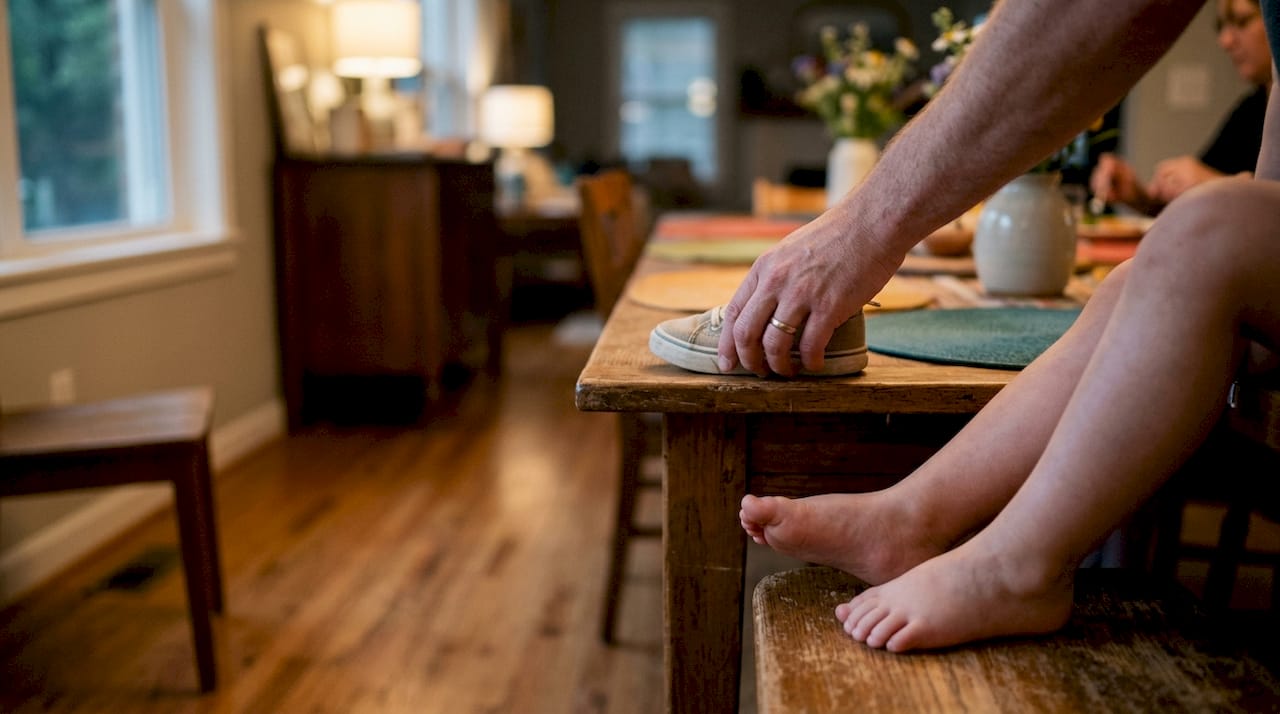
Offering genuine choice works on the same principle. Not a fake choice where both options lead to the same outcome, but real autonomy over sequencing or method: "Do you want to brush teeth first or get dressed first?" Small, but it hands back agency the nervous system is scanning for.
Here are tactics that consistently show up in practitioner guidance and community strategy sheets from sources like Somerset's local autism offer:
- Use indirect language ("I wonder if..." or "Shall we see if...") instead of direct instructions
- Build in planned choices throughout the day so autonomy feels routine, not rare
- Keep routines low-demand and predictable, but flexible enough to bend on hard days
- Lean on humor and play to defuse tension before a request even lands
- Explain the reasoning behind a request briefly, since PDA profiles often respond better to understanding why than to compliance for its own sake
Co-regulation matters just as much as any specific phrase. That means staying calm yourself, physically and vocally, because a dysregulated adult voice tends to escalate an already anxious nervous system. Sit at eye level. Lower your own volume before asking anyone else to lower theirs.
What to avoid is just as important as what to try. Reward charts, sticker systems, and time-outs—the standard toolkit for typical childhood defiance—frequently backfire with PDA. PDA North America's guidance is direct about this: behaviorist approaches built on rewards and punishments often increase anxiety rather than resolve it, because they add another layer of demand ("earn this by complying") on top of the original one.
Pro Tip: Watch for sensory and interoceptive triggers hiding underneath what looks like pure demand avoidance. A refusal to put on socks might be a texture problem, not a control issue. A meltdown over "just five more minutes" might be hunger or a full bladder the child hasn't registered yet. Rule out the body before assuming it's purely psychological.
None of this means permissiveness. It means picking your battles around genuine safety non-negotiables while loosening your grip everywhere else.
Supporting PDA at School: What Actually Helps in the Classroom
Schools built on compliance and reward systems often struggle with PDA students, not because staff lack good intentions, but because the standard toolkit, sit still, follow instructions, earn points, is built for a different nervous system than the one showing up in front of them.
The same depersonalizing principle from home translates directly to the classroom. A teacher saying "the fire drill schedule means we line up now" lands differently than "line up now," even though the instruction is identical. Predictable structure still matters, but it works best paired with built-in flexibility rather than rigid enforcement.
Adjustments that tend to help in real classrooms:
- Offer task choice. Let a student pick the order of assignments or choose between two ways to demonstrate the same skill.
- Build transition buffers. Give advance notice before switching activities, and where possible, let the student choose the moment within a window rather than on a fixed second.
- Trial small autonomy windows. Somerset's guidance for schools describes successful classroom trials that combine student-led choices with a small set of predictable, safety-related non-negotiables, tested over days to gauge what the student can actually sustain.
- Reduce direct instruction language. Phrases like "I wonder if" or "maybe we could try" open the same door indirect language opens at home.
When you talk to a school about adjustments, evidence beats description. Bring the behavior log mentioned earlier, screening results if you have them, and specific examples of what has worked at home. A vague request for "more understanding" rarely moves a busy school team. A concrete pattern does.
Practical accommodations worth requesting:
- A quiet, low-stimulation space the student can access without asking permission each time
- Flexibility on homework format or deadlines tied to demand load, not ability
- A trusted adult who can offer choices rather than direct commands during dysregulated moments
- Reduced reliance on whole-class reward and consequence systems for that individual student
Punitive escalation, detentions, exclusion, public correction, tends to intensify the exact anxiety driving the avoidance in the first place. A student sent to the office for refusing a worksheet hasn't learned compliance. They've learned that this classroom is another place where demands arrive without warning and without room to negotiate.
Meltdowns, Shutdowns, and PDA Burnout: What Recovery Actually Requires
Not every hard moment looks the same, and mixing up the terms leads to the wrong response. A meltdown is an outward explosion, shouting, crying, sometimes aggression, when the nervous system's capacity runs out. A shutdown is the opposite direction: withdrawal, silence, an apparent shutting off. Flopping is a physical collapse, often on the floor, that looks dramatic but reflects genuine overwhelm rather than performance. Burnout is different from all three: a longer-term depletion after sustained masking or demand exposure, sometimes lasting weeks or months rather than minutes.
In the moment, de-escalation depends on doing less, not more:
- Drop every non-essential demand immediately, including well-meaning ones like "calm down" or "use your words"
- Offer physical space without abandoning the person; presence without pressure
- Keep your own voice low and slow, since a calm adult body genuinely helps regulate a dysregulated one nearby
- Wait. Recovery from an active meltdown or shutdown is rarely fast, and rushing it usually restarts the cycle
Pro Tip: During an active meltdown, don't ask questions that require decisions, even simple ones like "do you want water?" A brain in crisis mode often cannot process choice at all. Offer statements instead: "I'm right here" works better than any question.
Recovery from burnout operates on a much longer timeline. Community reports gathered by organizations like PDA North America consistently describe extended low-demand periods as the thing that actually works, sometimes stretching across weeks, where expectations get stripped back to the bare minimum and slowly, deliberately rebuilt. That also means educating everyone around the person, teachers, extended family, coaches, so the recovery period isn't undermined by someone insisting on "just one more thing" before capacity has genuinely returned.
Seek urgent professional or emergency support if a meltdown or shutdown includes self-harm, harm toward others, or a level of distress that doesn't resolve with space and time. That's a signal to involve a doctor, crisis line, or emergency service rather than continuing to manage it solo at home.
PDA in Adults: Masking, Relationships, and Work
PDA doesn't disappear at eighteen. It usually just gets better disguised. Adults with a PDA profile frequently describe chronic procrastination on tasks they actively want to finish, a control need in relationships that has nothing to do with ego and everything to do with managing unpredictability, and years of masking that quietly drain their energy in ways coworkers and even partners never see.
A qualitative study of adults identifying with PDA found themes of pervasive anxiety, bidirectional social difficulty (struggling to read others while also feeling misread), and consistent gaps in service access, since most diagnostic pathways and support systems were built with children in mind, not adults navigating jobs and long-term partnerships.
Workplace adjustments that help tend to be small and structural rather than sweeping: flexible task ordering, the ability to work from a quiet space without justifying it repeatedly, and managers who frame deadlines collaboratively ("what timeline works for you") rather than as fixed commands. None of that requires disclosure of a PDA profile specifically, and plenty of adults choose not to disclose at all, opting instead to request the accommodation itself without the label attached.
Self-management strategies adults report finding useful:
- Building recovery buffers into the calendar after socially demanding events
- Front-loading autonomy where possible (choosing meeting times, task order, work location)
- Naming internal demands out loud to reduce their charge ("I'm telling myself I should do this now, which is making it harder")
- Deciding in advance, calmly, what disclosure looks like at work or in new relationships, rather than being forced into it during a crisis
Relationships tend to go better when partners understand that a request, even a loving one, can register as pressure. Framing things as offers rather than expectations reduces friction on both sides.
What the Research Actually Shows, and Where Tools Like Omniprism Fit
The evidence base for PDA is real but young, and any honest guide needs to say so plainly. O'Nions et al. (2015) remains the most-cited foundational study, using the DISCO interview to identify extreme demand avoidance, social avoidance strategies, and emotional lability as core, measurable features. That paper gave PDA researchers a shared vocabulary. It did not, and does not, establish PDA as a formal diagnostic category, and prevalence work remains thin: the Faroe Islands study found under 0.2% prevalence in one adolescent and young adult sample, a figure too narrow to generalize globally.
Screening tools like the EDA-Q and EDA-8 exist to flag patterns for further research and clinical exploration, not to replace a qualified assessment. That distinction matters every time someone quotes a score as though it were a verdict.
This is precisely the gap a structured self-assessment can help close, without pretending to be something it isn't. Omniprism's self-assessment methodology generates an instant profile across 14 domains, including autism, ADHD, sensory processing, and masking traits that frequently accompany a PDA presentation, using plain language instead of clinical jargon.
The value isn't a diagnosis. It's clarity you can bring into a clinical conversation:
- A structured starting point that organizes scattered observations into a shared framework
- Language that helps you describe patterns to a clinician who may be unfamiliar with PDA terminology
- A starting document for families weighing whether formal assessment is worth pursuing
Every honest version of this tool says the same thing clearly: self-assessment supports understanding and communication. It doesn't substitute for a clinical diagnosis.
When to Seek Professional Help and What That Process Looks Like
Some signs mean it's time to move past self-management and bring in a professional, rather than continuing to adjust things at home alone.
Red flags worth acting on:
- Meltdowns or shutdowns that involve self-harm, harm to others, or extreme, prolonged distress
- School refusal that persists despite adjustments, putting attendance and learning at real risk
- Burnout that isn't resolving after weeks of reduced demand
- A family or individual who feels stuck without a shared framework for what's happening
The professionals worth contacting depend on age and setting: a developmental pediatrician or child psychologist for kids, a psychiatrist or psychologist experienced with autism for adults, and school-based teams (special education coordinators, school psychologists) for education-specific support.
Walking in prepared changes outcomes:
- Bring your behavior log. Specific examples of triggers, responses, and what has helped carry more weight than general descriptions.
- Bring screening results if you have them. An EDA-Q score or a structured self-assessment summary gives the clinician a starting framework rather than a blank page.
- Ask directly how PDA will be documented. Since it isn't a standalone DSM or ICD diagnosis, many clinicians record it as a profile alongside an autism diagnosis. Understanding that language in advance avoids confusion later.
- Request adjustments in writing. Whether at school or in a workplace, a documented accommodation is easier to sustain than an informal understanding.
Advocacy gets easier once you're working from evidence instead of instinct alone. A clinician who sees a pattern, not just a single hard day, is far more likely to take the profile seriously and help you build supports that actually stick.
Resources Worth Reading Next
For ongoing support and community guidance, PDA North America and the PDA Society offer practical handbooks written for families and educators navigating this profile day to day.
For the research itself, start with O'Nions et al. (2015) on identifying features of PDA, and the Faroe Islands prevalence study for context on how limited current data really is. Sheffield Children's NHS and Somerset's local autism offer provide some of the most detailed, practitioner-tested strategy sheets available for free online.
A Closing Note on Living With PDA
The research on PDA is thin, but the pattern it describes is real, and I've come to think the biggest disservice done to families is treating this as a discipline problem when it's almost always a nervous system problem. The strategies that work, autonomy, depersonalized language, patience, aren't soft parenting. They're the correct response to anxiety, backed by the same clinical logic used for any anxiety-driven presentation.
Share what you learn here with schools, grandparents, and clinicians who haven't caught up yet. A structured tool can turn a hard-to-explain pattern into a document someone else can actually act on.
— Valerio
A Practical Next Step: Building a Clearer Picture With Omniprism
Reading about PDA traits is one thing. Seeing how they map onto your own child, teen, or your own patterns as an adult is another, and that's the gap Omniprism was built to close. Instead of waiting months for a formal evaluation just to get a starting framework, Omniprism gives you an instant profile across 14 domains, including autism, ADHD, masking, and sensory processing traits that often travel alongside a PDA presentation, in plain language you can actually use.
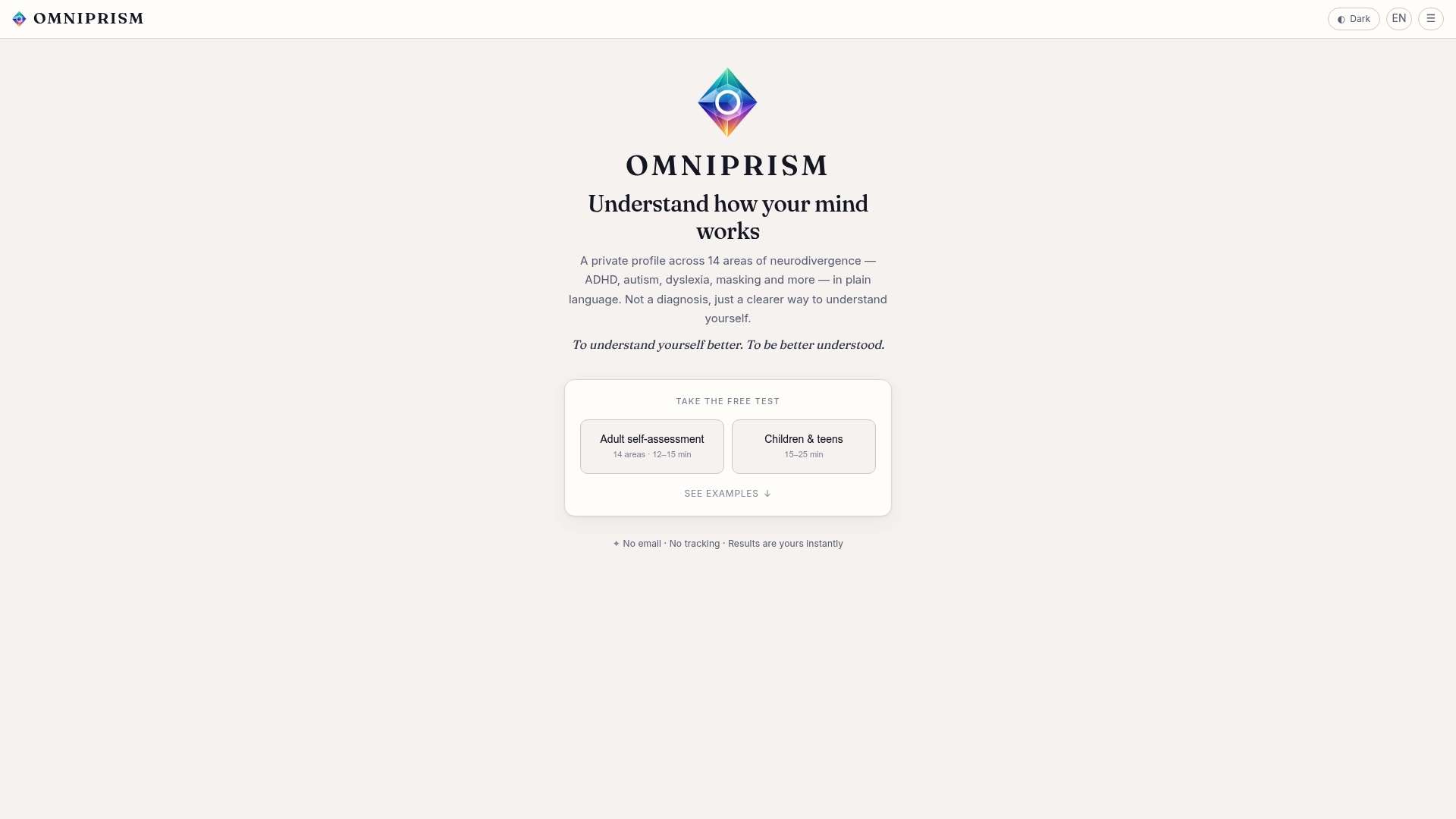
For children and teens, Omniprism offers guided assessments built specifically for younger age groups, including a version for ages 7 to 10 and another for ages 11 to 13, so the questions match how kids at each stage actually communicate. Once you have your results, the optional Specialist Briefing report turns your profile into a clear summary you can hand directly to a pediatrician, psychologist, or school team, saving the back-and-forth of trying to describe patterns from memory.
This isn't a diagnosis, and Omniprism doesn't pretend otherwise. It's a clear, private starting point that makes the next conversation with a professional shorter and more productive. Start your free assessment and see what your profile looks like today.
Sources
- Identifying features of 'pathological demand avoidance' using the Diagnostic Interview for Social and Communication Disorders (DISCO)
- Prevalence study reference (Gillberg et al.)
- Supporting demand avoidance — Sheffield Children's NHS
- Understanding and supporting PDA — PDA North America