

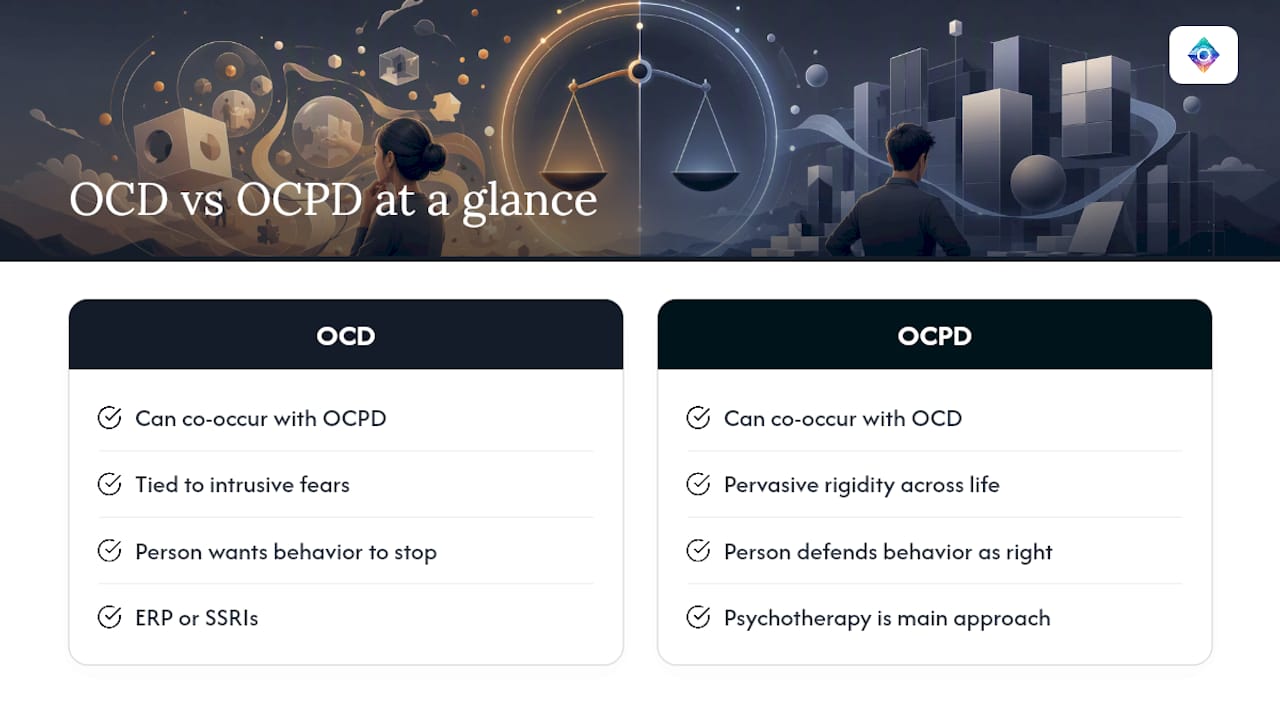
The core distinction is this: OCD involves intrusive, unwanted thoughts paired with compulsions aimed at reducing anxiety, while OCPD is a lifelong personality pattern built around perfectionism and control that the person usually experiences as correct, not distressing.
- People with OCD typically know their thoughts are irrational and want the rituals to stop (ego-dystonic); people with OCPD tend to see their rigidity as a strength, not a flaw (ego-syntonic).
- Treatment splits sharply: OCD responds well to exposure and response prevention (ERP) and SSRIs, while OCPD is managed mainly through talk therapy, with medication playing a minor role.
- Clinical threshold: OCD symptoms are usually diagnosed as clinically significant when they consume an hour or more a day and cause marked distress or impairment.
Key Takeaways
OCD is driven by anxiety-reducing compulsions a person wants to stop, while OCPD is a stable personality pattern of control the person usually defends as correct.
| Point | Details |
|---|---|
| Core distinction | OCD involves ego-dystonic obsessions and compulsions; OCPD involves ego-syntonic perfectionism and control. |
| Diagnostic threshold | OCD symptoms typically become clinically significant when the symptoms become time-consuming and cause significant distress or impairment. |
| Treatment paths differ | OCD responds to ERP and SSRIs; OCPD relies mainly on personality-focused psychotherapy. |
| Motive matters most | Ask whether the behavior feels unwanted or feels correct to separate the two conditions. |
| Co-occurrence complicates treatment | When both conditions overlap, integrated longer-term therapy often outperforms standard short-term OCD protocols. |
Table of Contents
- What Is Obsessive-Compulsive Disorder (OCD)?
- What Is Obsessive-Compulsive Personality Disorder (OCPD)?
- How Do OCD and OCPD Symptoms Actually Differ?
- How Do Clinicians Diagnose OCD Versus OCPD?
- What Causes OCD and OCPD?
- How Are OCD and OCPD Treated Differently?
- Why Do OCD and OCPD Get Confused So Often?
- How to Self-Assess Before Talking to a Clinician
- When Should You Actually See a Professional?
- Editorial Take: What This Comparison Really Comes Down To
- Frequently Asked Questions
- Sources
What Is Obsessive-Compulsive Disorder (OCD)?
OCD is an anxiety-related condition built on two moving parts: obsessions and compulsions. Obsessions are intrusive, unwanted thoughts, images, or urges that show up uninvited and won't leave. Compulsions are the repetitive behaviors or mental acts a person performs to neutralize the anxiety those thoughts create, even when they know the ritual doesn't logically fix anything.
The themes tend to cluster into recognizable patterns:
- Contamination fears paired with excessive washing or cleaning.
- Checking rituals, like repeatedly verifying a locked door or a turned off stove.
- Symmetry and ordering needs, where objects must be arranged "just right."
- Intrusive taboo thoughts, often violent or sexual in nature, that horrify the person experiencing them.
Clinically, OCD crosses from quirk into disorder when the symptoms become time-consuming (often an hour or more daily), cause real distress, and are not better explained by substance use or another condition. One useful signal: OCD is ego-dystonic. People with it hate the intrusive thoughts and desperately want the compulsions to stop. That internal conflict, thought versus wish, is often the clearest tell that separates OCD from a personality trait.
What Is Obsessive-Compulsive Personality Disorder (OCPD)?
OCPD is a different animal entirely. It's a persistent personality disorder marked by extreme perfectionism, orderliness, and a need for control, not a set of intrusive thoughts fighting against a person's will. Instead of discrete anxious rituals, you get a pervasive style of operating in the world.
Typical patterns include:
- Excessive devotion to work at the expense of relationships or leisure.
- Rigid insistence on rules, schedules, or "the right way" to do things.
- Reluctance to delegate tasks unless others do them exactly as instructed.
- Inflexibility around morals, ethics, or values, even in situations that call for nuance.
The defining feature is that these traits are largely ego-syntonic. People with OCPD often view their perfectionism as a virtue, the reason they're a good employee, a reliable parent, a disciplined person, rather than a problem worth fixing. That's a major reason OCPD tends to go undiagnosed longer than OCD. It typically emerges in late adolescence or early adulthood and stays fairly stable across a person's life, unlike OCD, which can wax and wane with stress.
How Do OCD and OCPD Symptoms Actually Differ?
Two people can look almost identical from the outside, both re-checking a spreadsheet three times, both insisting a desk stay spotless, and be dealing with completely different conditions underneath. The difference lives in the "why."
| Dimension | OCD | OCPD |
|---|---|---|
| Core feature | Intrusive obsessions driving anxious compulsions | Personality-level perfectionism, orderliness, control |
| Typical symptoms | Contamination fears, checking, symmetry, taboo thoughts | Rigid rules, overwork, reluctance to delegate, moral inflexibility |
| Insight | Ego-dystonic; person is distressed and wants it to stop | Ego-syntonic; person sees the behavior as correct |
| Onset & course | Can begin in childhood, adolescence, or adulthood; often fluctuates | Emerges in late adolescence/early adulthood; stable over time |
| Diagnostic threshold | Time-consuming (often 1+ hour/day), marked distress or impairment | At least four characteristic traits, pervasive across contexts |
| Primary treatment | ERP and SSRIs | Psychotherapy (CBT adaptations, schema, psychodynamic); medication is not a primary treatment |
| Impact on relationships/work | Anxiety and rituals interrupt routines and intimacy | Rigidity strains delegation, teamwork, and closeness |
| Comorbidity | Depression, other anxiety disorders; can co-occur with OCPD | Can co-occur with OCD; often overlaps with anxious traits |
A few short vignettes make the "why" concrete. Someone checks the stove five times because they're terrified they'll burn the house down and can't shake the image, that's OCD. Someone checks it because they believe there's one correct sequence for shutting down a kitchen and deviating from it feels wrong, that's closer to OCPD. Someone reorganizes a shared drive because clutter triggers a wave of dread, that's OCD. Someone reorganizes it because their colleagues' filing "isn't done properly" and it offends their sense of order, that's OCPD territory.
Clinicians use a short list of diagnostic clues to sort this out:
- Is there a genuine, unwanted intrusive thought driving the behavior, or is the behavior itself the point?
- Does the person want the behavior to stop, or do they defend it as reasonable?
- Did this show up suddenly in response to stress, or has it been a lifelong style?
- Does the pattern show up in one narrow domain, or across work, home, and relationships alike?
How Do Clinicians Diagnose OCD Versus OCPD?
Diagnosis leans on DSM-5-TR criteria, and the two conditions are evaluated in very different ways. OCD requires the presence of true obsessions and/or compulsions that are time-consuming or cause clinically significant distress or impairment. OCPD, by contrast, requires at least four of eight characteristic traits (perfectionism, rigidity, reluctance to delegate, and so on) that show up pervasively, not situationally.
Before an appointment, it helps to prepare notes covering, including considerations from why remote testing improves LSAT performance that highlight the impact of anxiety on high-stakes testing:
- Specific examples of the thoughts or behaviors, written out as concretely as possible.
- When they started and whether they've changed over time.
- How much daily time they consume and how distressing they feel.
- Where the impairment shows up: work, school, relationships, or all three.
- Observations from a partner, parent, or close friend who has noticed the pattern.
Primary care providers and telehealth platforms can screen for OCD reasonably well, especially with validated questionnaires, but OCPD often benefits from a psychiatrist or clinical psychologist experienced in personality disorders, since the assessment depends heavily on pervasiveness across contexts rather than a single symptom checklist. Collateral history, information from someone who knows the person well, frequently matters more here than in a typical OCD evaluation, because ego-syntonic traits are hard to self-report accurately.
What Causes OCD and OCPD?
The evidence base for OCD is considerably stronger than for OCPD. OCD is linked to serotonergic system irregularities, genetic risk, learned fear responses, and stressful life events, and imaging studies point to circuits involving the prefrontal cortex and basal ganglia, though this remains an active research area rather than settled fact.
OCPD's causes are murkier. Current thinking points to a mix of genetic predisposition, developmental factors, and personality formation during childhood and adolescence, but pharmacologic and neurobiological research here is notably more limited than OCD research. Some hypothesized overlaps in brain circuitry (prefrontal cortex, amygdala) exist between the two conditions, but treat that as an early-stage hypothesis, not an established mechanism.
- Well-supported: OCD's connection to serotonin pathways and genetic heritability.
- Preliminary: Shared neurobiological circuits between OCD and OCPD.
- Under-researched: The developmental origins of OCPD specifically.
How Are OCD and OCPD Treated Differently?
Treatment is where the two conditions diverge most sharply, and understanding this gap matters more than almost anything else in this comparison.
For OCD, the first-line approach combines exposure and response prevention (ERP) with SSRIs. ERP works by gradually exposing someone to the source of their obsession while blocking the compulsive response, retraining the brain that the feared outcome won't materialize. Many people see meaningful improvement within 12 to 20 weeks of consistent ERP, and psychotherapy alone can be as effective as medication for a subset of patients.
OCPD calls for a different toolkit entirely. Psychotherapy tailored to personality patterns, CBT adaptations, schema therapy, and psychodynamic approaches, carries the most support, while medication is not considered a primary treatment and SSRI evidence specifically for OCPD remains weak.
- OCD: ERP + SSRIs, often within 3 to 5 months for noticeable change.
- OCPD: Longer-term psychotherapy focused on flexibility and interpersonal patterns, not symptom elimination.
- Co-occurring OCD and OCPD: standard short-term ERP/SSRI protocols may underperform, and integrated, longer-term therapy is often needed to address the personality pattern maintaining the dysfunction.
Pro Tip: If ERP isn't producing the improvement you'd expect after a few months, ask your therapist directly whether underlying perfectionistic or rigid personality traits might be blunting the response. That single question often redirects treatment toward a more effective combined plan.
Seek specialist care quickly if symptoms are treatment-resistant, functional impairment is severe, or there's any sign of suicidality. Those situations call for psychiatric involvement, not a wait-and-see approach.
Why Do OCD and OCPD Get Confused So Often?
Both conditions share surface features: rigidity, perfectionism, checking and ordering behaviors. The confusion happens because outside observers see the behavior, not the motive behind it, and motive is everything here.
OCPD's repetitive behaviors aren't driven by intrusive obsessions or attempts to neutralize a specific fear; they're experienced as the correct way to live. That single distinction resolves most misdiagnosis cases once collateral history is gathered.
- The two conditions can and do co-occur in the same person.
- When they do, OCPD traits can dampen the effectiveness of standard OCD treatment, requiring a longer, more integrated therapeutic approach.
- Misdiagnosis often happens when a clinician sees a checking ritual and assumes OCD without asking whether the person actually wants it to stop.
How to Self-Assess Before Talking to a Clinician
A structured self-check won't diagnose anything, but it gives you language for a conversation that otherwise tends to stay vague. Try this before your appointment:
- Write down specific examples of the thoughts or behaviors, not general impressions.
- Note how much time they take daily and rate your distress from 1 to 10.
- Ask yourself honestly: do I want this behavior to stop, or does it feel right to me?
- Check whether the pattern shows up in one area of life or bleeds into work, home, and relationships alike.
Pro Tip: Ask a partner, parent, or close coworker to describe what they've noticed, in their own words. Ego-syntonic traits are notoriously hard to see in yourself, and a second perspective often reveals patterns you've normalized.
Self-assessment is not a diagnosis, and nothing here replaces a licensed clinician's evaluation. Omniprism's neurodivergence self-assessment can help you organize these observations into a clear profile before that appointment, and its optional Specialist Briefing report is built specifically to summarize results in language a clinician can use quickly.
When Should You Actually See a Professional?
A few concrete thresholds make the decision easier than it feels in the moment:
- The behavior consumes an hour or more of your day, consistently.
- You feel significant distress, or people close to you have flagged concern.
- Work, school, or relationships are visibly suffering because of the pattern.
- You've noticed any thoughts of self-harm or a sense that things are falling apart.
Bring specific questions to a first appointment: What assessment approach will you use? Is ERP appropriate here, and what's a realistic timeline? What are the risks and benefits of medication? If personality traits seem more central than anxiety, what therapy approach fits best? If suicidal thoughts or a severe functional collapse are part of the picture, contact crisis services immediately rather than waiting for a scheduled visit.
Editorial Take: What This Comparison Really Comes Down To
Most explanations of OCD and OCPD get lost in symptom lists and skip the one distinction that actually matters clinically: motive. A checking ritual driven by dread is a different disease than a checking ritual driven by conviction, even though they look identical from across the room.
Where conventional advice falls short is treating "perfectionism" as a soft, harmless descriptor. It isn't always. When it becomes rigid enough to damage relationships or careers, it deserves the same seriousness as an anxiety disorder, just a different treatment plan entirely.
If you take one thing from this, prioritize documenting the "why" before the "what." Write down whether the behavior feels unwanted or justified. That single note will save a clinician weeks of guesswork and point you toward ERP and SSRIs, or toward longer-term personality-focused therapy, much faster than a symptom checklist ever could.
Frequently Asked Questions
Can someone have both OCD and OCPD at the same time? Yes. The two conditions can co-occur, and when they do, treatment often needs to combine ERP or SSRIs for the OCD symptoms with longer-term personality-focused therapy for the OCPD traits.
Is perfectionism the same thing as OCPD? No. Perfectionism is a personality trait that can be perfectly healthy and only becomes a concern when it causes severe impairment; OCPD is a diagnosable disorder involving pervasive rigidity across multiple areas of life.
Does OCPD ever respond to medication? Medication is not considered a primary treatment for OCPD, and evidence for SSRIs specifically targeting OCPD traits remains weak. Psychotherapy is the main approach.
How common is OCD compared to OCPD? OCD affects roughly 1% to 3% of people worldwide. OCPD prevalence estimates vary more widely across studies, partly because ego-syntonic traits go underreported.
What's the fastest way to tell OCD and OCPD apart in everyday life? Ask whether the person wants the behavior to stop. If yes, and it's tied to an intrusive fear, that points to OCD. If they defend the behavior as the right way to do things, that points toward OCPD.
This article is general information, not a substitute for advice from a qualified doctor. Consult a qualified healthcare professional about your own circumstances before acting on anything here.
Sources
- Obsessive-Compulsive Personality Disorder - StatPearls - NCBI Bookshelf
- Obsessive-compulsive personality disorder (OCPD) — Merck Manual Professional
- Obsessive-Compulsive Disorder - StatPearls - NCBI Bookshelf
- Obsessive-compulsive disorder (OCD) — Mayo Clinic