

Giftedness and autism are not the same thing, but they can look strikingly similar in a classroom or at home. Some children are both, a profile called twice-exceptional (2e). Knowing which you are looking at, or whether both apply, changes every support decision you make.
Here is what the evidence says up front:
- Giftedness describes high performance or potential in intellectual ability, creativity, or achievement, as defined by the National Association for Gifted Children (NAGC). Identification typically uses above-level cognitive testing and achievement measures.
- Autism spectrum disorder (ASD) is defined by differences in social communication and restricted, repetitive behaviors, per CDC screening criteria. Diagnosis relies on developmental history and behavioral observation across settings.
- Both can coexist. Seeing one does not rule out the other. The Davidson Institute and the DSM-5 diagnostic framework both support evaluating each profile on its own terms.
- Immediate next step: Start documenting specific behaviors across home and school settings now. If concerns affect daily functioning, request a comprehensive, multidisciplinary evaluation. A structured tool like Omniprism's child assessments can help you organize observations before that first clinician visit.
Key Takeaways
Giftedness and autism are distinct profiles that can coexist, and the most effective support follows the child's actual needs rather than waiting for a single definitive label.
| Point | Details |
|---|---|
| Giftedness and autism can co-occur | Seeing one profile does not rule out the other; twice-exceptional children need both enrichment and scaffolding. |
| Watch motivation and functional impact | Ask whether the child seeks social connection around her interests, and whether difficulties appear across multiple settings. |
| Seek multidisciplinary assessment | When concerns affect daily life, a team including psychology, speech-language, and OT gives the most complete picture. |
| Document before the first appointment | Specific behavioral examples across home and school settings are more useful to evaluators than general impressions. |
| Omniprism prepares families for evaluation | The free child assessments (ages 7–10 and 11–13) generate an instant neurodivergence profile parents can bring to clinicians or IEP meetings. |
Table of Contents
- How giftedness and autism can look the same
- Giftedness vs autism: a trait-by-trait comparison
- What twice-exceptional means and why it complicates everything
- How assessments for giftedness and autism differ
- Practical strategies for home and school
- Why giftedness and autism overlap: what the science says
- How to start the evaluation process
- The label matters less than you think
- Omniprism's child assessments can help you prepare
- Sources
How giftedness and autism can look the same
The overlap between these two profiles is real enough that even experienced teachers misread it. Both gifted children and autistic children can show:
- Intense, narrowly focused interests that dominate conversations and free time
- Sensory sensitivity to sound, light, texture, or smell that peers seem to ignore
- Asynchronous development, where advanced reasoning sits alongside emotional or social immaturity
- Social differences, including preferring adult company, struggling with peer relationships, or seeming "out of sync" with classmates
- Executive-function challenges such as difficulty with transitions, organization, or starting tasks
- Strong moral or justice thinking, sometimes expressed as rigid rule-following or distress when fairness norms are violated
The confusion usually starts with intense interest. A seven-year-old who can talk for forty minutes about the Roman aqueducts might be a gifted child channeling curiosity, an autistic child whose interest is restricted and repetitive, or a twice-exceptional child who is both. From the outside, the behavior looks identical.
Consider two brief examples. A gifted child who plays alone at recess is often doing so because classmates want to talk about things she finds boring. She will happily join a group if the topic shifts to something she cares about. An autistic child who plays alone at recess may genuinely want connection but struggles to read the social cues that would let her enter the group. Same observable behavior, very different underlying experience.
Sensory sensitivity works the same way. Gifted children often show heightened perceptual awareness, noticing details others miss. Autistic children may experience sensory input as genuinely painful or overwhelming, triggering avoidance or meltdowns. The child covering her ears at a school assembly could be either, or both.
Pro Tip: When you see an intense interest, ask whether the child actively seeks to share it with others. A gifted child typically wants an audience and adjusts her pitch to keep the listener engaged. An autistic child may monologue without checking whether the listener is following, or show distress if the topic is redirected. That social motivation test is not definitive, but it is a useful first filter.
Giftedness vs autism: a trait-by-trait comparison
The table below maps the key dimensions side by side. Use it as a starting framework, not a checklist for diagnosis.
| Dimension | Gifted child | Autistic child |
|---|---|---|
| How the trait looks | Advanced reasoning, rapid learning, questions authority | Uneven skill profile, strong in some domains, significant gaps in others |
| Underlying motivation | Intellectual curiosity; seeks mastery and novelty | May seek sameness and predictability; novelty can be distressing |
| Social interaction | Prefers peers with shared interests; can adapt socially | Difficulty reading social cues; may want connection but lacks the tools |
| Language and communication | Sophisticated vocabulary; may argue or debate adults | May be literal, echolalic, or have unusual prosody; pragmatic language gaps |
| Interests and play | Broad or deep interests; shifts with curiosity | Restricted, repetitive interests; distress when routines are disrupted |
| Sensory and emotional regulation | Heightened awareness; emotional intensity; recovers with support | Sensory input can be painful; emotional dysregulation may be severe and prolonged |
| Achievement vs adaptive functioning | High achievement; adaptive functioning generally age-appropriate | Achievement may be uneven; adaptive functioning often lags behind IQ |
| Signs prompting referral | Underachievement, boredom, perfectionism, peer isolation | Regression, extreme anxiety, sensory impairment affecting daily life, social communication failures across settings |
A few classroom and home clues worth naming directly:
- A child who argues with the teacher about the rules of a game is often a gifted child testing logical consistency. An autistic child who melts down when the game rules change unexpectedly is responding to a disruption in predictability, not a logical debate.
- Parallel play in a gifted child often means mismatched interests: she would rather build her own structure than follow the group's plan. Parallel play in an autistic child may reflect genuine difficulty reading the social choreography of group play, even when she wants to join.
- Language sophistication can mask ASD. A child with a large vocabulary and fluid sentences may still have significant pragmatic language deficits, missing sarcasm, struggling with turn-taking in conversation, or failing to adjust her register for different audiences.
IQ heterogeneity in autism is well documented in peer-reviewed literature: autistic individuals span the full IQ range, and higher IQ tends to reduce the visibility of classic ASD signs on standard assessment tools. That is precisely why gifted autistic children are so often missed.
What twice-exceptional means and why it complicates everything
Twice-exceptional (2e) describes a child who is both gifted and has one or more disabilities or neurodevelopmental differences, with autism being one of the most common pairings. The profile is not rare, but it is routinely misidentified.

The typical 2e pattern looks like this: advanced domain skill in one or more areas (mathematics, reading, science, music) sitting alongside persistent struggles with social interaction, executive function, sensory regulation, or adaptive daily living. The child who reads at a tenth-grade level but cannot manage a lunch tray, remember to bring her homework, or tolerate the cafeteria noise is a classic 2e presentation.
Signs that suggest a 2e profile (for parents and teachers to watch for):
- High scores on cognitive or achievement tests combined with persistent social or communication difficulties
- Exceptional verbal ability alongside significant difficulty with written output or organization
- Strong domain knowledge but extreme rigidity when asked to approach a problem differently
- Masking: the child performs well enough academically that no one flags a concern, but she is exhausted, anxious, or falling apart at home
- Emotional intensity and perfectionism that go beyond typical gifted sensitivity
- Sensory responses that interfere with daily functioning despite high intellectual ability
The school implications are significant. Programs designed only for gifted students typically assume age-appropriate social and adaptive functioning. Programs designed only for special education may not provide the intellectual challenge a 2e child needs. Both mismatches increase anxiety and underachievement. The ERIC report on the paradox of giftedness and autism documents exactly this: when giftedness masks ASD, children lose access to social and sensory supports; when ASD masks giftedness, children are placed in programs that under-challenge them, compounding frustration.
For school planning, a 2e child may qualify for both gifted programming and an Individualized Education Program (IEP) or a 504 Plan simultaneously. These are not mutually exclusive. An IEP can address executive-function scaffolding and sensory accommodations while the child simultaneously accesses accelerated content. Getting both in place requires parents and educators to explicitly name both profiles during eligibility meetings, which rarely happens without deliberate advocacy.
How assessments for giftedness and autism differ
Giftedness identification and ASD diagnosis use different tools, different informants, and different frameworks. Running only one evaluation when both profiles are possible is one of the most common ways children get missed.
Who should conduct the evaluation:
- School psychologist: can administer cognitive and achievement testing; may have limited ASD-specific training
- Clinical psychologist or neuropsychologist: best positioned for comprehensive 2e evaluation; look for explicit experience with twice-exceptional profiles
- Developmental pediatrician: valuable for developmental history and medical context; often coordinates multidisciplinary teams
- Multidisciplinary team: the gold standard when both profiles are suspected; typically includes psychology, speech-language pathology, and occupational therapy
What each evaluation covers:
- Gifted evaluation: IQ testing (e.g., WISC-V, Stanford-Binet), above-level achievement testing, teacher and parent rating scales, portfolio review
- ASD evaluation: structured developmental history, direct behavioral observation, tools such as the ADOS-2 (Autism Diagnostic Observation Schedule), Vineland Adaptive Behavior Scales, and speech-language assessment for pragmatic skills
The DSM-5 spectrum model frames ASD as a single continuum replacing the previous subcategories (Asperger's, PDD-NOS), which means clinicians now look at severity across two core domains rather than fitting a child into a named subtype. That shift matters because a high-IQ child may show mild-to-moderate impairment in social communication while scoring in the superior range on cognitive tests, a combination that can fall below the threshold an evaluator is watching for if they are not specifically looking for it.
Red flags that should prompt a referral regardless of academic performance:
- Social communication failures that appear across home, school, and community settings
- Sensory responses severe enough to limit participation in daily activities
- Regression in previously acquired skills
- Extreme anxiety tied to routine changes or social demands
- Significant gap between intellectual ability and adaptive daily living skills
Pro Tip: Ask any prospective evaluator directly: "Have you assessed twice-exceptional children before?" and "Do you use the ADOS-2 as part of your ASD evaluation?" An evaluator who relies only on parent questionnaires and IQ scores for an ASD question is not running a comprehensive evaluation. The Hoagies' Gifted directory lists psychologists with documented experience testing gifted children, which is a reasonable starting point for finding 2e-experienced clinicians.
Masking is the biggest pitfall. High-IQ autistic children learn to imitate social behavior well enough to pass in structured settings, which means their ASD signs are often invisible to teachers and sometimes to evaluators using brief observation windows. Diagnostic overshadowing runs in the other direction: when a child carries an ASD diagnosis, evaluators may attribute all her strengths to compensation rather than genuine giftedness, missing the need for enrichment entirely.
Practical strategies for home and school
Support should follow the child's actual needs, not the label. That principle sounds obvious, but it gets lost constantly in eligibility debates. Here is what works across settings.
At home:
- Build predictable routines while building in explicit practice for flexible thinking (e.g., "today we are doing the routine in a different order")
- Provide sensory accommodations proactively: noise-canceling headphones, preferred textures, low-stimulation spaces for decompression
- Name emotions explicitly and model regulation strategies rather than expecting the child to self-regulate without scaffolding
- Feed intellectual interests without making them the only source of connection; use interests as an entry point to social interaction (interest-based clubs, online communities)
- Document everything: behaviors, triggers, what helps, what does not. This documentation is gold in a clinician's office or an IEP meeting
In the classroom:
- Offer flexible seating and sensory tools without making them conspicuous
- Chunk complex tasks into explicit steps with visual supports; do not assume a high-IQ child can self-organize
- Provide enrichment and acceleration in areas of strength simultaneously with scaffolding for areas of difficulty
- Use interest-based assignments to increase engagement and reduce avoidance
- Allow processing time: gifted and autistic children both often need more time to formulate a response than the typical classroom pace allows
Teacher-parent collaboration checklist:
- Agree on a shared vocabulary for describing the child's behaviors (avoid "lazy," "defiant," or "doesn't try")
- Set a regular communication channel (weekly email, shared log) so patterns across settings can be compared
- Document specific incidents with date, setting, antecedent, behavior, and consequence
- Share that documentation with any evaluator before the assessment begins
- After evaluation, hold a joint meeting with the evaluator, parents, and relevant school staff to translate findings into classroom accommodations
For 2e students specifically, the most effective school supports combine enrichment and executive-function scaffolding at the same time. Enrichment without scaffolding leaves the child overwhelmed by organizational demands. Scaffolding without enrichment leaves her bored and increasingly avoidant. Clinical and parent-focused sources document this pattern clearly: perfectionism and burnout are common in gifted autistic children who are challenged intellectually but not supported emotionally or executively.
Why giftedness and autism overlap: what the science says
The overlap is not coincidental. Researchers have proposed several mechanisms, and while the evidence is still developing, the broad picture is consistent.
Research context: Genetic studies find positive correlations between some autism-risk alleles and measures of high intelligence. One influential model proposes that autism can involve "high but imbalanced" components of intelligence, where certain cognitive capacities are elevated while others lag, producing the uneven profiles clinicians see.
Key findings from the research literature:
- Autistic individuals show wide heterogeneity in IQ, spanning the full range from intellectual disability to the superior range. The distribution is not uniform, and IQ level significantly affects how ASD presents and how reliably standard diagnostic tools detect it.
- Shared genetic architecture between autism risk and intelligence measures suggests the two are not biologically independent. This does not mean autism causes giftedness or vice versa; it means the underlying neurobiology overlaps in ways that produce correlated traits in some individuals.
- The "high-but-imbalanced" model helps explain why a child can score in the 99th percentile on verbal reasoning while showing significant deficits in social cognition and adaptive behavior. The intelligence is real; so is the autism.
Caveats worth stating plainly:
- Most research samples overrepresent white, male, and verbally fluent participants, which limits generalizability
- IQ tests themselves may not capture the full range of cognitive strengths in autistic individuals, particularly those with atypical processing styles
- Correlation between genetic variants and traits does not tell us anything definitive about any individual child
The practical implication: because high IQ can suppress the visibility of ASD signs on standard tools, evaluators need to explicitly look for both profiles rather than assuming one rules out the other. The ERIC report makes this point directly, recommending comprehensive, multidisciplinary assessment tailored to each student's profile rather than a single-lens evaluation.
How to start the evaluation process
You do not need a diagnosis in hand to start gathering useful information. The documentation you build now will make every professional conversation more productive.
- Track behaviors across settings. Note what happens at home, at school, and in community settings. Patterns that appear only at home may reflect family dynamics; patterns that appear everywhere are more clinically significant.
- Collect concrete examples. Save schoolwork samples, test results, teacher comments, and any written observations. Specifics ("she refused to enter the gym three times this week because of the noise") are far more useful to an evaluator than general impressions ("she seems sensitive").
- Request teacher observations in writing. Ask the classroom teacher, specialist teachers, and any support staff to write down what they observe. Ask them to describe behaviors, not interpretations.
- Use a structured self-assessment to organize your observations. Omniprism's children's assessment (ages 7–10) and young person's assessment (ages 11–13) generate an instant profile across neurodivergence domains including autism traits, sensory processing, and masking. The free assessment takes minutes and produces a plain-language summary you can bring to a clinician or use to prepare for an IEP meeting.
- Request formal testing through the school or privately. Parents have the right to request a school-based evaluation in writing. If the school declines or the evaluation feels incomplete, a private neuropsychological evaluation is the next step.
- Seek a multidisciplinary team when functional impact is significant. If the child's difficulties affect daily living, school participation, or social relationships, a single-clinician evaluation is rarely sufficient. Ask for a team that includes psychology, speech-language pathology, and occupational therapy.
Pro Tip: Before the first clinician appointment, print Omniprism's Specialist Briefing report and bring it with you. It summarizes the child's profile across 14 neurodivergence domains in language clinicians recognize, which saves the intake interview from starting at zero and helps the evaluator know where to look.
Omniprism's assessments are preparatory tools, not diagnostic instruments. A positive profile on any domain is not a diagnosis. When a child's difficulties have meaningful impact on daily functioning, a formal multidisciplinary evaluation by qualified clinicians is the appropriate next step. See Omniprism's full disclaimer for details on appropriate use.
The label matters less than you think
The pressure to get the "right" label before doing anything is one of the most counterproductive forces in this whole space. I have seen families wait eighteen months for a diagnosis while a child's anxiety compounds and her school placement stays wrong. The label clarifies; it does not create the need.

What actually matters is whether the child is getting the support that fits her actual profile. A gifted child who is bored and isolated needs enrichment and social connection, regardless of whether she also has an ASD diagnosis. An autistic child who is intellectually advanced needs both challenge and scaffolding, regardless of whether the school has formally recognized her giftedness. The Davidson Institute's guidance puts it well: focus on needs, not on forcing a single label onto a child whose profile is genuinely complex.
That said, the label does matter for access. An IEP requires an eligibility determination. Gifted programming often requires a formal identification. So the goal is not to ignore labels but to pursue them efficiently while supporting the child in the meantime. Find clinicians who know both profiles. Push for enrichment and accommodations simultaneously. Document everything. And do not let the diagnostic process become the thing that consumes all the family's energy while the child waits.
Working with schools requires a communication plan, not just a diagnosis. Share your documentation. Ask for specific accommodations in writing. Follow up. Confidentiality rules mean schools cannot share information across settings without consent, so parents are often the only people who hold the full picture. That makes your documentation the most important clinical tool in the room.
Omniprism's child assessments can help you prepare
Getting a comprehensive evaluation for a child who might be gifted, autistic, or both takes time. Waitlists for neuropsychologists run months in most U.S. cities. Omniprism's free child assessments give families something concrete to do right now, and something useful to bring when the appointment finally arrives.
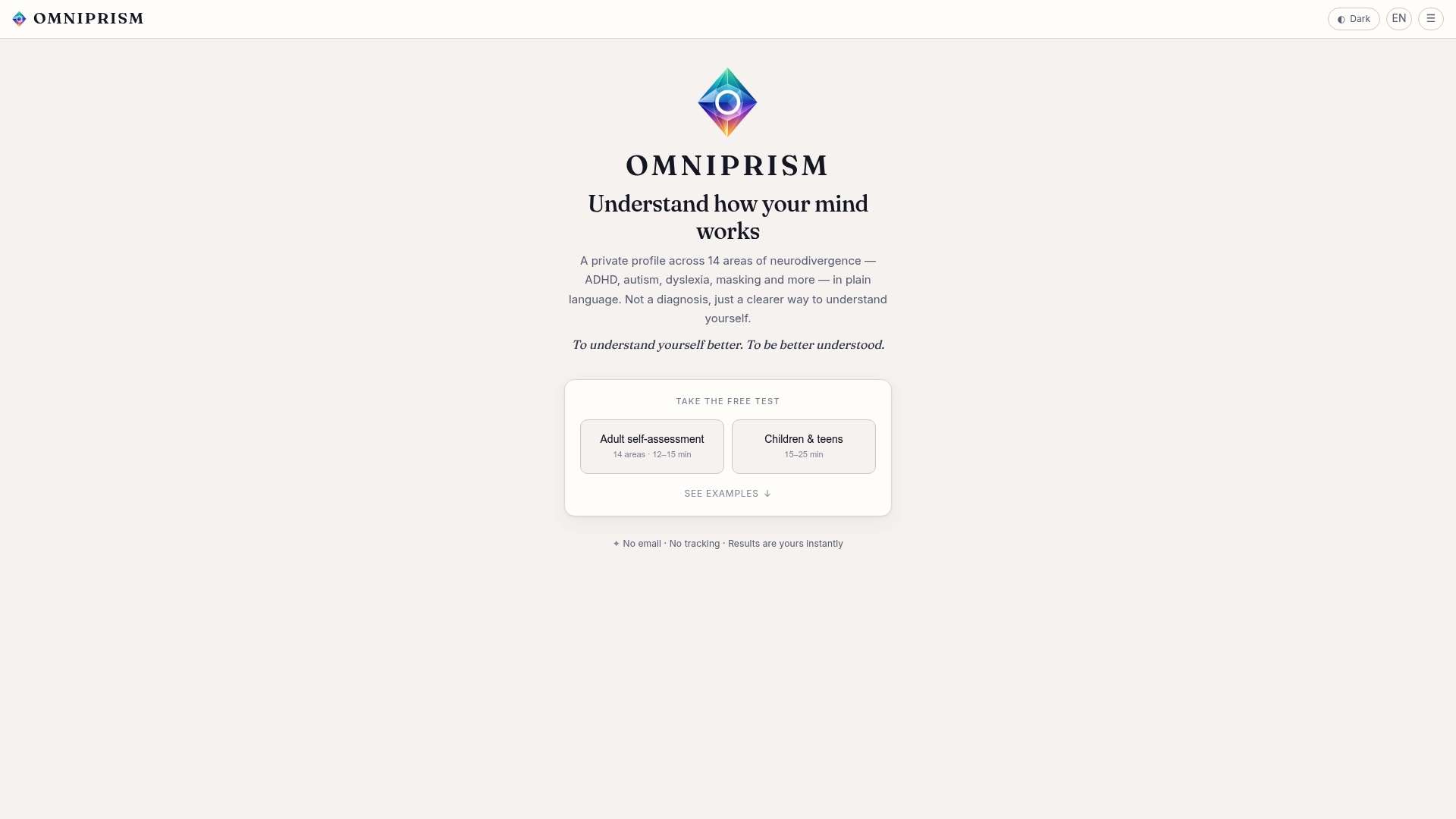
The children's assessment (ages 7–10) and young person's assessment (ages 11–13) generate an instant profile across 14 neurodivergence domains, including autism traits, sensory processing, masking, ADHD patterns, and emotional regulation. No data is collected. Results arrive in plain language, immediately. Parents can use the free profile to spot patterns they had not named, prepare questions for clinicians, and structure conversations with teachers before an IEP meeting.
For families who want a more detailed document, Omniprism's optional Specialist Briefing report summarizes the child's profile in clinical language, formatted for use in a clinician's office or a school eligibility meeting. It does not replace a formal diagnosis, but it gives evaluators a structured starting point rather than a blank intake form. Review Omniprism's assessment methodology to understand how the tool is built and what it measures.
When a child's difficulties have significant impact on daily life, school participation, or relationships, a multidisciplinary evaluation by qualified clinicians remains the appropriate standard. Omniprism is the preparation, not the destination. Start the free assessment today and bring the results to your next school or clinician meeting.
Sources
These sources are worth bookmarking and, where relevant, printing to bring to clinician or school meetings.
- CDC — Signs and symptoms of autism spectrum disorder
- Gifted, On the Spectrum, or Both? - Davidson Institute
- The Paradox of Giftedness and Autism - ERIC
- IQ heterogeneity in autism — PMC
This article is general information, not a substitute for advice from a qualified doctor. Consult a qualified healthcare professional about your own circumstances before acting on anything here.