

Executive dysfunction is a cluster of symptoms, not a standalone diagnosis, that occurs when the brain's management system breaks down, making it hard to plan, start, finish, or switch between tasks. If this sounds familiar, try this right now: pick one task you've been avoiding, break it into just two steps, and set a 10-minute timer for the first one. If symptoms came on suddenly, followed a head injury, or are significantly affecting your work or relationships, contact a clinician rather than waiting.
At a glance:
- Executive dysfunction affects working memory, cognitive flexibility, and inhibitory control
- It is a symptom set, not a DSM diagnosis in its own right
- ADHD and traumatic brain injury are the two most common causes
- Effective management combines targeted treatment with practical environmental support
- Sudden or rapidly worsening symptoms warrant prompt clinical evaluation
Key Takeaways
Executive dysfunction is a brain-based symptom set, not a character flaw, and it responds well to targeted treatment, practical strategies, and the right environmental supports.
| Point | Details |
|---|---|
| It's a symptom, not a diagnosis | Executive dysfunction describes a cluster of EF failures; ADHD, TBI, and mood disorders are common underlying causes. |
| ADHD and TBI are the leading causes | Both disrupt prefrontal-basal ganglia circuits; presentations overlap but prognosis and treatment differ. |
| Assessment requires a clinician | No single test diagnoses it; neuropsychological evaluation, rating scales, and clinical interview together build the picture. |
| Practical strategies work fast | Task breakdown, visible timers, external memory systems, and if-then rules reduce friction without waiting for clinical care. |
| Omniprism maps your profile | The free 14-domain self-assessment gives you structured information to bring to a clinician or use to target strategies. |
Table of Contents
- What is executive dysfunction, and how does it affect the brain?
- What does executive dysfunction look like in daily life?
- What causes executive dysfunction, especially in ADHD and brain injury?
- How is executive dysfunction assessed and diagnosed?
- What treatments and accommodations actually help?
- Practical strategies you can start using today
- When should you see a clinician about executive function problems?
- How Omniprism can help you map your executive challenges
- What living with executive dysfunction actually feels like
- Your executive function profile, mapped in minutes
- Sources
What is executive dysfunction, and how does it affect the brain?
Think of executive functions as the brain's air traffic control system. They don't do the work of landing planes, but without them, everything collides. According to the Cleveland Clinic, executive dysfunction disrupts working memory, cognitive flexibility, and inhibitory control, and commonly shows up as trouble planning, initiating tasks, managing time, and regulating emotions. These three core functions underpin almost every goal-directed behavior a person performs in a day.
Here's what each one actually does:
Working memory holds information in mind while you use it. It's what lets you remember the beginning of a sentence by the time you reach the end, or keep a grocery list in your head while navigating the store.
Cognitive flexibility (also called set-shifting) lets you adapt when plans change, see a problem from a new angle, or switch from one task to another without getting stuck. Poor flexibility shows up as rigidity, perseveration, or an inability to let go of a failed approach.
Inhibitory control is the brake pedal. It suppresses impulsive responses, filters irrelevant information, and keeps behavior goal-directed rather than reactive.
| Core Function | What It Does | Typical Sign of Difficulty |
|---|---|---|
| Working memory | Holds and manipulates information in real time | Forgetting instructions mid-task, losing train of thought |
| Cognitive flexibility | Adapts thinking when conditions change | Getting stuck on one approach, difficulty transitioning |
| Inhibitory control | Suppresses impulsive or off-task responses | Blurting out, acting before thinking, distraction |
Harvard's Center on the Developing Child notes that these skills develop across the lifespan and remain highly sensitive to environmental factors, including stress, sleep, social support, and physical activity. That sensitivity cuts both ways: it means EF skills are trainable, but also that they can degrade under wrong conditions even in people who don't have a neurological diagnosis.
What does executive dysfunction look like in daily life?
The gap between knowing what you need to do and actually doing it is the clearest everyday signal of executive function challenges. That gap shows up at work, at school, and at home, often in ways that get misread as laziness, carelessness, or lack of motivation.
Common signs include:
- Task initiation failure: Staring at an open document for 45 minutes without typing a word
- Time blindness: Consistently underestimating how long tasks take, missing deadlines despite good intentions
- Working memory lapses: Walking into a room and forgetting why, losing the thread of a conversation
- Difficulty switching tasks: Feeling genuinely unable to stop one activity and start another, even when you want to
- Emotional dysregulation: Overreacting to minor frustrations, difficulty recovering after an upset
- Perseveration: Returning obsessively to a worry or idea even when it's not useful
- Losing or misplacing items: Keys, phone, wallet, glasses, repeatedly
The same underlying failure can look completely different depending on context. At work, it might be an inbox that never gets processed. At home, it might be a half-finished home repair project that's been sitting for months. For a parent, it might be forgetting to sign the permission slip that's been on the counter for a week. Same mechanism, different setting.
What causes executive dysfunction, especially in ADHD and brain injury?
Executive dysfunction can be developmental, acquired, degenerative, or situational. The two most common clinical presentations are ADHD and traumatic brain injury, but the full causal map is broader than that.
ADHD
ADHD is the condition most closely associated with executive function challenges. The relationship is strong but not identical: EF problems and ADHD frequently co-occur but are not the same thing. Someone can have significant EF difficulties without meeting criteria for ADHD, and not everyone with ADHD has the same EF profile. What ADHD does involve is a developmental difference in the brain networks that regulate attention, impulse control, and working memory, particularly circuits connecting the prefrontal cortex to the basal ganglia and cerebellum.
Traumatic brain injury
Acquired brain injury, especially to the frontal lobes or their white-matter connections, is a leading cause of sudden-onset executive dysfunction. Research published in PMC confirms that dysexecutive symptoms follow damage to frontal-lobe regions and their connections, often implicating the prefrontal cortex, basal ganglia, and cerebellar networks. A person who was organized and efficient before a car accident or a fall may find themselves unable to plan a simple errand afterward. This is not psychological; it is structural.
Neurodegenerative and psychiatric causes
Parkinson's disease and Alzheimer's disease both affect the frontal-subcortical circuits that support executive function, often producing EF deficits early in the disease course. Major depressive disorder, bipolar disorder, and anxiety can all impair working memory and cognitive flexibility, sometimes severely.
Situational and reversible causes
Statistic callout: EF skills can be impaired by chronic sleep deprivation, sustained stress, social isolation, and physical inactivity, all of which are modifiable. Addressing these factors is often the fastest available intervention.
Other conditions that can produce EF symptoms include:
- Autism spectrum disorder
- Learning differences (dyslexia, dyscalculia)
- Chronic illness and pain
- Medication side effects
- Hormonal changes (perimenopause, thyroid dysfunction)
How is executive dysfunction assessed and diagnosed?
There is no single diagnostic code for "executive dysfunction." Clinicians assess EF as part of evaluating an underlying condition, using a combination of rating scales, clinical interviews, and formal neuropsychological measures. ASHA's clinical guidance confirms that assessment typically requires a multidisciplinary team, potentially including a neuropsychologist, speech-language pathologist, and occupational therapist, depending on the clinical picture.
Common screening and rating tools
- BRIEF-2 (Behavior Rating Inventory of Executive Function): A rating scale completed by the individual and/or an informant; measures real-world EF behavior across multiple domains
- Conners' Rating Scales: Widely used in ADHD evaluation; captures attention, impulse control, and behavioral regulation
- AISRS (Adult ADHD Investigator Symptom Rating Scale): An 18-item clinician-administered scale
Statistic callout: In one pooled-sample study, an AISRS total score of ≥28 was found to be predictive of clinical executive dysfunction, with reported sensitivity of approximately 74–79% and specificity of approximately 93–100%. This threshold is a screening aid, not a diagnosis, and requires clinical follow-up.
What a neuropsychological evaluation typically includes
- Clinical interview: Developmental history, current complaints, functional impact at work and home
- Collateral input: Information from a partner, parent, or close colleague who observes the person's daily functioning
- Standardized testing: Tasks measuring working memory span, processing speed, set-shifting, verbal fluency, and planning (e.g., Trail Making Test, Wisconsin Card Sorting Test, Tower of London)
- Rating scales: Self-report and informant-report questionnaires
- Feedback session: Results explained in plain language, with recommendations for treatment and accommodations
Who performs evaluations varies by setting. Primary care physicians can initiate screening and referrals. Neuropsychologists conduct formal batteries. Psychiatrists assess EF in the context of mood and attention disorders. Occupational therapists evaluate functional performance in daily tasks. Speech-language pathologists address EF in communication and cognitive-linguistic contexts.
What treatments and accommodations actually help?
Effective management of executive function challenges usually combines targeted treatment for the underlying condition with functional strategies and environmental accommodations. There is no single fix, but the evidence base is solid across several approaches.
Medication
For ADHD-related executive dysfunction, stimulant medications (amphetamine salts, methylphenidate) and non-stimulant options (atomoxetine, viloxazine) are first-line treatments. Cleveland Clinic's clinical overview notes that medication combined with psychotherapy and functional strategies represents the most effective approach. Medication does not teach skills, but it can reduce neurological noise enough for skills training to take hold.
Psychotherapy and skills training
Cognitive Behavioral Therapy adapted for ADHD and EF challenges targets the thought patterns and behavioral habits that maintain dysfunction. Metacognitive therapy specifically addresses awareness of one's own cognitive processes, helping people notice when they are off-track and self-correct. Dialectical Behavior Therapy elements, particularly distress tolerance and emotional regulation modules, address the emotional dysregulation component.
Coaching and occupational therapy
ADHD coaching focuses on accountability structures, goal-setting, and practical habit design. Occupational therapy addresses functional performance in daily life tasks, often using environmental modification and compensatory strategies. For acquired brain injury, cognitive rehabilitation combines restorative exercises with compensatory skill-building.
Workplace and school accommodations
Practical accommodations that make a real difference include:
- Extended time on tests and assignments
- Written instructions rather than verbal-only directions
- Reduced-distraction testing environments
- Flexible deadlines with check-in points
- Permission to use organizational tools (apps, planners, voice recorders)
- Breaking large projects into smaller, graded milestones with supervisor check-ins
- For students with documented disabilities, LSAT accommodations and similar academic testing supports are available through formal accommodation processes
Lifestyle supports
Harvard's research is clear that sleep, exercise, and stress reduction are not soft add-ons. They are primary levers. Regular aerobic exercise has a measurable effect on prefrontal cortex function. Consistent sleep protects working memory consolidation. Chronic stress actively degrades the neural circuits that support EF.
Practical strategies you can start using today
Small environmental scaffolds and micro-habits produce outsized gains for executive function challenges, often faster than any single clinical intervention.
- Break tasks using implementation intentions. Instead of "I'll work on the report," write "When I sit down at 9 AM, I will open the document and write the first two sentences." Specificity collapses the gap between intention and action.
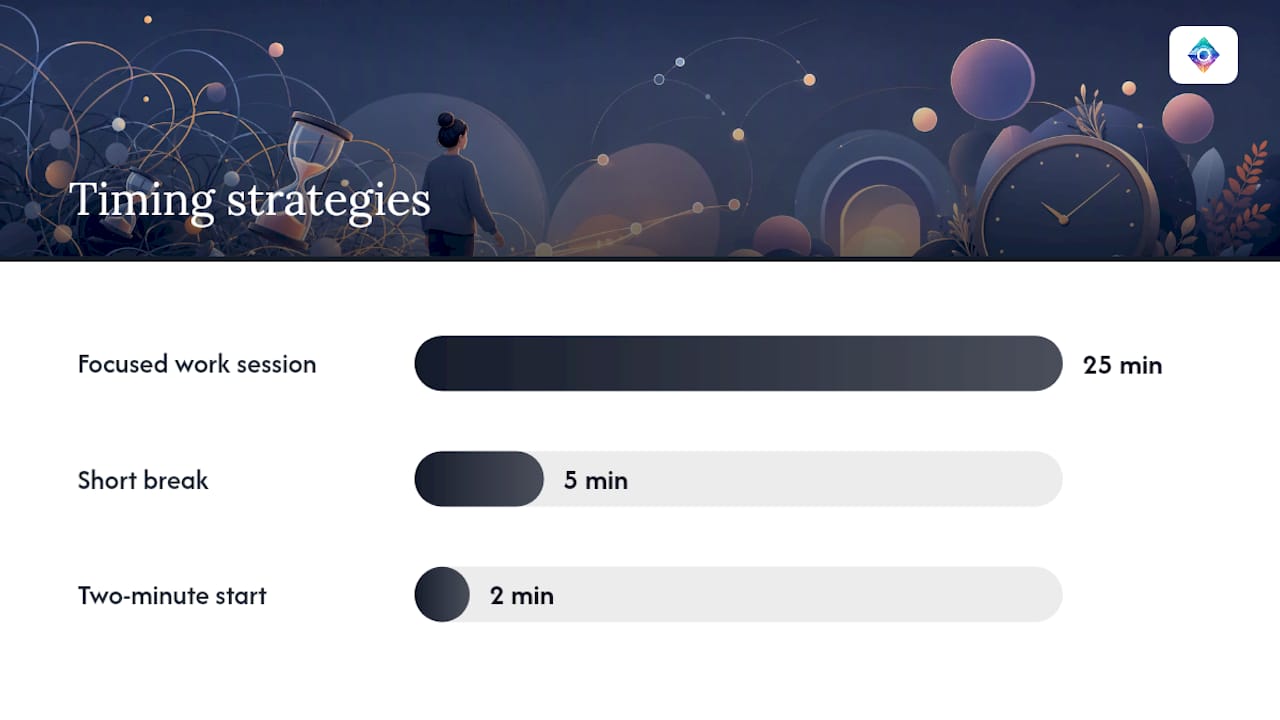
- Use visible timers. A physical or on-screen countdown timer (Time Timer is a popular option) makes time concrete and prevents time blindness. Set it for 25 minutes of focused work, then a 5-minute break.
- Externalize your memory. Don't trust your brain to hold it. Write it down immediately, use a voice memo, or drop a note in a dedicated app. The goal is to get the information out of your head and into a reliable system.
- Single-task with environmental design. Phone in another room, browser tabs closed, one document open. Reducing the number of available distractions is more effective than trying to resist them through willpower.
- Use structured checklists. A written checklist for recurring tasks (morning routine, weekly review) removes the need to re-plan from scratch every time. Laminate it if you use it daily.
- Apply if-then rules. "If it's Sunday evening, then I lay out my clothes and pack my bag." Linking a behavior to a trigger removes the initiation decision entirely.
Pro Tip: The two-minute start rule: commit to working on a task for exactly two minutes. You are not committing to finishing it, just starting. Most of the time, starting is the only barrier, and two minutes of momentum is enough to continue.
Useful tool categories to explore:
- Timers: Time Timer, Forest app, Toggl Track
- Visual calendars: Google Calendar with color-coding, Fantastical
- Reminder systems: Todoist, TickTick, Apple Reminders with location-based alerts
- Note capture: Notion, Obsidian, a simple voice memo app
Pro Tip: External accountability works better than internal willpower for most people with EF challenges. A body double (working alongside someone, even on video call), a weekly check-in with a friend, or a paid coach all leverage social commitment in ways that to-do lists cannot.
When should you see a clinician about executive function problems?
Prognosis varies significantly by cause. Developmental EF challenges, like those associated with ADHD, often improve meaningfully with targeted support, skill training, and sometimes medication. Acquired EF deficits from brain injury depend on the location and severity of the lesion, the person's age, and the quality of rehabilitation. Neurodegenerative causes follow a different trajectory, where the goal shifts toward compensation and quality of life rather than restoration.
Seek evaluation if any of the following apply:
- EF symptoms appeared suddenly or after a head injury, fall, or illness
- Symptoms are worsening over weeks or months without a clear situational cause
- You have lost a job, relationship, or housing because of cognitive difficulties
- There are safety concerns (forgetting medications, leaving the stove on, getting lost in familiar places)
- A child's EF difficulties are significantly affecting school performance or social development
- You have tried practical strategies consistently for 4–6 weeks without improvement
Red flags requiring prompt evaluation:
- Sudden confusion or disorientation
- New difficulty with language or word-finding
- Unexplained falls or coordination problems
- Rapid personality change or loss of social inhibition
For non-urgent concerns, start with your primary care physician, who can screen and refer to a neuropsychologist, psychiatrist, or neurologist. For sudden or severe changes, go to an emergency department.
How Omniprism can help you map your executive challenges
A guided self-assessment can quickly surface patterns consistent with executive dysfunction and identify specific domains worth discussing with a clinician. Before investing in a full neuropsychological evaluation, which can be expensive and time-consuming, having a structured picture of your own profile is genuinely useful.
Omniprism's free neurodivergence self-assessment covers 14 domains relevant to neurodivergent experience, including ADHD traits, working memory, cognitive flexibility, sensory processing, and masking. Results are delivered instantly in plain language, with no data collection and no pressure to purchase anything. For adults, the assessment takes minutes. For families, Omniprism also offers guided assessments for children ages 7–10 and young people ages 11–13.
What to do with your results:
- Bring the profile to your next clinical appointment as a structured starting point for conversation
- If you are pursuing formal evaluation, consider the optional Specialist Briefing report, which summarizes your results in a format designed for clinicians
- Use the domain breakdown to identify which EF areas to target first with practical strategies
- Re-assess after 4–6 weeks of consistent strategy use to track change
Pro Tip: A self-assessment result is not a diagnosis. Use it as a map, not a verdict. The goal is to walk into a clinical conversation with structured, specific information rather than a vague sense that something is off.
Important: Omniprism is a self-assessment tool, not a diagnostic instrument. Results should be interpreted with a qualified clinician. See Omniprism's disclaimer for full details.
What living with executive dysfunction actually feels like
EF challenges are common, and they are manageable with the right supports. That second part matters as much as the first.
Many people describe the experience not as being unable to do things, but as being unable to make themselves do things they genuinely want to do. The gap between intention and action can feel humiliating, especially when it looks like laziness from the outside. A parent who forgets to schedule a pediatric appointment for the third week in a row is not indifferent to their child's health. A professional who misses a deadline despite working late the night before is not disorganized by choice.
Reframing EF struggles as brain-based management breakdowns rather than character flaws is not just therapeutic language. It changes what interventions make sense. You don't fix a broken brake pedal by trying harder to stop the car. You fix the brake pedal.
Progress is real and often faster than people expect once the right supports are in place. That might mean medication, coaching, a better task management system, or simply sleeping eight hours consistently. Usually it's a combination. The point is that the trajectory is not fixed, and the shame that often accompanies these struggles is the least useful thing to carry into treatment.

When lived experience alone isn't enough, that's exactly when clinical help earns its keep.
Your executive function profile, mapped in minutes
Knowing that executive dysfunction is affecting you is one thing. Knowing which domains are most affected, and having that information organized in a way a clinician can actually use, is something else entirely.
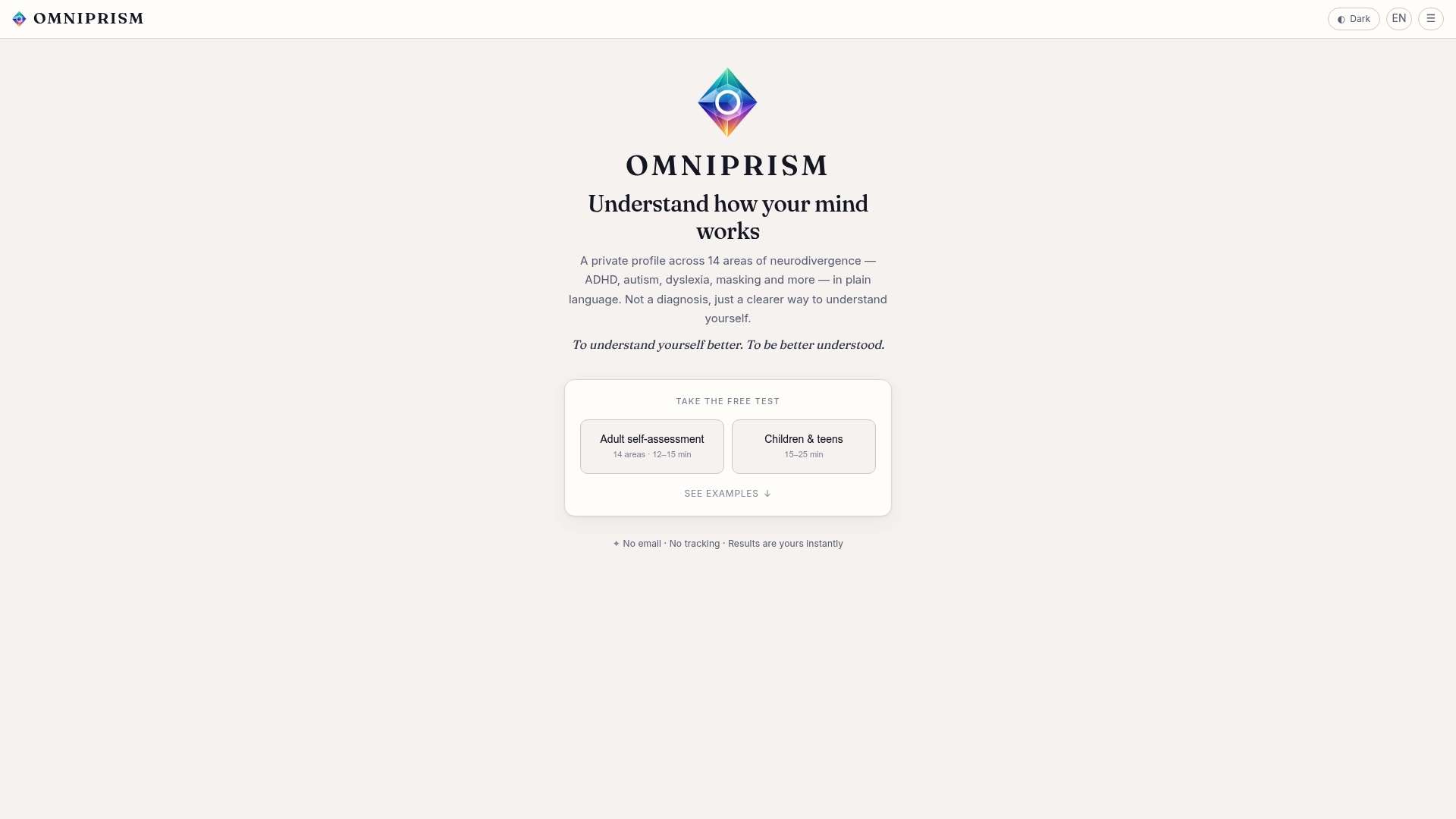
Omniprism's free self-assessment gives you an instant profile across 14 neurodivergent domains, including the executive function areas most relevant to ADHD, brain injury recovery, and related conditions. No account required, no data stored, results in plain language the moment you finish. If you want to take that profile into a clinical conversation, the optional Specialist Briefing translates your results into a structured summary designed for healthcare providers.
The assessment is free. The clarity it provides before a clinical appointment, or before committing to a treatment path, is the point. Start your free assessment at Omniprism and see where your profile lands across the domains that matter most.
Omniprism is not a diagnostic tool. Results are for informational and self-reflection purposes only. Always consult a qualified clinician for diagnosis and treatment decisions. See the assessment methodology for details on how the tool was developed.
Sources
These are the primary sources underpinning this guide, selected for clinical authority and accessibility.
- Executive Dysfunction: What It Is, Symptoms & Treatment
- Executive Dysfunction - PMC - NIH
- A Guide to Executive Function: What is it, and how is it developed?
- Executive function deficits
This article is general information, not a substitute for advice from a qualified doctor. Consult a qualified healthcare professional about your own circumstances before acting on anything here.