

Under the DSM-5, ADHD requires a persistent pattern of inattention and/or hyperactivity-impulsivity that has lasted at least six months, with several symptoms present before age 12, evidence of impairment in two or more settings, and a symptom count that meets the threshold for the person's age. No checklist alone closes the case. Diagnosis requires clinician judgment, collateral information from multiple informants, and a careful review of the full developmental history, as the CDC and NIMH both emphasize.
The core thresholds at a glance:
- Symptom count: ≥6 symptoms in a domain for children and adolescents under 17; ≥5 symptoms for ages 17 and older
- Duration: Symptoms present for a prolonged period, generally half a year or more
- Age of onset: Several symptoms must have appeared before early adolescence
- Settings: Symptoms present in multiple settings such as home and school or work
- Impairment: Evidence that symptoms interfere with social, academic, or occupational functioning
- Exclusion: Symptoms not better explained by another mental disorder
Key Takeaways
The DSM-5 requires ≥6 symptoms (or ≥5 for ages 17+) in at least one domain, present for six months, with onset before age 12, impairment in two or more settings, and a clinician ruling out other explanations.
| Point | Details |
|---|---|
| Symptom count thresholds | Children under 17 need ≥6 symptoms per domain; adults aged 17+ need ≥5. |
| Six-month duration rule | Symptoms must persist for at least 6 months and be inconsistent with developmental level. |
| Age-of-onset requirement | Several symptoms must have been present before age 12, verified by developmental history. |
| Two-settings requirement | Symptoms must appear in two or more settings; single-setting problems rarely meet DSM-5 criteria. |
| Omniprism self-assessment | Omniprism's free tool helps individuals organize cross-setting observations before a clinical evaluation. |
Table of Contents
- What the DSM-5 ADHD criteria actually require, A through E
- How the same symptoms look different across age groups
- How DSM-5 changed the rules from DSM-IV
- Conditions that mimic ADHD and how clinicians rule them out
- What a clinical ADHD evaluation actually looks like
- Why checklists alone can't diagnose ADHD
- Why getting the criteria right changes everything
- Omniprism helps you prepare for the clinical conversation
- Sources
What the DSM-5 ADHD criteria actually require, A through E
The APA's DSM-5 ADHD criteria are organized into five criteria, each of which must be satisfied for a valid diagnosis. The table below summarizes each one.
| Criterion | Requirement |
|---|---|
| A | ≥6 symptoms of inattention and/or ≥6 symptoms of hyperactivity-impulsivity (≥5 each for ages 17+), persistent for ≥6 months, maladaptive and inconsistent with developmental level |
| B | Several symptoms were present before age 12 |
| C | Symptoms are present in two or more settings |
| D | Clear evidence that symptoms interfere with or reduce the quality of social, academic, or occupational functioning |
| E | Symptoms do not occur exclusively during the course of schizophrenia or another psychotic disorder and are not better explained by another mental disorder |
The NCBI Bookshelf summary of these criteria notes that the shift to "before age 12" (from the DSM-IV's "before age 7") was deliberate, reflecting research showing little clinical difference between those identified before 7 and those with onset in early adolescence.
The 9 inattention symptoms
- Often fails to give close attention to details or makes careless mistakes in schoolwork, at work, or during other activities (child: messy homework; adult: repeated errors in reports)
- Often has difficulty sustaining attention in tasks or play activities (child: can't finish a worksheet; adult: loses focus in long meetings)
- Often does not seem to listen when spoken to directly (mind appears elsewhere even without obvious distraction)
- Often does not follow through on instructions and fails to finish schoolwork, chores, or duties (not due to defiance or failure to understand)
- Often has difficulty organizing tasks and activities (child: backpack chaos; adult: missed deadlines, poor time management)
- Often avoids, dislikes, or is reluctant to engage in tasks requiring sustained mental effort
- Often loses things necessary for tasks or activities (keys, phone, school materials)
- Often easily distracted by extraneous stimuli (including unrelated thoughts in older adolescents and adults)
- Often forgetful in daily activities
The 9 hyperactivity-impulsivity symptoms
- Often fidgets with or taps hands or feet, or squirms in seat
- Often leaves seat in situations where remaining seated is expected
- Often runs about or climbs in situations where it is inappropriate (in adolescents/adults: may be limited to feeling restless)
- Often unable to play or engage in leisure activities quietly
- Often "on the go," acting as if "driven by a motor"
- Often talks excessively
- Often blurts out an answer before a question has been completed
- Often has difficulty waiting their turn
- Often interrupts or intrudes on others
Symptom count rule: Children and adolescents under 17 must meet ≥6 symptoms in a domain; individuals 17 and older need only ≥5, per the NCBI Bookshelf criteria summary. The AAFP clinical reference table reproduces these lists with practical coding notes for primary care clinicians.
How the same symptoms look different across age groups
The DSM-5 symptom language is deliberately broad so it applies across the lifespan. The challenge is that "fails to follow through" looks nothing alike in a 7-year-old and a 35-year-old. Understanding those differences helps parents and educators describe what they observe, and helps clinicians ask the right questions.
School-age children (roughly ages 6–12)
Symptoms tend to be visible and externally disruptive. Inattention shows up as incomplete assignments, lost permission slips, and a desk that looks like a recycling bin. Hyperactivity is often literal: getting up from the chair, running in hallways, touching everything. Teachers are usually the first to flag concerns because the classroom demands sustained attention in a way that home routines often don't.
- Fails to follow through: Starts three homework problems, wanders to the kitchen, returns to a different task
- Difficulty organizing: Cannot sequence a multistep project without adult scaffolding
- Leaves seat: Gets up repeatedly during circle time or a test
Adolescents (roughly ages 13–17)
Hyperactivity often goes internal. The student who used to run around the classroom now just feels restless and taps a pen constantly. Impulsivity shifts toward social contexts: interrupting conversations, risky decisions, difficulty waiting in line. Inattention becomes harder to catch because adolescents can sometimes compensate with effort or by choosing tasks they find interesting, masking the underlying pattern.
- Easily distracted: Scrolls through a phone during a lecture, then can't reconstruct the content
- Blurts out answers: Speaks over classmates in discussion, not from rudeness but from impulse
- Forgetful in daily activities: Repeatedly forgets locker combination, lunch, or after-school commitments
Adults (ages 18+)
Research on lifespan ADHD presentation highlights that adult symptoms are often subtler and more internalized. Adults rarely run around rooms; instead, they describe a constant mental restlessness, chronic lateness, difficulty finishing projects, and a pattern of underperformance that doesn't match their intelligence. Many adults seeking diagnosis for the first time were high-achieving students who compensated until the demands of work or parenting overwhelmed their coping strategies.
- Fails to follow through: Starts a work project enthusiastically, stalls at the tedious middle phase, misses the deadline
- Difficulty organizing: Pays bills late not from lack of funds but from inability to initiate the task
- Restlessness: Feels compelled to check email every few minutes during a meeting, not because of boredom but because sitting still feels physically uncomfortable
Pro Tip: When preparing for an adult ADHD evaluation, gather retrospective evidence: old report cards, parent recollections, or college transcripts showing a pattern of inconsistent performance. Clinicians need to establish that symptoms were present before age 12, and adult patients often can't recall this without prompts. School records are the single most useful document you can bring.
How DSM-5 changed the rules from DSM-IV
The DSM-5 made several targeted changes to ADHD criteria. For clinicians and families who went through a DSM-IV evaluation, the differences below explain why a re-evaluation under DSM-5 might yield a different result.
| Dimension | DSM-IV | DSM-5 |
|---|---|---|
| Symptom count (adults) | ≥6 symptoms in a domain (all ages) | ≥5 symptoms for ages 17+ |
| Age of onset | Several symptoms before age 7 | Several symptoms before age 12 |
| Settings requirement | Impairment in two or more settings | Symptoms present in two or more settings |
| Adult-relevant examples | Not included | Included inline with symptom items |
| ASD comorbidity | ADHD excluded if ASD present | ADHD can be diagnosed alongside ASD |
The practical implications are significant:
- More adults qualify. Lowering the symptom threshold from 6 to 5 for adults acknowledges that some symptoms naturally attenuate with age without the underlying condition resolving.
- Retrospective onset is easier to document. The shift from "before age 7" to "before age 12" reflects the reality that many adults cannot reliably recall symptoms from early childhood, and that the clinical picture at age 9 is as valid as one at age 6.
- ASD and ADHD can now co-occur. This single change opened the door to dual diagnoses that were previously excluded, which matters enormously for individuals who had been told their ADHD-like symptoms were "just autism."
- Adult examples reduce missed diagnoses. The APA's rationale for DSM-5 updates explicitly notes that adding adult-relevant examples was intended to reduce the under-recognition of ADHD in adults who had been missed under DSM-IV language written primarily for children.
Conditions that mimic ADHD and how clinicians rule them out
Criterion E exists for a reason. Inattention, restlessness, and impulsivity are not unique to ADHD. A clinician who counts symptoms without ruling out alternatives risks a misdiagnosis that delays the right treatment.
Common differential diagnoses
- Anxiety disorders: Worry and rumination consume attention and cause restlessness; the key distinction is whether inattention is situation-specific (triggered by anxiety) or pervasive
- Depression: Low motivation, poor concentration, and psychomotor slowing can look like inattention; onset timing and mood history help differentiate
- Sleep disorders: Chronic sleep deprivation produces nearly every ADHD symptom; a sleep history is non-negotiable in any ADHD workup
- Autism Spectrum Disorder (ASD): Attention difficulties, sensory sensitivity, and impulsivity overlap significantly; DSM-5 now permits both diagnoses, but the functional profile differs
- Learning disorders: Reading or math difficulties can cause avoidance and apparent inattention that is actually task-specific, not pervasive
- Substance use: Stimulant use, cannabis, and alcohol all affect attention and impulse control; substance history must be reviewed
Common comorbidities
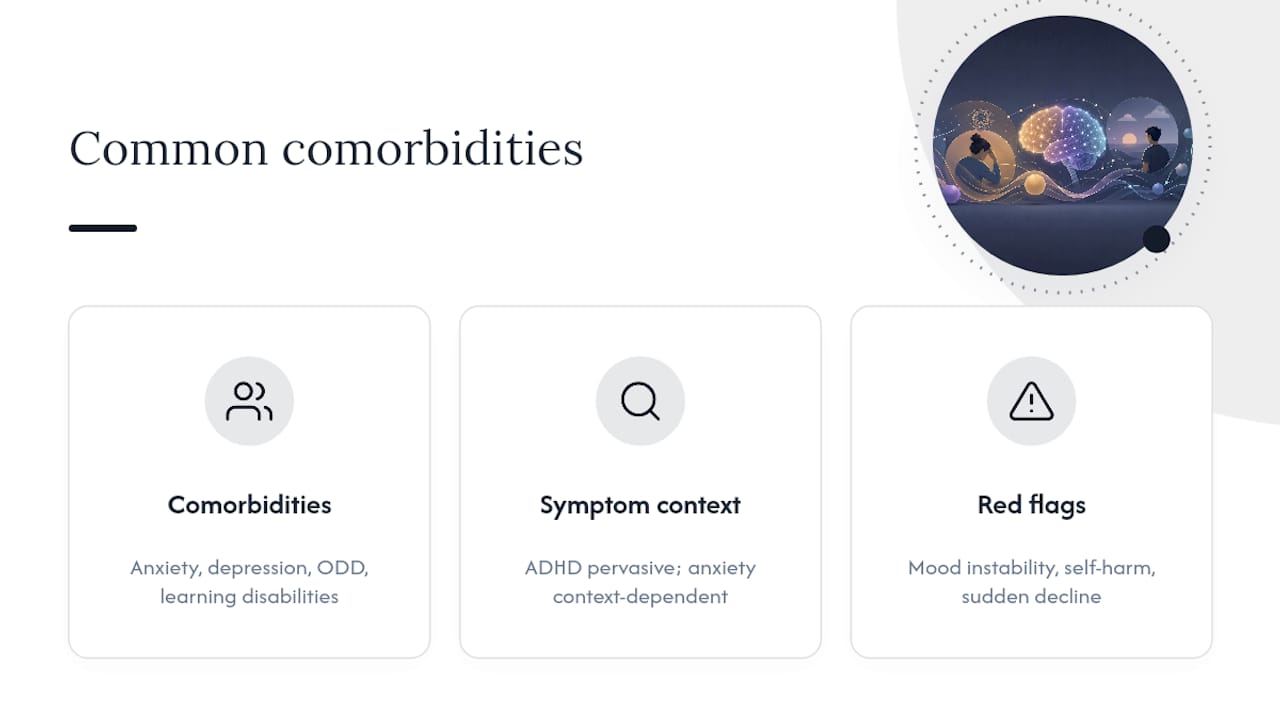
Research on ADHD comorbidity consistently shows that ADHD rarely travels alone. Anxiety disorders, depression, oppositional defiant disorder, and learning disabilities co-occur at rates that make careful differential diagnosis a clinical necessity rather than a formality.
Pro Tip: Clinicians will often ask caregivers or teachers whether symptoms are consistent across contexts or whether they spike in specific situations. ADHD symptoms are pervasive; anxiety symptoms tend to be context-dependent. That single distinction guides a lot of the differential.
A note on urgency: if a child or adult presents with ADHD-like symptoms alongside significant mood instability, self-harm, or a sudden decline in functioning, those features warrant urgent assessment before any ADHD diagnosis is finalized. Bipolar disorder and severe depression can present with distractibility and impulsivity, and treating those with stimulants before stabilizing mood can worsen outcomes.
What a clinical ADHD evaluation actually looks like
Knowing the DSM-5 criteria is useful. Knowing what happens in a real evaluation helps you walk in prepared. The CDC's guidance on diagnosing ADHD makes clear that no single test, scale, or checklist is sufficient; the process is multi-step and multi-informant.
Typical evaluation steps
- Intake interview: The clinician takes a detailed history covering current symptoms, developmental milestones, academic and occupational history, and family psychiatric history.
- Developmental timeline: Establishing that symptoms were present before age 12 often requires reconstructing childhood from school records, parent recollections, or old report cards.
- Multi-informant rating scales: Clinicians use structured tools to quantify symptoms across settings. For adults, the Adult ADHD Self-Report Scale (ASRS) is widely used. For children, the Conners Rating Scales and the Vanderbilt Assessment Scales are standard options. These tools support clinical judgment; they do not replace it.
- Collateral information: Teacher questionnaires, caregiver reports, and workplace feedback provide the cross-setting evidence Criterion C requires.
- Cognitive and learning screens: When learning disabilities or intellectual concerns are present, neuropsychological testing may be added.
- Physical exam and medication review: Thyroid conditions, vision or hearing problems, and certain medications can produce ADHD-like symptoms. A physical exam and medication history rule these out.
- Diagnostic formulation: The clinician synthesizes all findings against the DSM-5 criteria, assigns a presentation specifier, and documents severity.
ADHD presentations and severity specifiers
The AAFP clinical reference outlines three presentations clinicians code:
- Combined presentation: Criteria met for both inattention and hyperactivity-impulsivity
- Predominantly inattentive presentation: Criteria met for inattention only
- Predominantly hyperactive-impulsive presentation: Criteria met for hyperactivity-impulsivity only
Severity is rated mild, moderate, or severe based on the number of symptoms beyond the threshold and the degree of functional impairment.
Pro Tip: Bring three things to an evaluation: a completed symptom timeline (when problems first appeared, in which settings), any school reports or progress notes from childhood, and the names of two people who can serve as collateral informants. Clinicians can move much faster when the developmental history is already documented.
Why checklists alone can't diagnose ADHD
A DSM-5 ADHD checklist is a starting point, not a finish line. Several structural limitations mean that self-report or parent-report checklists, however well-designed, cannot substitute for a clinical evaluation.
- Self-report bias: Adults with ADHD often underreport symptoms they have normalized over years; parents may over-report in high-stress periods
- Context-specific problems: A child who struggles only at school may have a learning disorder, a classroom mismatch, or an anxiety response, not ADHD
- Age-masking: High intelligence, strong motivation, or a supportive environment can suppress visible symptoms even when the underlying condition is present
- Comorbidity confusion: Anxiety and depression produce checklist scores that overlap heavily with ADHD; a checklist cannot distinguish between them
- Retrospective bias: Adults reconstructing childhood symptoms often color their memories with their current self-perception
What to bring to a diagnostic appointment
- School records, report cards, or teacher notes from childhood
- A written timeline of when and where symptoms first appeared
- Names and contact information for collateral informants (teacher, partner, parent)
- A list of current medications and any prior mental health diagnoses
- Examples of functional impairment: missed deadlines, relationship conflicts, academic failures
Seek a formal evaluation when symptoms are causing clear functional impairment across more than one setting, when a teacher or employer has raised concerns, or when an adult recognizes a lifelong pattern of underperformance that has never been explained. The NIMH guidance on ADHD is explicit: a diagnosis requires a trained professional, not a score on a checklist.
Why getting the criteria right changes everything
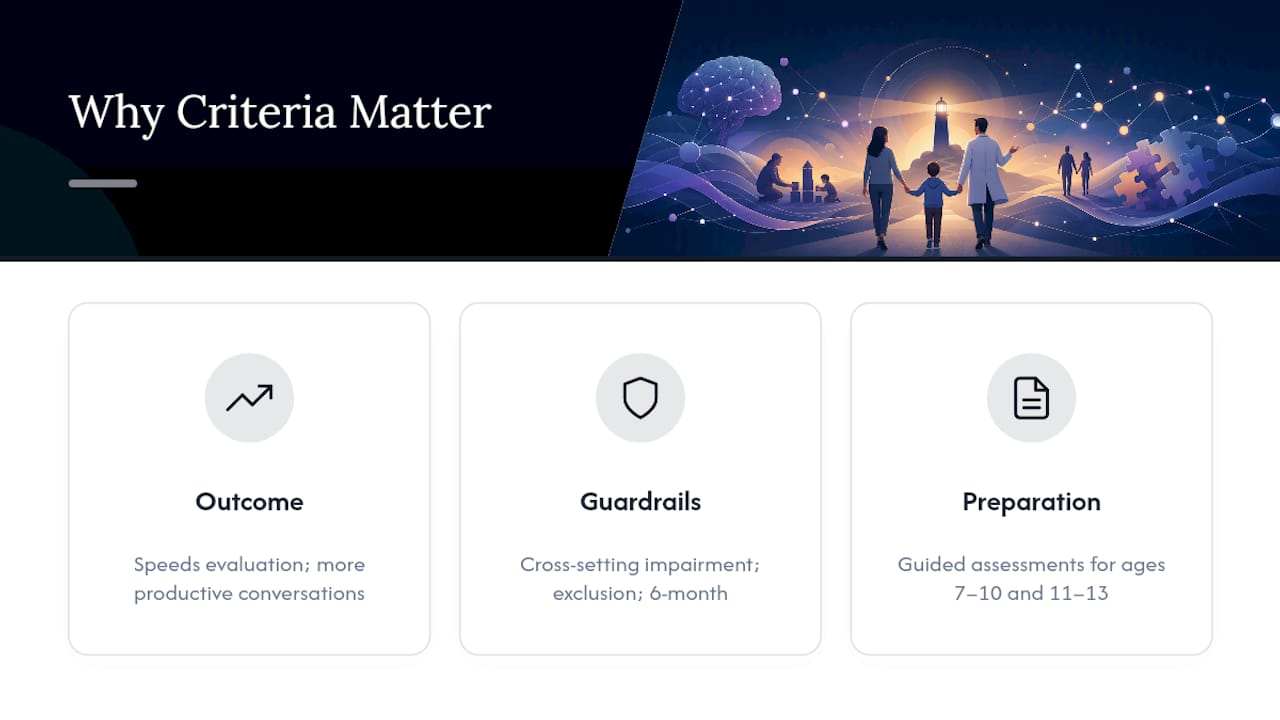
Accurate use of the DSM-5 ADHD criteria is not a bureaucratic exercise. When clinicians, parents, and educators share a common understanding of what the criteria actually require, conversations become more productive and support arrives faster. A parent who can describe symptoms across two settings, with examples tied to specific DSM-5 items, gives a clinician far more to work with than a general complaint that a child "can't focus." An adult who arrives at an evaluation with a documented developmental timeline cuts the intake process in half.
The criteria also protect against over-diagnosis. The requirement for cross-setting impairment, the exclusion clause, and the six-month duration threshold exist precisely to prevent a bad week, a difficult classroom, or a stressful job from being labeled a disorder. Understanding those guardrails is as important as knowing the symptom lists.
For families preparing for a pediatric evaluation, Omniprism's guided assessment for children ages 7–10 and young people ages 11–13 can help caregivers organize observations across settings before the clinical appointment.
Omniprism helps you prepare for the clinical conversation
Knowing the DSM-5 criteria is one thing. Arriving at a clinician's office with organized, cross-setting evidence is another. Omniprism's free neurodivergence self-assessment covers 14 domains, including ADHD traits, and generates an instant profile in plain language. It is not a diagnostic tool and does not replace a clinician's evaluation.
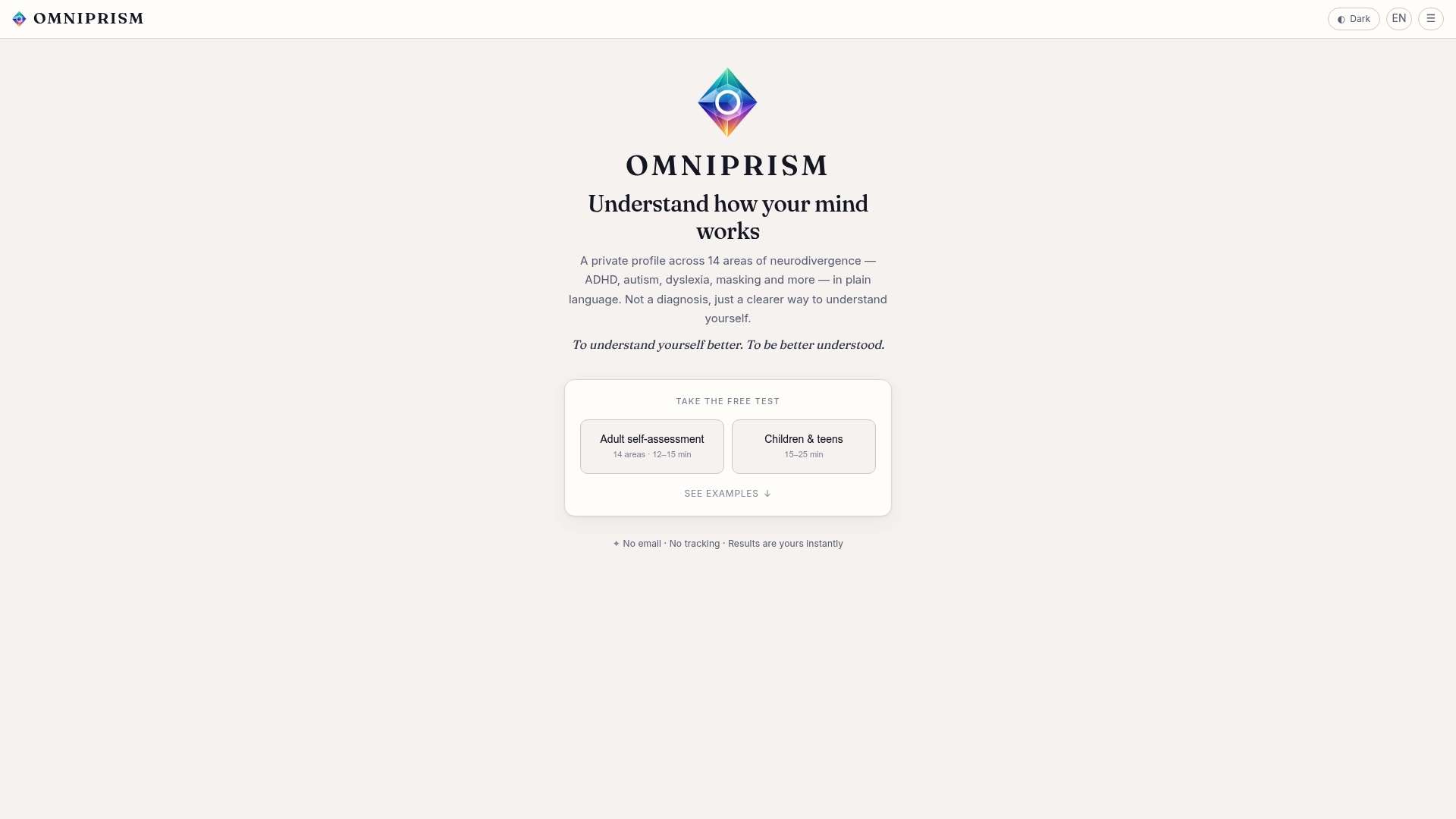
What it does is give you a structured starting point. The assessment captures patterns across contexts, flags areas worth discussing with a clinician, and can generate an optional Specialist Briefing report designed to be shared directly with a healthcare provider. For families navigating a pediatric referral, the children and young people's assessment pages offer age-appropriate guided questions that help caregivers document what they observe at home and at school. Start the free assessment at Omniprism and arrive at your next clinical appointment with something concrete to show.
Sources
The following primary sources were consulted for this article. Each provides authoritative, freely accessible information on DSM-5 ADHD criteria and clinical assessment.
- Attention-Deficit/Hyperactivity Disorder Diagnostic Criteria (NCBI Bookshelf)
- Diagnosing ADHD | Attention-Deficit / Hyperactivity (CDC)
- ADHD: What You Need to Know (NIMH)
- DSM-5 Diagnostic Criteria for ADHD (AAFP table)
This article is general information, not a substitute for advice from a qualified doctor. Consult a qualified healthcare professional about your own circumstances before acting on anything here.