

Autistic inertia is the difficulty starting, stopping, or switching between activities, following the same logic as Newton's first law: a body at rest stays at rest, and a body in motion stays in motion, unless something acts on it. It shows up as being physically unable to begin a task you want to do, or being unable to stop one once you're in it, even when you know you should. This is not laziness or a motivation problem. A 2021 focus-group study published in Frontiers in Psychology documented these patterns directly from autistic adults, and later thematic work analyzing autistic online communities found the same two-sided pattern at scale.
The core mechanics break down into three functional states:
- Start inertia: unable to initiate a task despite wanting or needing to do it.
- Stop inertia: unable to disengage from an activity once absorbed in it.
- Switch difficulty: unable to transition between tasks, even low-stakes ones.
Understanding autistic inertia matters because it reframes what looks like avoidance or stubbornness as something closer to a neurological gear stuck in place. A structured self-assessment tool like Omniprism can help map where executive function, sensory processing, and other traits intersect with these patterns, giving you language for what's happening before you even talk to a clinician.
Key Takeaways
Autistic inertia is a documented, research-backed pattern of difficulty starting, stopping, and switching tasks that responds far better to external scaffolding than to willpower or pressure.
| Point | Details |
|---|---|
| Definition matters | Autistic inertia describes involuntary difficulty starting, stopping, or switching tasks, distinct from unwillingness. |
| Two extremes exist | Inertial rest (can't start) and inertial motion (can't stop) are both common and can coexist in the same person. |
| Prompting beats willpower | External cues, co-working, and micro-step scripting consistently outperform self-motivation techniques. |
| Shame deepens the cycle | Self-criticism after missed tasks raises stress, which research links to worsening future inertia. |
| Differentiation guides support | Distinguishing inertia from procrastination, ADHD paralysis, burnout, or catatonia determines which approach actually helps. |
Table of Contents
- Autistic Inertia Meaning: What Start, Stop, and Switch Actually Feel Like
- What Do Autistic People Actually Say About Living With Inertia?
- What Does the Research Say About Autistic Inertia?
- Why Does Autistic Inertia Happen? The Mechanisms Behind It
- Autistic Inertia vs. Procrastination, ADHD Paralysis, and Burnout
- How Can You Overcome Inertia in Autism? Practical Strategies That Work
- How Can Families, Teachers, and Managers Support Someone With Inertia?
- When Should You Seek Clinical Help for Autistic Inertia?
- Can a Self-Assessment Help You Understand Your Own Inertia Patterns?
- Frequently Asked Questions
- Sources
Autistic Inertia Meaning: What Start, Stop, and Switch Actually Feel Like
Inertial rest and inertial motion are the two extremes autistic adults describe most consistently, according to a qualitative study of Autistic adults' experiences published in Autism. Inertial rest is the stuck-at-zero state: you want to get up, brush your teeth, answer the email, but nothing happens. Inertial motion is the opposite problem: you're three hours into a task and physically cannot pull yourself out, even to eat or use the bathroom.
Here's what that looks like in ordinary moments:
- Morning start inertia. You're awake, aware of the time, mentally rehearsing getting up. Your body doesn't move. Twenty minutes pass. This isn't dozing. You're fully conscious and frustrated, watching the gap between intention and action.
- Stop inertia during hyperfocus. You sit down to answer one message and resurface four hours later, dehydrated, having missed a meal, unaware time passed at all.
- Switch failure between chores. You finish washing dishes and know laundry is next. You stand in the kitchen, task complete, next task loaded, and simply cannot cross the threshold into the next room.
- Task-initiation autism in professional settings. A work deadline sits untouched not from indifference but because the act of opening the document requires an activation energy that doesn't arrive.
Sensory and interoceptive signals often ride alongside these episodes. Some people report a physical heaviness, like wading through resistance; others describe a mental fog that makes the next step feel unreachable rather than merely undesirable. Fatigue, low blood sugar, and sensory overload frequently show up as triggers or amplifiers, which is why autistic inertia tends to worsen during burnout periods and ease somewhat when the nervous system has more slack to work with.
What Do Autistic People Actually Say About Living With Inertia?
The Frontiers focus-group study surveyed 32 autistic adults and pulled out four consistent themes: how inertia is described, what scaffolding helps, how wellbeing shapes its severity, and how much it affects daily functioning. Two of those themes come up again and again in participant accounts: the difficulty locating a "first step" small enough to actually perform, and a heavy reliance on other people or external systems to break the freeze.
A recurring pattern in that research: people describe needing someone else to physically start a task alongside them, not because they lack the skill, but because their own internal cue for "go" doesn't fire reliably.
Community discourse mirrors and expands this. A large-scale thematic analysis of Reddit posts and comments spanning 2005 to 2023 found the same two extremes and added a darker throughline: shame. People describe berating themselves for "simple" tasks left undone, which increases stress, which deepens the inertia. Others describe the flip side with real affection, the days when inertial motion means eight hours of uninterrupted, joyful focus on a project they love.
That contrast, from paralysis to relentless momentum, is why so many autistic adults describe inertia as living at the extremes rather than in a moderate middle ground most systems are built for.
What Does the Research Say About Autistic Inertia?
The evidence base is still young, qualitative, and growing, but it converges on a consistent picture rather than scattered anecdotes.
The Frontiers 2021 focus-group study is the foundational paper here. Researchers worked directly with autistic adults and identified four themes: descriptions of the inertia experience itself, the scaffolding participants used to manage it, the role wellbeing plays in how severe it gets, and its broader impact on independent living. One detail stands out: a subset of participants described something closer to a motor-initiation block than a motivational one, an inability to move a limb to start an action even when fully willing to do it.
Key research signal: the same qualitative pattern, difficulty with start, stop, and switch, replicated independently in both a small structured focus-group study and a large-scale, naturalistic analysis of tens of thousands of online community comments. That kind of convergence across very different methods is rare in a field this new.
The Nature Human Behavior thematic analysis examined 501 posts and 9,955 comments from autistic online communities. It corroborated the rest/motion framework and identified a "vicious cycle" where inertia produces shame and exhaustion, which in turn deepens inertia. The paper also cataloged community-generated coping strategies, many of which echo what clinicians independently recommend.
Open questions remain, and it's worth being honest about them:
- Nearly all current evidence is qualitative (interviews, focus groups, forum text analysis), not physiological or neuroimaging data.
- No study has yet isolated whether motor-initiation differences, executive dysfunction, or both drive a given person's experience.
- Sample sizes in the interview-based studies are small, so findings describe common patterns rather than universal rules.
- Longitudinal research tracking inertia alongside burnout cycles over time is still missing.
None of that undermines the core finding. It just means autistic inertia is best treated as a well-documented lived pattern with an incomplete mechanistic explanation, not a fully mapped clinical entity yet.
Why Does Autistic Inertia Happen? The Mechanisms Behind It
No single mechanism explains autistic inertia. It's better understood as several overlapping systems that can each contribute, sometimes stacking on top of each other.
- Executive function in autism: Task initiation and set-shifting, the mental skills for starting something new and moving between tasks, are frequently affected in autism. Educational research on executive functioning notes these challenges are common enough that many classroom and workplace strategies are built specifically around task-initiation support rather than general motivation-building.
- Motor and initiation differences: For some people, the block looks less like "can't decide to move" and more like "decided, and the body didn't receive the message." The Frontiers researchers flagged this as a distinct possibility worth studying separately from executive dysfunction, since some descriptions resembled motor-initiation problems more than planning failures.
- Monotropism and hyperfocus: Many autistic people process the world through one deeply engaged attention channel at a time rather than several shallow ones. That single-channel focus is what produces stop inertia. Once attention locks onto a task, redirecting it takes real force, not a gentle reminder.
- Sensory overload and interoception: A nervous system already managing loud, bright, or chaotic input has less spare processing capacity for initiating a new task. Interoception, the sense of your own internal body states, is often blunted in autism, which means hunger, fatigue, or a full bladder may not register clearly enough to trigger a stop.
- Stress and burnout: Wellbeing is one of the four core themes identified in the Frontiers study, and it moderates everything else. Higher baseline stress narrows the margin for initiation, which is why inertia tends to spike during autistic burnout and ease during calmer stretches.
These factors interact rather than operate independently. Low interoceptive awareness delays recognizing you're overloaded, which raises stress, which then narrows executive function capacity, which deepens inertia, which produces shame at the missed task, which raises stress again. That loop is exactly the "vicious cycle" the Nature thematic analysis documented in community writing, and it's a big part of why willpower-based fixes so often fail.
Autistic Inertia vs. Procrastination, ADHD Paralysis, and Burnout
The overlap in surface behavior, someone not starting a task, is where most of the confusion happens. The underlying difference usually comes down to intention, response to prompting, and whether flow states are part of the picture.

| Marker | Autistic inertia | Procrastination | ADHD task paralysis | Depression/burnout | Catatonia |
|---|---|---|---|---|---|
| Intent to act | Present and often strong | Often ambivalent or avoidant | Present but overwhelmed by choice/priority | Reduced or absent | Present but physically blocked |
| Response to external prompt | Often responds well to a specific cue or co-doing | Responds inconsistently, avoidance may persist | Responds to novelty, urgency, or interest | Prompting often doesn't restore energy | May require medical intervention |
| Flow/hyperfocus present | Yes, inertial motion is common and can be positive | Rare, often replaced by distraction | Common, but with poor task-switching control | Rare; anhedonia usually blocks flow | Absent |
| Typical timeline | Fluctuates day to day, tied to context and wellbeing | Tied to task aversiveness, often chronic pattern | Fluctuates with stimulation and interest | Persistent low mood over weeks | Often sudden onset, sustained |
| Underlying driver | Executive function, motor initiation, sensory/interoceptive load | Emotion regulation, task aversion | Working memory and prioritization overload | Mood disorder, energy depletion | Neuropsychiatric motor disturbance |
The clearest differentiator is the gap between wanting to act and being able to. Someone procrastinating usually has an available path to start and chooses not to take it; someone with autistic inertia frequently cannot locate the path at all, even with full motivation. Sudden, severe, or sustained motor blockage, especially with mutism, rigid posturing, or repetitive movement, points toward catatonia and needs prompt clinical evaluation rather than behavioral scaffolding. These conditions also co-occur often enough that a combined approach, addressing ADHD-style prioritization issues alongside autistic inertia's initiation block, is frequently more effective than treating either alone.
How Can You Overcome Inertia in Autism? Practical Strategies That Work
Overcoming inertia in autism rarely means trying harder. It means changing the conditions around the task so less activation energy is required to start it.
- Use external activation instead of internal willpower. A visible timer, a body-doubling call, or someone saying "let's start now, together" repeatedly outperforms self-directed motivation, according to qualitative evidence on environmental and prompt-based support. The external cue does the work your internal starter signal can't.
- Script the first physical action, not the whole task. "Clean the kitchen" is too big to trigger a start. "Pick up the one mug on the counter" is small enough to actually move on. Task initiation autism strategies from educational practice consistently point to this kind of micro-step breakdown as the single most reliable lever.
- Build a low-demand bridge activity. A compatible activity, something low effort that shares a physical or sensory feature with your target task, can shift your body toward motion without demanding the full leap. Standing up to stretch before a work session, or holding your keys before you're expected to leave, primes the transition.
- Budget your energy around flow, not against it. If inertial motion means eight productive hours, plan for recovery afterward rather than fighting the flow itself. Set a soft alarm for basic needs (water, food, movement) rather than trying to force an early stop.
- Adjust the sensory environment before you try to start. Dim harsh light, reduce background noise, or put on noise-canceling headphones first. A nervous system already fighting sensory input has less capacity left over for initiation.
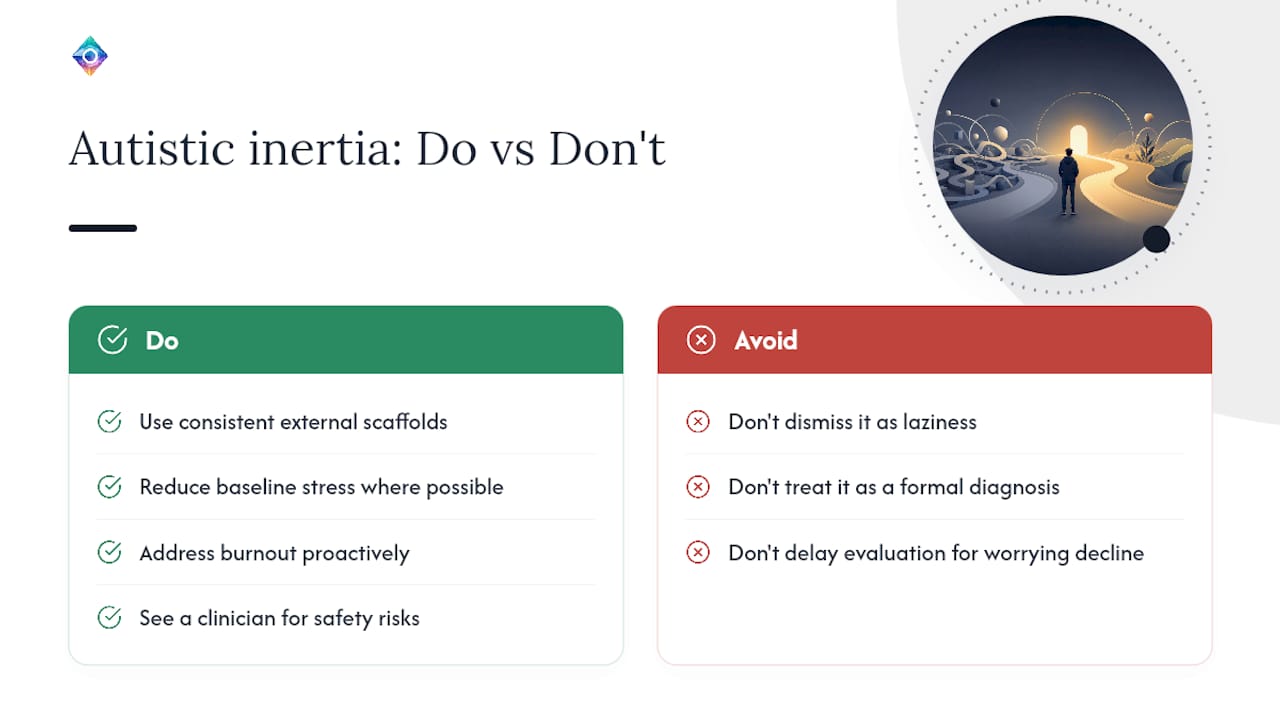
- Know when to escalate to clinical support. If inertia is accompanied by sudden severe functional decline, safety concerns, or signs resembling catatonia, self-strategies aren't the right tool. That calls for a clinician, not a better checklist.
Pro Tip: Keep a running list of two or three "compatible activities" that reliably work for you, things like folding one item of laundry or opening (not answering) an email, so you're not trying to invent a bridge task in the middle of a freeze.
Overcoming autistic inertia is less about a single trick and more about stacking small, externally anchored interventions until one of them catches. What works on a low-stress Tuesday might fail during a burnout week, and that's not a personal failure. It's the wellbeing factor the Frontiers researchers identified doing exactly what it does.
How Can Families, Teachers, and Managers Support Someone With Inertia?
Supporting someone through autistic inertia starts with dropping the assumption that they need more motivation. What they usually need is a smaller first step and a cue that doesn't rely on their own internal timing.
- Prompt with specifics, not generalities. "Let's put on your left shoe" works better than "get ready to go," because it hands over the exact first physical action instead of the whole abstract task.
- Offer to co-start, not just remind. Standing next to someone while they begin a task, or starting alongside them, uses the same body-doubling mechanism that helps adults manage stop inertia at work.
- Build transition buffers into schedules. In classrooms and workplaces, a five-minute warning before a task switch, paired with a concrete cue like a visual timer, reduces the shock of an abrupt demand to switch gears.
- Avoid framing missed tasks as a discipline problem. Educational guidance on task initiation strategies is explicit that treating initiation failure as defiance backfires, increasing shame and, per the vicious-cycle pattern documented in community research, deepening the inertia itself.
- Connect tasks to personal relevance where possible. Framing an assignment or chore around something the person already cares about lowers the activation barrier more reliably than a deadline does.
Pro Tip: Ask the person directly which specific phrasing or cue helps them start, rather than guessing. What sounds encouraging to you might land as pressure, and what sounds blunt to you might be exactly the clear signal their brain needs.
Academic settings benefit from structured, consistent scaffolding delivered by people trained in breaking tasks into manageable steps. Programs like WonPrep's tutoring services build this kind of step-by-step structure into their academic support model, which can be a useful complement for autistic students who need transition support built into their study routine rather than added as an afterthought.
When Should You Seek Clinical Help for Autistic Inertia?
Most autistic inertia is manageable with the scaffolding strategies above, and it doesn't require urgent intervention. Some presentations do.
Watch for these red flags:
- Sudden onset of severe functional decline, especially if someone who previously managed daily tasks independently stops being able to eat, wash, or move without help.
- Signs resembling catatonia: rigid posturing, repetitive purposeless movement, mutism, or being physically frozen in place for extended periods.
- Safety risks, including inability to respond to danger, extreme self-neglect, or missed essential medication.
- A marked shift alongside mood changes, which may signal co-occurring depression or burnout rather than inertia alone.
If any of these appear, a clinical evaluation, ideally with a clinician familiar with autism, is the right next step rather than trying a new coping technique first. Before an appointment, keep a simple log: what tasks trigger the freeze, how long it lasts, what helps or doesn't, and whether it's new or long-standing. That record gives a clinician far more to work with than a general description of "trouble getting things done."
Can a Self-Assessment Help You Understand Your Own Inertia Patterns?
Autistic inertia rarely shows up alone. It tends to travel with related traits, executive function differences, sensory sensitivities, masking habits, that shape exactly how it presents for you. Omniprism's self-assessment covers 14 domains, including executive function, sensory processing, and masking, and generates an instant plain-language profile without requiring weeks of tracking or a formal referral.
That kind of mapping is useful precisely because inertia mechanisms differ person to person. Someone whose profile points heavily toward sensory overload will benefit from different first moves than someone whose pattern centers on motor initiation differences. A structured profile can help you and a clinician prioritize which scaffolding strategies from this article are worth trying first.
- Instant results across all 14 domains, with no data tracking required.
- Guided versions available for young people ages 11 to 13 and children ages 7 to 10, useful for families trying to understand a child's transition struggles at school or home.
- Results are designed in plain language, meant to support a conversation with a clinician, not replace one.
The full methodology behind how Omniprism generates its profiles is publicly available if you want to understand the approach before using it.
Why Understanding Beats Willpower Every Time
The biggest misread on autistic inertia, and I'd argue the most damaging one, is treating it as a character flaw that responds to pressure. It doesn't. Every piece of research cited here, from the Frontiers focus groups to the community discourse analysis, points the same direction: external structure works, internal pressure backfires.
What gets underestimated is how much shame accelerates the problem. The vicious-cycle finding in the community research isn't a side note, it's arguably the most important practical insight in the whole field right now. Berating yourself, or someone else, for not starting a task doesn't just fail to help. It actively raises the stress that makes the next freeze more likely.
I'd also push back gently on treating inertial motion as purely a problem to fix. The flow states some autistic adults describe, hours of uninterrupted, joyful focus, are a genuine strength when the crash afterward is managed. The goal isn't to eliminate inertia. It's to build enough scaffolding that the disabling side loses ground without flattening the enabling side along with it. If you're building supports for yourself or someone else, that distinction should guide every choice you make. Where symptoms overlap with ADHD, depression, or possible catatonia, professional assessment should always sit alongside self-directed strategies, not replace them.
Frequently Asked Questions
Is autistic inertia the same as laziness or procrastination? No. Procrastination usually involves an available path to start that someone avoids; autistic inertia often means the path to starting isn't accessible at all, even with full motivation and no aversion to the task.
Does autistic inertia affect all autistic people the same way? No. Some people experience mostly start inertia, others mostly stop inertia, and severity fluctuates with stress, sensory load, and overall wellbeing, based on the four-theme pattern identified in the Frontiers focus-group research.
Can autistic inertia improve over time? Yes, for many people it fluctuates rather than staying fixed. Reducing baseline stress, building consistent external scaffolds, and addressing burnout tend to ease inertia, though it rarely disappears entirely.
Is autistic inertia a formal diagnosis? No. It's a well-documented lived experience and research construct, not a standalone diagnostic category. It's typically understood as a feature of autism rather than a separate condition.
Should I talk to a doctor about autistic inertia? If it causes significant safety risks, sudden functional decline, or overlaps with signs of depression or catatonia, yes. For milder, fluctuating patterns, scaffolding strategies are often the first reasonable step before a clinical evaluation.
This article is general information, not a substitute for advice from a qualified doctor. Consult a qualified healthcare professional about your own circumstances before acting on anything here.
Sources
- “No Way Out Except From External Intervention”: First‑Hand Accounts of Autistic Inertia
- ‘I live in extremes’: A qualitative investigation of Autistic adults’ experiences of inertial rest and motion
- Understanding phenomenological experiences of autistic inertia using online community discourse
- Task initiation and autism: executive functioning skills