

Autistic burnout is an energy-and-capacity collapse driven by chronic masking and sensory or social overload. Depression is a mood disorder defined by persistent low mood and loss of interest or pleasure. The two can look alike from the outside, and they can occur together, but the underlying drivers and the most helpful responses differ in ways that matter for your next steps.
Quick signals to check right now:
- Does rest, a quieter environment, or reduced demands make you feel meaningfully better? That pattern points toward burnout.
- Is low mood, hopelessness, or a loss of pleasure in things you normally care about the dominant feature, even when demands are low? That pattern points toward depression.
- Have you lost skills you previously had, such as cooking, driving, or speaking fluently, especially after a period of intense masking or overload? Skill regression is a burnout hallmark.
- Are you having thoughts of suicide or self-harm, or has your ability to manage basic daily functioning completely collapsed? Get urgent help now.
Key Takeaways
Autistic burnout and depression share surface symptoms but differ in cause, trajectory, and what actually helps, and getting that distinction right shapes every next step.
| Point | Details |
|---|---|
| Core difference | Burnout is a capacity collapse from masking and overload; depression is a mood disorder with anhedonia and persistent low mood. |
| Immediate safety step | Suicidal thoughts require urgent help now, call or text 988, regardless of which condition is present. |
| Burnout recovery priority | Reduce demands and sensory load first; rest and accommodation often improve functioning when burnout is the primary driver. |
| When depression needs clinical care | Persistent anhedonia, hopelessness, or low mood lasting two or more weeks warrants a clinician visit and possible PHQ-9 screening. |
| Omniprism for preparation | Omniprism's free profile across masking, sensory, and executive domains gives you structured language to bring to a clinician appointment. |
Table of Contents
- How do autistic burnout and depression compare?
- What is autistic burnout, exactly?
- What is clinical depression, and how does it look in autistic people?
- How do you tell autistic burnout and depression apart?
- What causes autistic burnout to build up?
- Can burnout and depression occur together?
- How management differs for burnout versus depression
- What should you track and how do you prepare for a clinician visit?
- The difference between knowing and being believed
- Omniprism can help you prepare for that conversation
- Sources
How do autistic burnout and depression compare?
The table below maps the most clinically useful differences. No table replaces a clinician's assessment, but it can help you identify which pattern fits your experience before that conversation.
| Feature | Autistic Burnout | Clinical Depression |
|---|---|---|
| Typical triggers/onset | Prolonged masking, sensory overload, life transitions, chronic lack of accommodations | Can arise without a clear external trigger; may follow loss, trauma, or accumulate gradually |
| Core symptoms | Exhaustion, loss of previously held skills, executive dysfunction, heightened sensory sensitivity, social withdrawal, increased stimming | Persistent low mood, anhedonia (loss of pleasure), sleep/appetite changes, concentration problems, feelings of worthlessness |
| Duration/timeline | Days to years; often chronic or episodic; tied to demand levels | Weeks to months per episode; responds to clinical treatment over time |
| Role of masking | Central driver; masking effort directly depletes capacity | Masking may worsen depression in autistic people but is not the primary cause |
| Response to rest/accommodation | Functioning often improves when demands are reduced and sensory environment is adjusted | Rest alone rarely resolves depression; clinical treatment (therapy, medication) is usually needed |
| When to seek professional help | When functioning has collapsed, suicidal ideation is present, or burnout is not improving after weeks of reduced demands | Immediately if suicidal ideation is present; also when low mood and anhedonia persist for two or more weeks |
Three checks you can run on your situation right now:
- Track whether a genuinely quieter, lower-demand day produces any relief. Even partial improvement is a signal.
- Notice whether anhedonia (not just tiredness, but a flat absence of pleasure) is present even on low-demand days.
- Ask yourself whether you recently came out of a period of intense social performance, sensory exposure, or life change. A clear precipitating overload period is a strong burnout indicator.
What is autistic burnout, exactly?
The working definition most researchers now use traces back to Raymaker et al. (2020), developed through the AASPIRE research partnership with autistic adults. Their framework describes burnout as a syndrome of exhaustion, loss of skills, and reduced tolerance to stimuli that results from chronic life stress and a mismatch between demands and capacity, particularly when masking is required.
A systematic review synthesizing 48 studies involving approximately 4,000 autistic people described burnout as a debilitating state of exhaustion with increased disability, often chronic with intermittent crises. The review identified sensory and social overwhelm, camouflaging, and lack of accommodations as the primary contributors.
Core features that distinguish burnout from other forms of exhaustion:
- Skill regression: Tasks that were previously automatic, such as cooking, driving, or holding a conversation, become difficult or impossible. This is not laziness; it reflects depleted executive and sensory processing capacity.
- Heightened sensory sensitivity: Sounds, lights, textures, and social stimulation that were previously tolerable become overwhelming.
- Increased stimming: Repetitive movements or behaviors often intensify as the nervous system attempts to self-regulate under strain.
- Social withdrawal: Not preference, but necessity. Interaction costs more than the person has available.
- Executive dysfunction: Planning, initiating tasks, and switching between activities become significantly harder.
The autismCRC final report on autistic burnout notes that burnout is distinct from depression in key ways, though the two commonly correlate and burnout can lead to depression over time.
Duration matters. According to The Conversation's research-informed synthesis, autistic burnout can last days to years. Without systemic change or meaningful accommodation, some people never fully recover from a given episode.
What is clinical depression, and how does it look in autistic people?
NIMH defines major depressive disorder by a cluster of symptoms persisting for at least two weeks: persistent low or empty mood, loss of interest or pleasure in nearly all activities (anhedonia), significant changes in sleep or appetite, difficulty concentrating, feelings of worthlessness or guilt, and in severe cases, recurrent thoughts of death or suicide.
Core clinical markers:
- Anhedonia is the most diagnostically specific feature. When things you normally enjoy produce no response at all, that is a depression signal rather than a burnout signal.
- Sleep and appetite changes tend to be pervasive in depression, not just present on high-demand days.
- Concentration problems in depression often feel like mental fog that persists regardless of sensory environment.
- Suicidal ideation, when present, requires immediate clinical attention regardless of whether burnout or depression is the primary driver.
Depression in autistic individuals can look atypical. Emotional expression may be muted, or distress may show up as increased rigidity, irritability, or physical complaints rather than visible sadness. This means standard screening tools can undercount severity. The PHQ-9, the most widely used depression screener in primary care, is a useful starting point for clinicians, but it was not designed with autistic presentations in mind. A score on the PHQ-9 opens a conversation; it does not close one.
Autistic people are at elevated risk for depression compared to the general population. The cross-sectional study by Cassidy et al. found that more than 70% of autistic adults in their sample scored in the clinical range for depression, though the study's design means causal direction cannot be assumed.
How do you tell autistic burnout and depression apart?
The most useful practical questions are about onset, triggers, and what actually helps.
Questions to ask yourself:
- What happened in the weeks or months before symptoms appeared? A period of intense masking, a major life transition, or a stretch of sensory overload points toward burnout.
- Does reducing demands, even for a day or two, produce any noticeable improvement in functioning? If yes, burnout is the more likely primary driver.
- Is low mood the dominant experience, or is exhaustion and loss of capacity the dominant experience? Both can be present, but which came first matters.
- Have you lost skills you previously had? Skill regression is a burnout feature, not a depression feature.
- Is there a pervasive loss of pleasure even in activities that require no energy and no masking?
Red flags that point toward depression:
- Persistent hopelessness that does not lift even after rest
- Anhedonia that spans all domains, including solitary, low-demand activities
- Suicidal ideation or plans
Red flags that point toward burnout:
- Skill regression following a high-demand period
- Sensory intolerance that improves when the environment is adjusted
- Functioning that tracks closely with demand levels
For your clinician visit, bring:
- A timeline of when symptoms started and what preceded them
- Notes on masking history: how much social performance you sustain daily, and for how long before symptoms appeared
- Examples of any skill regression (specific tasks you can no longer do)
- Sensory changes: what has become intolerable and when that shifted
- A PHQ-9 score if you have completed one, with the caveat that it may not capture the full picture
- Any results from the AASPIRE Autistic Burnout Measure (AABM) or the Autistic Burnout Measure (ABM), which were developed specifically to quantify burnout severity
Pro Tip: Behavioral activation, a standard first-line technique for depression, can worsen autistic burnout. If a clinician suggests pushing through fatigue or increasing social activity before addressing the underlying overload, that approach may be counterproductive for burnout. You have the right to ask whether accommodations and demand reduction will be part of the plan.
What causes autistic burnout to build up?
Burnout rarely arrives suddenly. It accumulates. The autism.org.uk guidance on autistic fatigue describes how daily sensory and social processing costs add up over time, eventually exceeding the person's capacity to recover between demands.
The most common contributors:
- Masking and camouflaging: Suppressing autistic traits, mirroring neurotypical social behavior, and managing others' comfort costs significant cognitive and emotional energy. Done daily, it is one of the most consistent predictors of burnout.
- Sensory overload: Open-plan offices, fluorescent lighting, crowded transit, unpredictable noise. Each exposure is a small withdrawal from an already limited energy account.
- Life transitions: Starting college, changing jobs, moving, becoming a parent. Transitions require new masking scripts and new sensory environments simultaneously.
- Chronic unmet accommodation needs: When the environment never adjusts to the person, the person must perpetually adjust to the environment. That asymmetry is exhausting over months and years.
- Comorbid health conditions: Chronic pain, sleep disorders, ADHD, and anxiety all reduce the baseline capacity available to absorb daily demands.
Camouflaging is not a choice people make lightly. Research shows it is often a survival strategy in environments that penalize visible autistic traits. The cost is real and cumulative, and it is one reason burnout disproportionately affects autistic people who have spent years passing as neurotypical.
A school-aged child masking all day, then melting down at home, is showing the same basic dynamic as an adult who performs well at work and collapses on weekends. For younger people navigating school environments, ongoing support that extends beyond the classroom can meaningfully reduce the cumulative load.
Can burnout and depression occur together?
Yes, and frequently. The cross-sectional study on camouflaging and burnout found that social camouflaging and burnout-exhaustion were positively correlated with depression scores in a sample of autistic adults, and that burnout-exhaustion partially mediated the relationship between camouflaging and depression. Because the study was cross-sectional, it cannot establish which came first.
The plausible mechanism runs in both directions. Prolonged burnout depletes coping capacity, erodes self-worth, and can produce the persistent low mood and anhedonia that meet criteria for a depressive episode. Conversely, untreated depression deepens exhaustion and makes it harder to reduce masking or advocate for accommodations, which sustains the burnout.
Burnout and depression are not mutually exclusive diagnoses. The autismCRC report notes that burnout may lead to or interact with depression, and that differential diagnosis requires attention to both the timeline and the specific symptom profile. Treating only one when both are present will produce incomplete recovery.
The practical implication: if you have been in burnout for months and low mood has become a persistent, pervasive feature rather than a situational response to overload, it is worth screening for depression alongside burnout, not instead of it.
How management differs for burnout versus depression
The approaches are not interchangeable, and applying the wrong one can delay recovery.
For autistic burnout, the priority is reducing load:
- Identify and remove the highest-cost demands first. Not all demands are equal; some are discretionary.
- Adjust the sensory environment: reduce noise, lighting, and unpredictability where possible.
- Build in genuine recovery time, not just shorter work days but actual unstructured, low-stimulation rest.
- Practice unmasking in safe contexts. Allowing autistic traits to be visible, even partially, reduces the energy cost of daily functioning.
- Return to activity gradually and only when capacity has meaningfully recovered, not on a fixed schedule.
Workplace accommodations, such as remote work, flexible hours, and reduced open-plan exposure, can be part of a sustainable plan. Resources on inclusive practices for neurodivergent team members offer practical framing for those conversations with employers.
For clinical depression, evidence-based treatment is the foundation:
- Cognitive behavioral therapy (CBT) and other structured psychotherapies have strong evidence for major depressive disorder.
- Antidepressant medication is appropriate for moderate to severe depression and is often used alongside therapy.
- Behavioral activation, which involves gradually re-engaging with meaningful activities, is effective for depression but should be introduced carefully when burnout is also present.
When both are present:
- Address the overload drivers first. Depression that is being continuously fed by burnout will not fully respond to therapy or medication alone.
- Work with a clinician who understands autistic presentations. Misapplied behavioral activation can worsen burnout even while targeting depression.
- Expect a longer timeline. Recovery from combined burnout and depression typically takes months, not weeks.
Pro Tip: Bring a one-page summary of your masking history, sensory changes, and demand timeline to your first appointment. A concise written summary helps clinicians who are less familiar with autistic burnout understand the context quickly, and it reduces the cognitive load of explaining everything verbally when you are already depleted.
What should you track and how do you prepare for a clinician visit?
Two to four weeks of simple self-monitoring gives you and your clinician far more to work with than a single appointment snapshot.
Track daily (a few lines is enough):
- Energy level on waking and by end of day
- Sensory tolerance: what felt manageable versus overwhelming
- Masking effort: how much social performance the day required
- Mood: not just low or high, but whether pleasure or interest was present at any point
- Sleep quality and appetite changes
- Any tasks you could not complete that you normally can
Before your appointment:
- Write a timeline: when did symptoms start, and what was happening in the weeks before?
- List specific examples of skill regression or functioning loss.
- Note the context of demands: work, school, family, social obligations.
- Complete a PHQ-9 (freely available online) and bring the score, with the note that it may underrepresent autistic depression presentations.
- If you have access to the AABM or ABM, complete it and bring results.
- Summarize your masking history: how long, in what contexts, and at what cost.
Self-assessment tools, including Omniprism's free neurodivergence profile, can help you identify patterns across domains like masking, sensory processing, and executive function before that conversation. They are not diagnostic, and they do not replace a clinician's evaluation, but a structured profile across relevant domains gives you concrete language to use.
For parents monitoring a school-aged child, the Omniprism guided assessment for ages 7–10 and the assessment for ages 11–13 follow the same structured approach and can help frame conversations with pediatricians or school psychologists.
The difference between knowing and being believed
There is a particular kind of exhaustion that comes from not having a name for what is happening to you. You know something is wrong. You know it is not simply laziness or a bad attitude. But without language, without a framework, it is hard to ask for what you need, and harder still to be taken seriously when you do.
The distinction between autistic burnout and depression is not just clinical. It is practical. When you understand that your functioning collapses because your capacity has been depleted, not because your mood is disordered, you stop blaming yourself for not pushing through. You start looking for what to remove rather than what to add. That shift alone can change the trajectory of recovery.

Both conditions deserve care. Neither is a character flaw. And the fact that they can coexist does not mean you have to figure out which one to address first on your own. What it does mean is that you deserve a clinician who takes the time to understand the difference, and that you are allowed to ask for that.
Omniprism can help you prepare for that conversation
Knowing you are in burnout or depression is one thing. Walking into a clinician's office and explaining it clearly, when you are already depleted, is another challenge entirely.
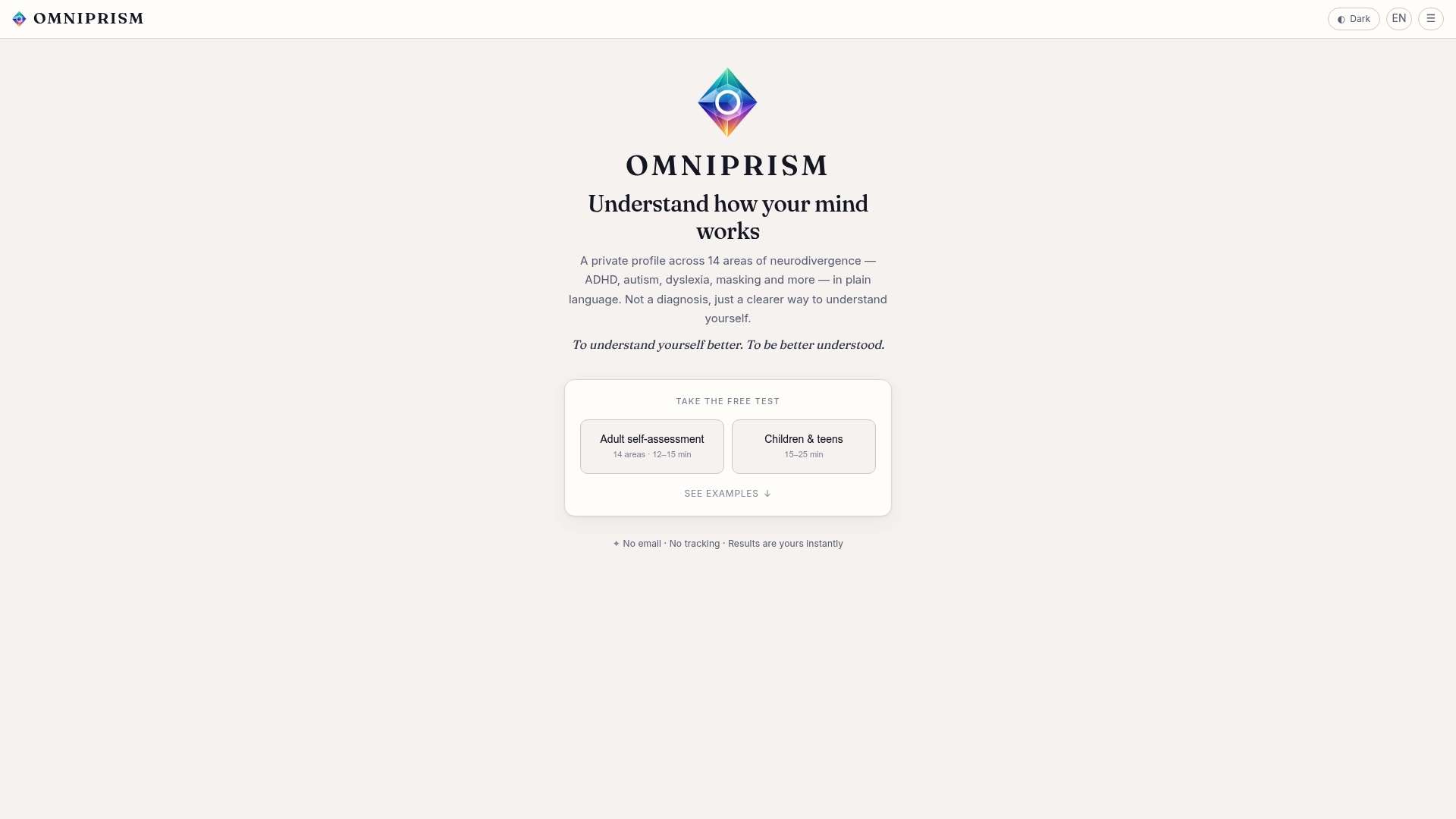
Omniprism's free self-assessment generates an instant profile across 14 domains, including masking, sensory processing, and executive function, in plain language you can hand to a clinician or use as a starting point for your own reflection. No data is collected, no tracking, no lengthy evaluation process. If you want a more detailed summary to share with a specialist, the optional Specialist Briefing report organizes your results into a one-page clinical-ready document. Omniprism is not a diagnostic tool and cannot determine whether you have burnout or depression. Only a qualified clinician can do that. But it can give you structured, specific language to bring into that room. See how the assessment works and take the first step toward a more informed conversation.
Sources
This article is general information, not a substitute for advice from a qualified doctor. Consult a qualified healthcare professional about your own circumstances before acting on anything here.