

Autism primarily affects social communication and drives restricted, repetitive behaviors. ADHD primarily disrupts attention regulation and impulse control. These are separate conditions with separate diagnostic criteria in the DSM-5-TR, but they overlap constantly in real life.
That overlap isn't rare. Research shows 40 to 70 percent of autistic people show significant ADHD traits, and a smaller but meaningful share of people diagnosed with ADHD meet full autism criteria too. The DSM-5 dropped its old rule barring both diagnoses in 2013, so clinicians now regularly diagnose both when the evidence supports it.
Here's the fast version before we go deep:
- Autism: differences in social reciprocity, nonverbal communication, and restricted or repetitive behaviors.
- ADHD: difficulty regulating attention, impulse control, and activity level.
- Both: executive function struggles, sensory sensitivity, and a documented tendency to co-occur, sometimes called AuDHD.
- Sources: the CDC and a 2024 clinical review both confirm frequent overlap and diagnostic complexity.
Key Takeaways
Autism and ADHD are distinct diagnoses that frequently co-occur, and distinguishing them requires looking at social communication, repetitive behavior, attention regulation, and executive function together, not in isolation.
| Point | Details |
|---|---|
| Core distinction | Autism centers on social communication and restricted behaviors; ADHD centers on attention and impulse regulation. |
| Overlap is common | Up to 40 to 70 percent of autistic people show significant ADHD traits, per a 2024 clinical review. |
| AuDHD is descriptive, not diagnostic | It names how autistic rigidity and ADHD impulsivity compound sensory and executive challenges, not a DSM category. |
| Masking delays diagnosis | Girls, women, and many adults get missed because masking hides traits until later in life. |
| Prepare before evaluation | Omniprism's free 14-domain self-assessment helps structure what you bring to a clinician. |
Table of Contents
- Autism vs ADHD: How the Core Symptoms Actually Differ
- What Happens When Autism and ADHD Overlap (AuDHD)
- How Do Clinicians Tell Autism and ADHD Apart?
- Do Autism and ADHD Need Different Treatments?
- Why Masking Hides Autism and ADHD, Especially in Women
- What to Do Before an Autism or ADHD Evaluation
- Weighing Self-Reflection Against a Clinical Diagnosis
- Preparing for a Clinician Conversation With Omniprism
- Sources
Autism vs ADHD: How the Core Symptoms Actually Differ
The clearest place to separate autism from ADHD is social behavior, even though both can make social situations exhausting.
Autistic people often struggle with the back-and-forth flow of conversation, missed nonverbal cues, or a strong preference for routine and predictable interaction. Someone with ADHD, by contrast, tends to interrupt, lose the thread of a conversation, or say something impulsive, not because they misread social cues but because their attention jumped elsewhere. The DSM-5-TR frames autism around social communication deficits and restricted/repetitive patterns, while ADHD criteria center on inattention, hyperactivity, and impulsivity.
A few domains where the split shows up most clearly:
- Attention style. Autistic focus often looks like hyperfocus on a narrow interest for hours; ADHD attention is inconsistent, drifting even during tasks the person cares about.
- Repetitive behavior and sensory response. Stimming, insistence on sameness, and strong sensory reactions are far more characteristic of autism than ADHD.
- Executive function pattern. A 2024 PMC clinical review found ADHD tends to show up as weaker inhibition and sustained attention, while autism shows up more as cognitive inflexibility, trouble shifting between tasks or accepting a change of plan.
- Movement and impulsivity. Hyperactivity and blurting things out track with ADHD; autism doesn't inherently include either.
Fast fact: the same 2024 review notes that 40 to 70 percent of autistic children display clinically significant ADHD symptoms, which is exactly why clinicians rarely treat these as an either/or question anymore.
What Happens When Autism and ADHD Overlap (AuDHD)
"AuDHD" isn't a diagnosis you'll find in the DSM-5-TR. It's a term the autistic and ADHD communities coined, and organizations like Autistica and the Child Mind Institute now use it to describe the specific way these two conditions interact rather than simply coexist.
The combination tends to intensify certain struggles rather than just adding them up:
- Executive dysfunction gets worse when autistic rigidity meets ADHD's inconsistent follow-through.
- Sensory overload compounds with impulsivity, since someone might rush into an overwhelming environment before registering the sensory cost.
- Emotional regulation takes a double hit: autistic meltdown triggers plus ADHD's rejection sensitivity.
Prevalence numbers vary a lot depending on method. Trait-based surveys that ask about symptoms broadly report far higher overlap than formal dual-diagnosis rates from clinics, which require both conditions to meet full diagnostic thresholds. That gap explains why one article might say "half of autistic people have ADHD" while a diagnostic clinic reports a smaller figure.
The internal conflict is real and specific. Autistica describes it as autistic routine-seeking colliding with ADHD's novelty-seeking. Picture someone who needs the same morning routine every single day to feel steady, but whose ADHD brain is already bored with it by Tuesday. That tension, not just symptom addition, is what AuDHD is trying to name.

How Do Clinicians Tell Autism and ADHD Apart?
Differentiating the two takes more than a single questionnaire, because the PMC review notes both conditions overlap in executive function, social function, and emotional regulation. A thorough evaluation usually pulls from several sources at once:
- Developmental history, including early language milestones, play patterns, and school reports going back years.
- Multi-informant reports from parents, teachers, or partners, since self-report alone misses a lot, especially in adults.
- Standardized screening tools for both conditions, used to flag likelihood, not confirm diagnosis.
- Structured clinical observation, watching how someone interacts, focuses, and responds to sensory input in real time.
- DSM-5-TR criteria applied by a qualified clinician, cross-checking symptoms against both symptom sets.
Age patterns differ too. Autism is often flagged earlier, sometimes before age 3, because delayed language or unusual play patterns draw attention. ADHD frequently isn't diagnosed until school demands sustained attention and impulse control the child can't yet produce. Adults in both categories often go years without a diagnosis, and it's common for one condition to surface in adulthood only after the other is already identified and treated.
Pro Tip: Bring specific, dated examples to an evaluation, not general impressions. "Melts down when the bus route changes" carries more diagnostic weight than "gets upset easily."
Masking complicates this further, especially for girls and women, who often learn to script social interactions or suppress stimming well enough to avoid clinical suspicion. Specialists worth consulting include developmental pediatricians, neuropsychologists, and psychiatrists experienced in adult presentations, not just pediatric ones.
Do Autism and ADHD Need Different Treatments?
Treatment pathways diverge because the underlying challenges differ. The American Psychiatric Association points out that ADHD care often includes FDA-approved medication, stimulant or nonstimulant, alongside behavioral coaching and classroom or workplace accommodations. Autism support leans more on behavioral therapy, communication and social skills work, plus sensory and environmental adjustments, since there's no medication that treats autism itself.
When both are present, care gets more individualized, not simpler:
- Medication tolerability can shift, since some autistic people react more strongly to stimulant side effects.
- Behavioral plans need to account for both rigidity and impulsivity at once, not treat them as the same problem.
- Sensory accommodations (lighting, noise, seating) often help both conditions simultaneously.
- Ongoing monitoring matters more, since one condition's treatment can change how the other presents.
The Frontiers review is blunt about this: co-occurring cases need multidisciplinary, tailored plans rather than a standard protocol borrowed from either condition alone.
Why Masking Hides Autism and ADHD, Especially in Women
Masking means consciously suppressing traits to fit in: forcing eye contact, scripting small talk, or hiding stimming behind fidgeting with a pen instead. It's exhausting, and it's a major reason diagnoses get delayed or missed entirely.
Girls and women are disproportionately affected. Clinicians historically built diagnostic criteria around how autism and ADHD present in boys, so quieter, more internalized presentations get overlooked. National Geographic's reporting on AuDHD documents something clinicians are seeing more often now: starting ADHD medication sometimes reveals autistic traits that impulsivity and inattention had been obscuring for years.
Watch for these signs in teens and adults:
- Persistent executive dysfunction despite clearly trying harder than peers.
- Sensory fatigue after ordinary social situations that others seem to shrug off.
- A pattern of social exhaustion followed by needing to withdraw and recover.
Pro Tip: If a new ADHD diagnosis and medication resolve some symptoms but sensory or social struggles persist, that gap is worth raising directly with your clinician. For adults noticing these patterns for the first time, this overview of late ADHD identification walks through why so many go undiagnosed until well into adulthood.
What to Do Before an Autism or ADHD Evaluation
Preparation makes evaluations faster and more accurate, and it doesn't require a medical background.
- Track specific examples over two to three weeks: what happened, where, and how the person responded. Patterns matter more than a single bad day.
- Use screening tools as a signal, not a verdict. They flag likelihood; only a full evaluation confirms anything.
- Write down direct questions for the clinician: what assessments will be used, how long results take, and what happens if both conditions apply.
- Bring documentation for school or work, past report cards, performance reviews, or prior evaluations if any exist.
- Use short-term strategies while you wait: consistent routines, sensory adjustments like noise-canceling headphones, and simple executive-function scaffolds like visual schedules.
Weighing Self-Reflection Against a Clinical Diagnosis
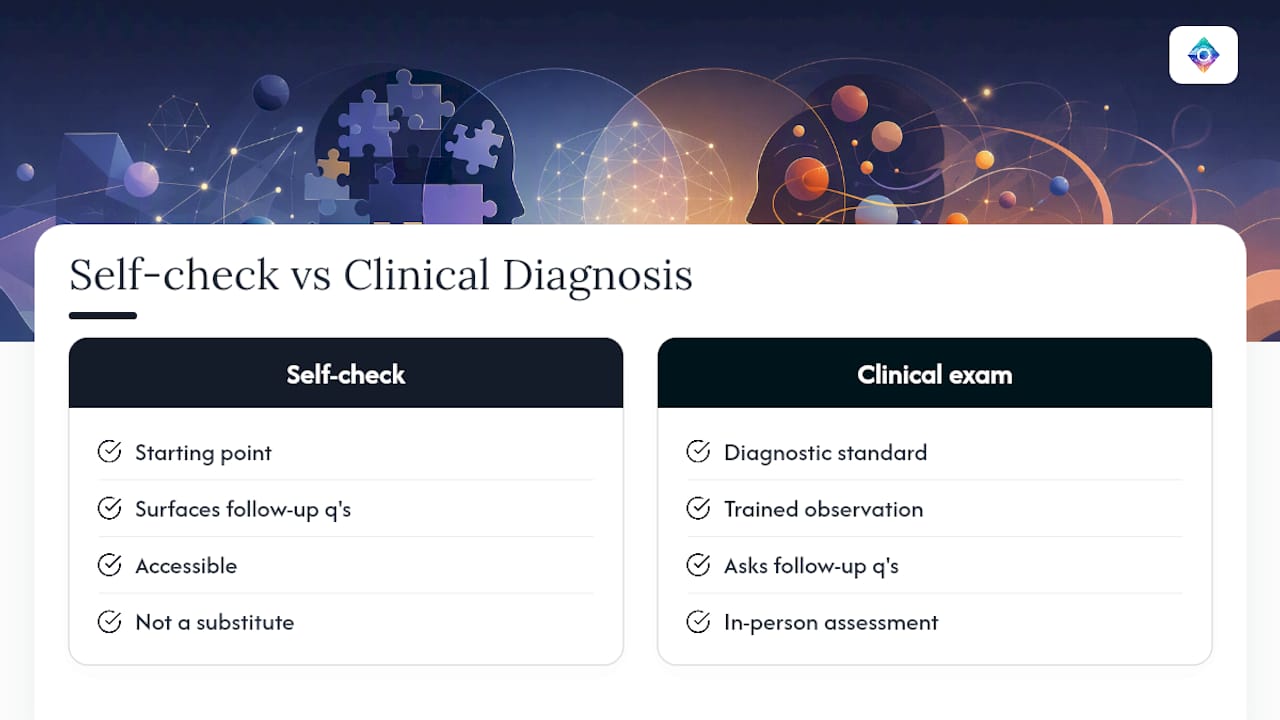
Symptom checklists are useful, but they're a starting point, not an answer. What surprises people most in this research isn't that autism and ADHD overlap. It's how often one diagnosis sits hidden behind the other for years, simply because nobody asked the right follow-up question. Self-assessment tools can surface that follow-up question before a clinician ever does. That's valuable. It's also not a substitute for someone trained to sit across from you and actually look.
Preparing for a Clinician Conversation With Omniprism
Getting a clearer picture of your own patterns before an appointment can change how that appointment goes. Omniprism's self-assessment tool generates an instant profile across 14 domains, including ADHD, autism, sensory processing, and executive function traits, giving you specific language for what you've been living with instead of a vague sense that "something's different."
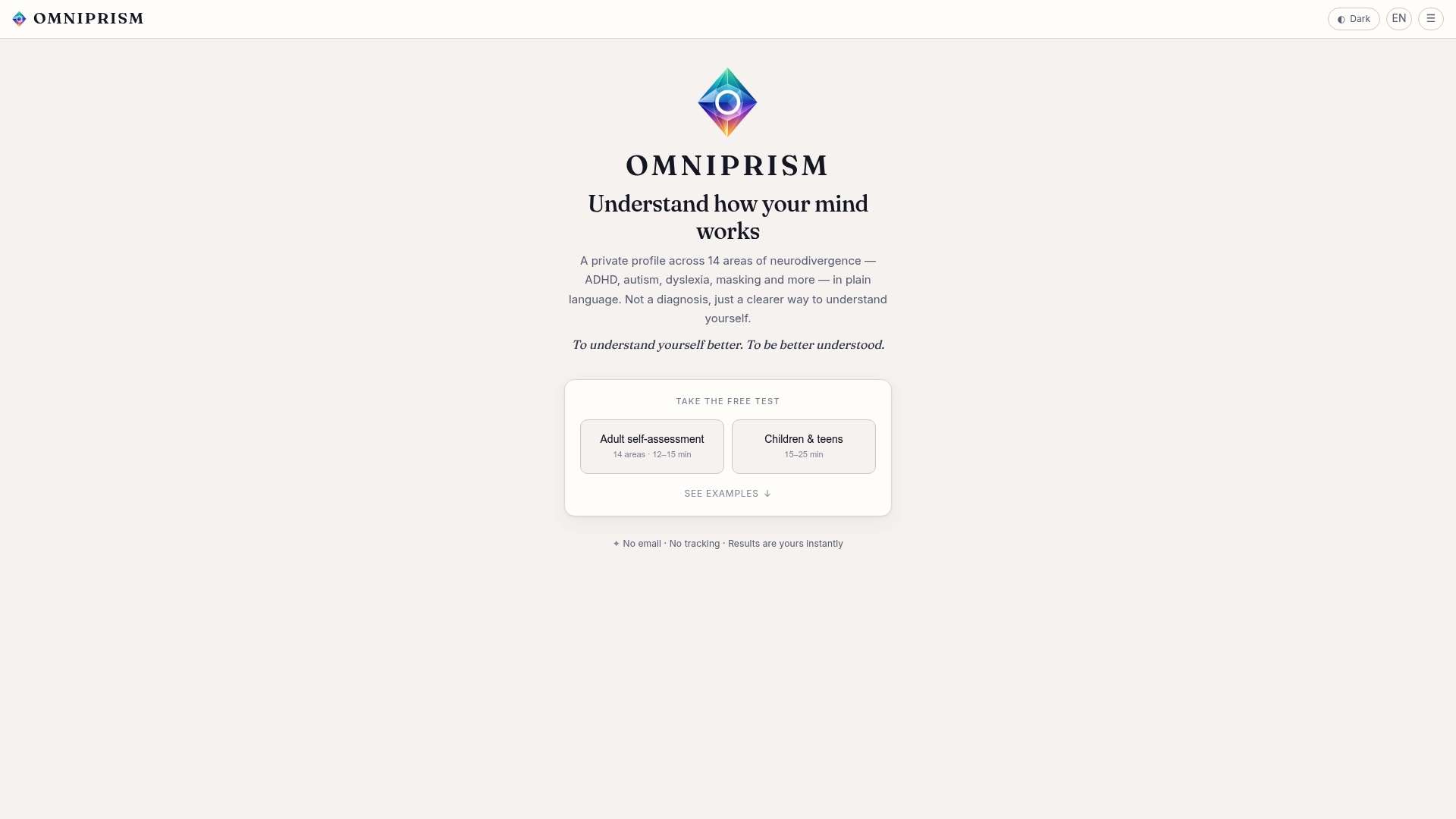
It's built for accessibility, not diagnosis: no data collection, no waitlist, results in plain language you can read in minutes. Parents can use guided assessments designed for children ages 7 to 10 or young people ages 11 to 13, which walk families through the process with age-appropriate framing. Adults and families who want something more formal to bring into a clinical conversation can generate an optional Specialist Briefing report summarizing results in a format built for clinicians. None of this replaces a developmental pediatrician, neuropsychologist, or psychiatrist. It just means you can walk into that room with real language instead of guesswork. Start with the free self-assessment and see where your own profile lines up.
Sources
- Autism spectrum disorder — CDC
- Unraveling the spectrum: overlap, distinctions, and nuances of ADHD and ASD in children — Frontiers in Psychiatry
- Attention-deficit Hyperactivity Disorder and Autism Spectrum ... — PMC
- ADHD and autism — Autistica
- Scientists are starting to understand how autism and ADHD can overlap — National Geographic