

ADHD and OCD are distinct conditions. ADHD is a neurodevelopmental, externalizing disorder defined by persistent inattention, hyperactivity, and impulsivity. OCD is an anxiety-based, internalizing disorder defined by unwanted obsessions and the compulsive rituals people use to neutralize them. They are not the same condition, and they do not respond to the same treatments.
That said, they can look strikingly similar in daily life. A child who can't stop checking their homework may have OCD, ADHD, or both. An adult who loses track of conversations mid-sentence may be struggling with inattention or with intrusive thoughts consuming their working memory. The difference matters enormously for treatment.
A few things to know right now:
- ADHD symptoms are persistent across settings and tied to a developmental pattern, not to specific triggering thoughts.
- OCD symptoms are driven by obsessions (unwanted, distressing thoughts) and compulsions (rituals performed to reduce that distress).
- Both conditions can co-occur, and clinicians should evaluate whether attention problems are primary or secondary to anxiety and obsessions.
- This article is informational. It is not a diagnosis. If you recognize these patterns in yourself or your child, a licensed clinician is the right next step.
Pro Tip: Before your first clinical appointment, bring a written timeline of when symptoms first appeared, a list of specific behaviors you've observed (with examples), any school or work performance records, and a summary of medications or supplements tried. Concrete details help clinicians distinguish primary from secondary attention problems far faster than a general description.
Key Takeaways
| Point | Details |
|---|---|
| Core distinction | ADHD is externalizing and neurodevelopmental; OCD is internalizing and anxiety-driven. |
| Co-occurrence rates | Around 11.8% overall; pediatric estimates reach 25.5% in some studies, with higher severity when both are present. |
| Executive overload | OCD's intrusive thoughts can produce ADHD-like attention deficits; treating OCD first often resolves secondary inattention. |
| Treatment approach | CBT with ERP and SSRIs for OCD; stimulants and behavioral CBT for ADHD; integrated treatment when both are present. |
| Omniprism | A free 14-domain self-assessment that helps adults and families prepare structured clinician briefings before evaluation. |
Table of Contents
- How do ADHD and OCD differ in core symptoms?
- Why ADHD and OCD can look so similar
- How often do ADHD and OCD co-occur?
- How do clinicians tell ADHD and OCD apart?
- What does the overlap mean for treatment?
- How to get assessed and what to bring
- When should you seek urgent help?
- A note for parents and adults navigating this
- Omniprism can help you prepare for your clinical evaluation
- Sources
How do ADHD and OCD differ in core symptoms?
The clearest way to separate these two conditions is to look at what drives the behavior, not just the behavior itself. A child who repeats an action may be impulsive (ADHD) or may be performing a ritual to reduce anxiety (OCD). The surface looks the same. The mechanism is completely different.
| Feature | ADHD | OCD |
|---|---|---|
| Core driver | Neurodevelopmental dysregulation of attention and impulse control | Anxiety triggered by intrusive, unwanted thoughts |
| Inattention | Persistent, across all settings, not linked to specific thoughts | Often secondary to obsessions consuming working memory |
| Hyperactivity | Physical restlessness, fidgeting, difficulty staying seated | Not a core feature; may appear as agitation during rituals |
| Impulsivity | Acts before thinking; risk-taking; interrupts others | Low; compulsions are deliberate, rule-governed, and repetitive |
| Repetitive behavior | Driven by boredom or stimulation-seeking; inconsistent | Driven by anxiety reduction; rigid, rule-bound, ego-dystonic |
| Emotional reactivity | High; quick frustration, rejection sensitivity | Distress tied specifically to obsessional content |
| Rule-following | Struggles to follow complex rules consistently | Follows self-imposed rules rigidly; may resist external rules that conflict |
| Response to anxiety | Avoidance or impulsive reaction | Compulsive ritual to neutralize the anxiety |
| Onset pattern | Symptoms present before age 12, across multiple settings | Can emerge at any age; often episodic, tied to triggering content |
A few behavioral illustrations help make this concrete.
In children: A 9-year-old with ADHD blurts out answers in class, loses their pencil case daily, and can't sit through dinner. A 9-year-old with OCD may sit quietly but spend 45 minutes arranging their backpack before school because it doesn't feel "right," and become extremely distressed if interrupted. Both kids may look disorganized to a teacher. Only one is driven by intrusive anxiety.
In adults: An adult with ADHD misses deadlines because they got distracted mid-task and genuinely forgot. An adult with OCD may miss the same deadline because they spent three hours re-reading an email to make sure it didn't contain an accidental insult. The outcome is identical. The internal experience is not.
Timing matters too. ADHD is a developmental pattern: parents and teachers typically notice it early, and it shows up across home, school, and social settings. OCD can emerge later, often in adolescence or early adulthood, and its severity tends to fluctuate with stress and the content of triggering thoughts.
Why ADHD and OCD can look so similar
The overlap is real, and it has a neurobiological explanation.
The executive overload mechanism
Dr. Amitai Abramovitch describes "executive overload" as the key mechanism: obsessive thoughts in OCD consume executive resources so completely that the person shows secondary attention and executive-function deficits that look like ADHD on testing and in daily life. Someone spending significant mental energy suppressing an intrusive thought has less cognitive capacity left for everything else. On a neuropsychological battery, they may score similarly to someone with ADHD, even though the root cause is entirely different.

This is why treating the OCD first sometimes resolves the apparent attention problems, while treating the same presentation as ADHD with stimulants alone may produce little improvement or even worsen anxiety.
Opposite brain activity, similar surface deficits
Brain imaging research shows that ADHD and OCD involve opposite frontostriatal activity patterns: ADHD is generally associated with frontostriatal hypoactivity, while OCD shows frontostriatal hyperactivity. Yet both produce executive-function impairments because the frontostriatal circuit is central to planning, inhibition, and working memory regardless of whether it is underactive or overactive.
Think of it like a car engine running too cold versus running too hot. Both conditions impair the drive. The fix is completely different.
Impulsivity versus compulsivity
These two constructs are related but distinct. Impulsivity in ADHD means acting without adequate forethought, often in pursuit of reward or stimulation. Compulsivity in OCD means repeating a behavior despite knowing it is excessive, driven by the need to reduce distress rather than gain reward. In practice, some individuals show both: they act impulsively on an intrusive thought before the anxiety even fully registers. This is one reason the ADHD-OCD overlap is so diagnostically tricky, particularly in adolescents.
How often do ADHD and OCD co-occur?
More often than most people expect. A 2019 review reported co-morbid ADHD in approximately 11.8% of individuals with OCD overall, with pediatric estimates reaching as high as 25.5% in some studies. The variability across studies reflects differences in diagnostic methods, age groups, and whether structured clinical interviews or rating scales were used.
Pediatric rates tend to run higher than adult rates for a few reasons. Children's symptoms are more likely to be flagged by teachers and parents, increasing detection. Developmental trajectories also mean that some children who meet criteria for both conditions in childhood may present differently as adults, as compensatory strategies develop or as one condition becomes more dominant.
Co-occurrence is not just a diagnostic footnote. Adults with OCD and co-morbid ADHD show worse functional outcomes across depression, anxiety, substance use, education, and employment compared to those with OCD alone. When both conditions are present, severity tends to be higher and prognosis more complex. That is a strong clinical argument for thorough differential assessment rather than treating whichever condition is most visible first.
How do clinicians tell ADHD and OCD apart?
The diagnostic challenge is real, and misdiagnosis happens in both directions. OCD can masquerade as ADHD when the compulsive behaviors look like disorganization or the inattention caused by obsessions is mistaken for primary ADHD. ADHD can mask OCD when impulsivity and restlessness draw all the clinical attention and the quieter obsessional content goes unasked about.
Practical diagnostic clues
- Ask about the internal experience, not just the behavior. Does the child feel compelled to repeat an action until it feels "just right"? That is OCD language. Does the adult simply forget to check, or do they check repeatedly to prevent a feared outcome? The distinction is in the motivation.
- Look at impulsivity and risk-taking. ADHD-related impulsivity involves acting without thinking, often in pursuit of something rewarding. OCD-related repetition is deliberate, rule-governed, and experienced as unwanted.
- Map the onset and developmental history. ADHD symptoms are typically present before age 12 and consistent across settings. OCD can emerge later and may be episodic, worsening during stress.
- Check whether attention problems disappear when obsessional content is reduced. If a course of CBT with ERP reduces the OCD and attention improves alongside it, the inattention was likely secondary.
- Use collateral reports. School records, teacher questionnaires, and parent interviews often reveal whether the child's difficulties are consistent across settings (pointing to ADHD) or tied to specific situations or themes (pointing to OCD).
Common misdiagnosis scenarios
- OCD diagnosed as ADHD: The child's inability to start tasks or finish homework is attributed to inattention, when the real barrier is a ritual or a fear of making a mistake.
- ADHD masking OCD: The adult's impulsivity and disorganization are treated with stimulants, but the underlying obsessional content is never assessed. Stimulants may reduce some executive symptoms while leaving the OCD entirely untreated.
- Treating one condition in isolation: When both are present, treating only ADHD or only OCD typically produces partial improvement at best.
Questions to ask your clinician
- "Are my attention problems present in all settings, or mainly when I'm anxious or having intrusive thoughts?"
- "Could my difficulty concentrating be caused by thoughts I'm trying to suppress?"
- "Have you screened for both ADHD and OCD, or only the one that's most visible?"
- "Would neuropsychological testing help clarify whether my executive deficits are primary or secondary?"
Red flags worth noting: If a clinician diagnoses ADHD without asking about intrusive thoughts, rituals, or anxiety-driven repetition, that is worth raising. Neuropsychological testing and collateral reports from school or family members are particularly useful when the clinical picture is ambiguous.
What does the overlap mean for treatment?
Getting the diagnosis right is not just academic. The treatment paths for ADHD and OCD are different, and combining them incorrectly can make things worse.
First-line treatments
For OCD, CBT with exposure and response prevention (ERP) and SSRIs are the evidence-based first-line treatments. ERP involves deliberately confronting feared situations without performing the compulsive ritual, gradually reducing the anxiety response. The American Psychiatric Association's clinical guidance on OCD supports this approach.
For ADHD, stimulant medication (methylphenidate or amphetamine-based) combined with behavioral or skills-based CBT is the standard first-line approach. The CBT component addresses organization, time management, and emotional regulation.
When both conditions are present
Treating both conditions when they co-occur tends to improve outcomes. Treating only one while ignoring the other is associated with worse outcomes across multiple studies and case series. In practice, this usually means sequencing carefully: many clinicians address OCD first (because untreated obsessions can interfere with ADHD treatment and make stimulants feel more activating), then layer in ADHD-specific interventions once the obsessional content is more controlled.
Pitfalls to avoid
Stimulants can sometimes increase anxiety or worsen OCD symptoms if the OCD is unmanaged. SSRIs alone typically do not address ADHD symptoms. Neither medication alone replaces the behavioral component for either condition.
Pro Tip: Ask your prescriber to use validated monitoring scales throughout treatment: the Yale-Brown Obsessive Compulsive Scale (Y-BOCS) for OCD severity and a standardized ADHD rating scale (such as the Adult ADHD Self-Report Scale or Conners) for ADHD. Tracking both gives you and your clinician a clear signal of which symptoms are responding and which are not, rather than relying on general impressions.
How to get assessed and what to bring
A structured approach to your first appointment makes a real difference. Clinicians work faster and more accurately when they have organized information rather than a general description of "I can't focus."
- Keep a symptom diary for two to four weeks before your appointment. Note specific behaviors, their frequency, what triggers them, and how long they last. For children, ask teachers to contribute observations.
- Write a timeline of onset. When did the first symptoms appear? Were there any life events, illnesses, or stressors around that time? Did symptoms predate school, or emerge later?
- Gather school or work records. Report cards, teacher comments, performance reviews, and any prior psychological or educational evaluations are all useful collateral.
- Document your medication and treatment history. List every medication tried, the dose, the duration, and the response. Note any side effects that led to discontinuation.
- Record your family psychiatric history. ADHD and OCD both have heritable components. A first-degree relative with either condition is clinically relevant.
- Use a structured self-assessment to organize your findings. Tools like Omniprism's neurodivergence self-assessment can help you map symptoms across multiple domains before your appointment. The optional Specialist Briefing report is designed to summarize your profile in a format clinicians can read quickly. This is a preparatory tool, not a diagnostic instrument.
What to expect during evaluation: a thorough assessment typically includes a structured clinical interview, standardized rating scales completed by you and a collateral informant, and a review of developmental and medical history. Neuropsychological testing may be recommended when the differential is unclear, particularly when executive-function deficits are prominent but the primary cause is ambiguous. Results are usually communicated in a written report that includes diagnostic impressions, functional impact, and treatment recommendations.
For families with children, age-appropriate guided assessments can help parents organize observations before the clinical appointment. Omniprism offers guided assessments for children ages 7–10 and young people ages 11–13, both designed to help parents structure what they've observed into a clinician-ready format.
When should you seek urgent help?
Most ADHD and OCD presentations are managed in outpatient settings. Some situations require faster action.
- Suicidal ideation or self-harm: Intrusive thoughts in OCD sometimes include unwanted thoughts about harm. If these thoughts feel compelling rather than distressing, or if self-harm has occurred, seek emergency psychiatric care immediately.
- Sudden, severe functional decline: If a child stops attending school, an adult can no longer work or care for themselves, or rituals are taking more than several hours per day and preventing basic functioning, this warrants urgent evaluation, not a routine referral.
- Severe panic or uncontrollable compulsions: When rituals escalate to the point that eating, sleeping, or leaving the house becomes impossible, outpatient care may not be sufficient.
- Substance misuse alongside ADHD or OCD: Adults with co-morbid ADHD and OCD show elevated rates of alcohol and substance use disorders. If substance use is present alongside either condition, integrated psychiatric and addiction care is needed.
- Dangerous impulsive behavior: Impulsivity in ADHD can, in some cases, lead to reckless driving, financial decisions, or physical altercations. If behavior is putting the person or others at risk, psychiatric evaluation should not wait.
If you are in crisis, contact the 988 Suicide and Crisis Lifeline by calling or texting 988.
A note for parents and adults navigating this
The confusion between ADHD and OCD is not a failure of observation. These conditions genuinely overlap in how they present, and the diagnostic process takes time for good reason. A family that has spent years being told their child has ADHD, only to discover OCD was the primary driver, has not been failed by bad parenting or inattentive teachers. They've been navigating a genuinely complex clinical picture.
What matters now is getting an accurate assessment. Effective treatments exist for both conditions, and when both are present, treating them together produces better outcomes than treating only the most visible one. The research on this is consistent.
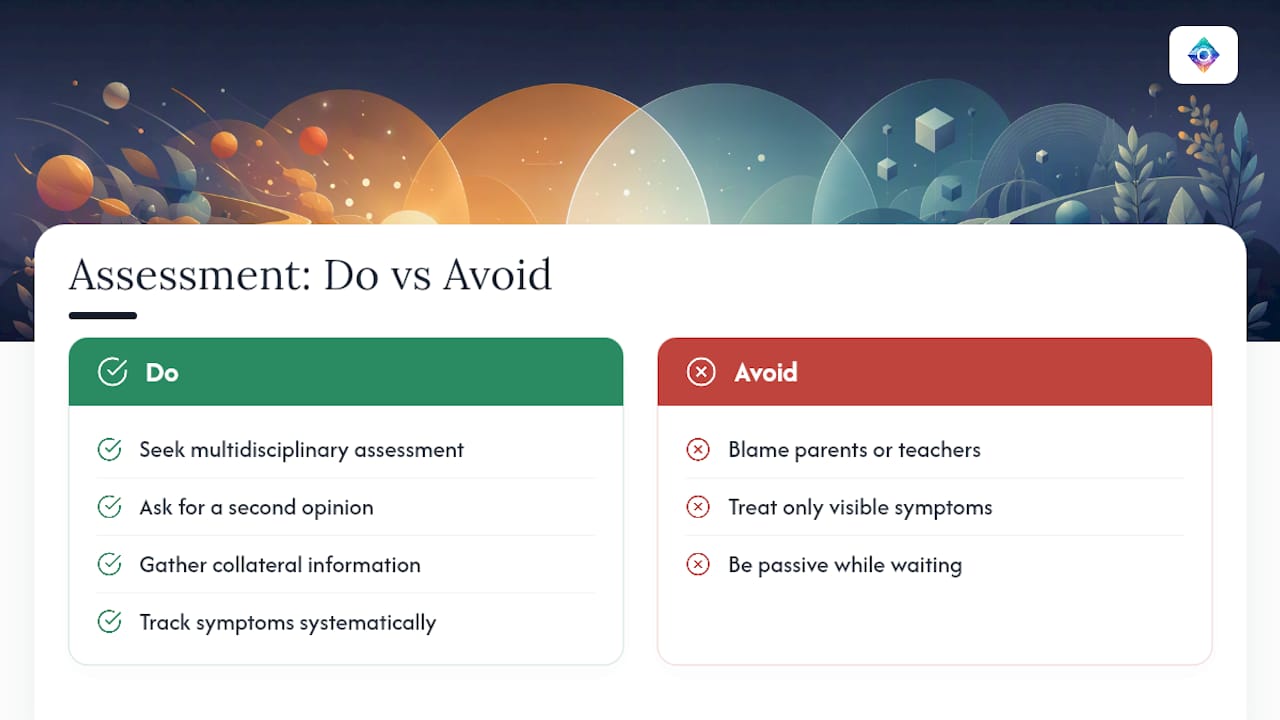
One thing worth saying plainly: multidisciplinary assessment, where a psychologist, psychiatrist, and possibly a neuropsychologist each contribute, tends to produce more accurate diagnoses than a single-clinician evaluation when the picture is ambiguous. If your first evaluation leaves you with more questions than answers, a second opinion from a specialist in neurodevelopmental or anxiety disorders is a reasonable next step, not an overreaction.
Pro Tip: Patience in the diagnostic process is not passivity. Use the waiting time to gather collateral information, track symptoms systematically, and prepare a structured briefing for your clinician. The more organized your input, the more useful the evaluation.
Omniprism can help you prepare for your clinical evaluation
Knowing you need an assessment and knowing how to prepare for one are two different things. Omniprism's free neurodivergence self-assessment covers 14 domains, including ADHD traits, OCD traits, autism, sensory processing, and high sensitivity, giving you an instant profile in plain language with no data collection required.
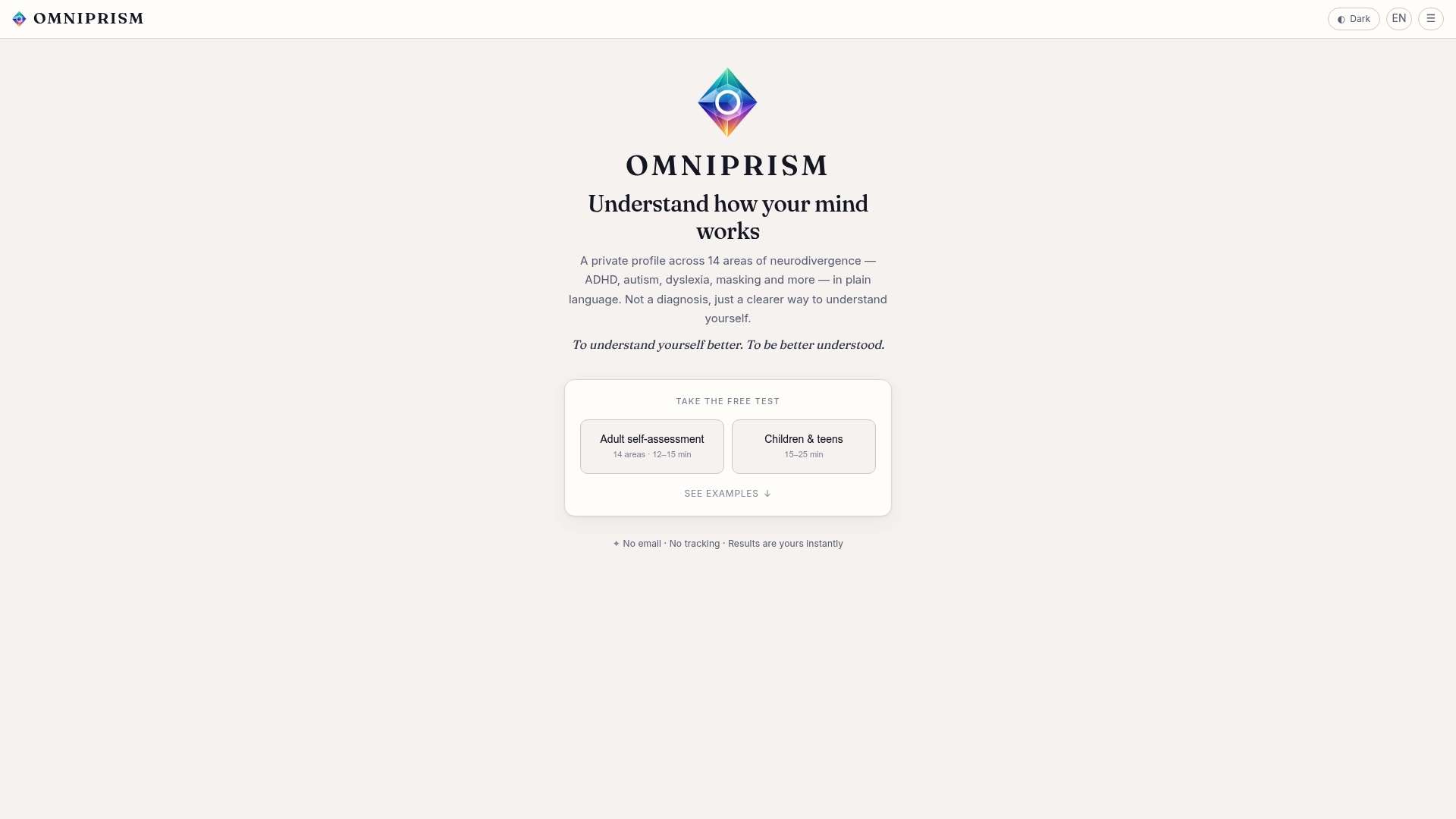
For families, Omniprism's guided assessments for children and teens help parents translate months of observations into a structured format a clinician can actually use. The optional Specialist Briefing report goes further: it summarizes your profile across all 14 domains in a format designed for clinical conversations, covering symptom timelines, behavioral patterns, and functional impact. That kind of organized input can meaningfully shorten the path from first appointment to accurate diagnosis.
Omniprism is not a diagnostic tool. It does not replace a clinical evaluation, and it cannot tell you whether you or your child has ADHD, OCD, or both. What it does is help you arrive at that evaluation prepared, with a clear, structured account of what you've observed. You can review Omniprism's assessment methodology and its disclaimer before you begin. Start your free assessment today and bring something concrete to your next appointment.
Sources
The sources below are the primary references used in this article. Each is worth reading directly if you want to go deeper.
- Co-Morbid Obsessive–Compulsive Disorder and Attention Deficit Hyperactivity Disorder: Neurobiological Commonalities and Treatment Implications - PMC
- OCD and ADHD dual diagnosis, misdiagnosis and the cognitive ‘cost’ of obsessions | International OCD Foundation
- ADHD vs. OCD differences | Dr. Amitai Abramovitch
This article is general information, not a substitute for advice from a qualified doctor. Consult a qualified healthcare professional about your own circumstances before acting on anything here.