

The clearest clinical distinction is this: bipolar disorder produces discrete episodes of mania or hypomania that represent a clear change from baseline, while ADHD produces persistent, trait-level problems with attention and executive function that have been present since childhood. That difference is not just academic. Treating ADHD with stimulants before ruling out bipolar disorder carries a real risk of triggering a manic episode, which is why clinicians need to get this right before prescribing anything.
- Bipolar disorder: defined by episodic mood highs (mania/hypomania) and lows (depression) that come and go, often with relatively normal functioning between episodes.
- ADHD: defined by chronic, persistent inattention, hyperactivity, and impulsivity that started in childhood and never really let up.
Two immediate steps worth taking right now: start a simple daily log of mood, sleep, energy, and attention (even a notes-app entry works), and schedule a primary care or psychiatry intake. Bring that log to the appointment. Clinicians call this a longitudinal history, and it is the single most useful thing you can hand them.
Pro Tip: Ask a parent, sibling, or long-term partner to write down what they remember about your behavior and attention in childhood. Collateral history from people who knew you early is one of the most powerful diagnostic tools a clinician has.
Key Takeaways
The clearest clinical difference between ADHD and bipolar disorder is that bipolar disorder produces discrete, episodic mood shifts while ADHD produces persistent, childhood-onset attention and executive-function problems that never fully remit.
| Point | Details |
|---|---|
| Episodic vs. persistent | Bipolar disorder causes distinct mood episodes; ADHD symptoms are chronic and present even during stable periods. |
| Onset and history | ADHD symptoms begin before age 12; bipolar disorder typically emerges in late adolescence or early adulthood. |
| Stimulant risk | Starting stimulants before ruling out bipolar disorder can trigger a manic episode; mood stabilization comes first. |
| Comorbidity is common | Roughly 20% of adults with bipolar disorder also meet criteria for ADHD, requiring staged, carefully monitored treatment. |
| Omniprism self-assessment | Omniprism's free 14-domain profile creates a structured symptom summary you can bring to a clinical intake appointment. |
Table of Contents
- What bipolar disorder actually looks like
- What ADHD looks like across the lifespan
- Why these two conditions get confused so often
- Clinical clues that help distinguish ADHD from bipolar disorder
- When both conditions are present at the same time
- Treatment differences and the real risks of misdiagnosis
- What a clinical evaluation actually involves
- How a structured self-assessment helps clinicians
- What you can do right now
- The confusion is understandable, and the path forward is clear
- A structured self-assessment to prepare for your clinical visit
- Sources
What bipolar disorder actually looks like
Bipolar disorder is a mood disorder defined by distinct episodes of mania or hypomania alternating with depressive episodes. The key word is discrete: these are identifiable periods when a person's mood, energy, and behavior shift markedly from their usual baseline.
Core manic and hypomanic symptoms:
- Elevated, expansive, or irritable mood lasting at least several days
- Dramatically decreased need for sleep (feeling rested after 2–3 hours)
- Grandiosity or inflated self-esteem
- Racing thoughts and pressured speech
- Impulsive, high-risk behavior (spending sprees, sexual impulsivity, reckless decisions)
- Increased goal-directed activity or psychomotor agitation
Core depressive symptoms:
- Persistent low mood, hopelessness, or emptiness
- Fatigue and loss of energy
- Difficulty concentrating
- Changes in sleep and appetite
- Suicidal ideation or thoughts of death
A full manic episode requires symptoms lasting at least 7 days, or any duration if hospitalization is necessary. Hypomanic episodes are shorter (at least 4 days) and less functionally impairing, but they still represent a clear departure from normal. Bipolar I involves full mania; Bipolar II involves hypomania and major depression.
Typical onset is in the late teens to mid-twenties, though symptoms can appear earlier or later. The episodic nature, the functional change during episodes, and the return to a different baseline between them are what clinicians anchor their diagnosis to.
Statistic: Research estimates that a significant portion of adults with bipolar disorder also meet diagnostic criteria for ADHD, making accurate differential diagnosis especially consequential.
What ADHD looks like across the lifespan
ADHD is a neurodevelopmental disorder, not a mood disorder. Its core features are persistent inattention, hyperactivity-impulsivity, and executive dysfunction that begin in childhood, typically before age 12, even when a formal diagnosis doesn't come until adulthood.
Core ADHD symptoms:
- Difficulty sustaining attention on tasks that aren't immediately rewarding
- Frequent careless mistakes, losing things, forgetting appointments
- Trouble starting tasks (task initiation difficulty), even ones the person wants to do
- Internal restlessness, especially in adults who have learned to mask physical hyperactivity
- Impulsive speech or decisions without full consideration of consequences
- Time-blindness: chronic underestimation of how long things take
Adults often present differently than children. The bouncing-off-walls hyperactivity of childhood often becomes a constant internal buzz, a feeling of being driven by a motor. Executive-function deficits, such as poor working memory, difficulty shifting between tasks, and emotional dysregulation, tend to be the dominant complaints by adulthood.
The critical diagnostic point: ADHD symptoms are persistent, not episodic. They show up during stable periods, stressful periods, good weeks, and bad weeks. The attention problems don't disappear when mood is neutral. That consistency across time and context is what separates ADHD from a condition driven by mood episodes.
Why these two conditions get confused so often
The symptom overlap is real, and it trips up even experienced clinicians. Both conditions can produce racing thoughts, high energy, impulsive behavior, irritability, and difficulty concentrating. On a single cross-sectional snapshot, a person in a hypomanic episode and a person with ADHD can look nearly identical.

| Symptom | In ADHD | In Bipolar Disorder |
|---|---|---|
| Distractibility | Chronic, present most days regardless of mood | Worse during mood episodes; often normal between them |
| Racing thoughts | Scattered, hard to focus; mind jumps between topics | Pressured, fast, often grandiose; part of a mood shift |
| High energy | Persistent restlessness, internal motor feeling | Episodic surge, often with decreased sleep need |
| Impulsivity | Consistent pattern across situations | Spikes sharply during manic/hypomanic episodes |
| Irritability | Common, often tied to frustration or overwhelm | Can be a feature of mania or mixed states |
| Sleep problems | Difficulty falling asleep, inconsistent schedule | Decreased need for sleep (not just insomnia) during mania |
Symptoms that most commonly cause diagnostic confusion:
- Distractibility and poor concentration
- Rapid or pressured speech
- Irritability and emotional reactivity
- Restlessness and physical agitation
- Impulsive decisions
The key interpretive question is always: is this a change from baseline, or has it always been this way? A person with ADHD has usually been distractible since elementary school. A person experiencing hypomania has usually been noticeably different from their own normal for the past several days or weeks. Context and timeline change everything.
The Child Mind Institute notes that mania is episodic by definition, while ADHD symptoms are persistent, and that this distinction is the most reliable starting point for families and clinicians trying to sort out which condition they're dealing with.
Clinical clues that help distinguish ADHD from bipolar disorder
Clinicians don't rely on a single symptom. They look at the whole picture across time. Here are the practical signals that shift the diagnosis one way or the other.
Key clinical clues:
- Age of onset: ADHD symptoms start in childhood (before 12). Bipolar disorder typically emerges in late adolescence or early adulthood.
- Course: ADHD is chronic and persistent. Bipolar disorder is episodic, with identifiable highs and lows.
- Sleep: ADHD often involves sleep-onset problems and inconsistent schedules. Bipolar mania produces a decreased need for sleep, meaning the person feels rested and energized on very little sleep, not just unable to fall asleep.
- Grandiosity: A sense of inflated self-importance or special powers is a hallmark of mania. It is not a feature of ADHD.
- Psychotic features: Hallucinations or delusions can occur in severe bipolar mania. They do not occur in ADHD.
- Functional change: Bipolar episodes represent a clear departure from the person's usual self. ADHD is the person's usual self.
- Collateral history: What did teachers, parents, or early employers notice? Childhood reports of inattention and impulsivity point toward ADHD; a history of distinct mood episodes points toward bipolar.
| Feature | ADHD | Bipolar Disorder |
|---|---|---|
| Typical onset | Before age 12 | Late teens to mid-twenties |
| Pattern | Chronic, persistent | Episodic (highs and lows) |
| Primary domain | Attention, executive function | Mood regulation |
| Episode duration | Not applicable (trait-level) | Mania ≥7 days; hypomania ≥4 days |
| Sleep change | Difficulty falling/staying asleep | Decreased need for sleep during mania |
| Grandiosity/psychosis | Absent | Present in mania |
| Functional change | Consistent impairment | Clear shift from baseline during episodes |
| First-line treatment | Stimulants, behavioral therapy | Mood stabilizers, antipsychotics |
Pro Tip: Request old school report cards, employment reviews, or any past psychological evaluations before your appointment from WonPrep's education resources." A teacher's comment from third grade about "can't sit still" or "doesn't finish work" is worth more diagnostically than any single rating scale completed today.
When both conditions are present at the same time
Co-occurrence is more common than most people expect. Clinical studies estimate that roughly 20% of adults with bipolar disorder also meet diagnostic criteria for ADHD. That figure comes primarily from adult clinical samples, so it likely reflects a population that has already sought care, but it signals that dual diagnosis is a real and frequent clinical scenario, not a rare edge case.
Having both conditions compounds the difficulty considerably:
- More frequent mood episodes and shorter periods of stability between them
- Higher risk of substance use disorders
- Greater functional impairment at work and in relationships
- More complex treatment planning, since standard ADHD medications carry risks in the presence of untreated bipolar disorder
- Delayed or missed diagnosis, because each condition can mask or mimic the other
The Depression and Bipolar Support Alliance notes that bipolar mood swings are typically more extreme and episodic than the mood variability seen in ADHD, which is a useful framing for people trying to understand their own experience.
When both conditions are confirmed, clinicians generally prioritize mood stabilization first. Attempting to treat ADHD with stimulants while bipolar disorder is active and uncontrolled is the scenario most likely to cause harm.
Treatment differences and the real risks of misdiagnosis
Getting the diagnosis wrong has direct, concrete consequences. The treatments for these two conditions are not interchangeable, and using the wrong one can make things significantly worse.
Typical treatment approaches:
For bipolar disorder:
- Mood stabilizers (lithium, valproate, lamotrigine)
- Atypical antipsychotics (quetiapine, aripiprazole, lurasidone)
- Psychotherapy, particularly psychoeducation and interpersonal therapy
- Lifestyle structure (sleep regularity, substance avoidance)
For ADHD:
- Stimulant medications (amphetamine salts, methylphenidate)
- Non-stimulant options (atomoxetine, bupropion, guanfacine)
- Behavioral interventions and executive-function coaching
- Cognitive behavioral therapy adapted for ADHD
The most serious misdiagnosis risk runs in one direction: stimulants and certain antidepressants can trigger treatment-emergent hypomania or mania in people with bipolar disorder. This "manic switch" is a recognized clinical risk, and it is the primary reason clinicians are cautious about prescribing stimulants before ruling out a bipolar spectrum condition.
Risk warning: If you or someone you know has been prescribed stimulants and then experienced a sudden, marked increase in energy, dramatically reduced sleep need, grandiose thinking, or reckless behavior, contact a clinician promptly. This pattern warrants urgent reassessment.
For people with confirmed comorbid ADHD and bipolar disorder, the standard approach is staged: achieve mood stabilization first with a mood stabilizer or antipsychotic, then carefully introduce ADHD-targeted medication under close monitoring. Non-stimulant options like atomoxetine are sometimes preferred in this context because they carry a lower risk of triggering mood episodes, though the evidence base continues to develop.
What a clinical evaluation actually involves
A good diagnostic evaluation for this question is not a single questionnaire. It is a structured process that builds a picture of the person across time.
What clinicians typically assess:
- Full developmental and psychiatric history from childhood to present
- Collateral reports from family members, partners, or teachers
- Validated rating scales (such as the Adult ADHD Self-Report Scale, the Mood Disorder Questionnaire, or the Young Mania Rating Scale)
- Medical history and physical exam to rule out thyroid disorders, sleep apnea, or other conditions that mimic symptoms
- Substance use history (stimulants, cannabis, and alcohol can all produce or mask symptoms)
- Medication history and responses (did a previous antidepressant cause a mood spike?)
- Family psychiatric history (bipolar disorder has strong genetic loading)
CHADD emphasizes that comprehensive diagnostic history and collateral information are the gold standard for differentiating ADHD from bipolar disorder. No single test, scan, or rating scale replaces a thorough longitudinal account.
What to bring to your first appointment:
- A written timeline of your mood, sleep, energy, and attention patterns over the past several months (or years, if you can)
- Old school records, report cards, or teacher comments
- Any previous psychological evaluations or psychiatric records
- A list of all medications you have taken and how you responded to each
- Notes from a family member or close friend about what they have observed over time
- A record of any episodes that felt distinctly different from your normal baseline
How a structured self-assessment helps clinicians
One of the practical problems in diagnosis is that people often arrive at appointments with a general sense of what's wrong but no organized way to communicate it. A structured self-assessment changes that.
How to use a self-assessment to build a useful clinical record:
- Map symptoms by age and life period (childhood, adolescence, early adulthood) to show when things started
- Flag distinct mood episodes separately from baseline functioning
- Timestamp any medication changes and note what shifted afterward
- Ask a family member or partner to complete parallel questions about what they have observed
Limitations matter here: a self-assessment is not a diagnosis. It cannot replace a clinical evaluation, and results should never be used to self-diagnose or self-medicate. What it does is create a structured, organized summary that a clinician can review quickly, ask follow-up questions about, and use to guide the evaluation.
Pro Tip: Print or export your self-assessment results before your intake appointment and hand them to the clinician at the start of the session. A structured summary of your symptom history across 14 domains can cut the back-and-forth in half and help the clinician ask sharper questions faster.
What you can do right now
You don't need to wait for an appointment to start building a useful clinical picture. These steps are practical and take less than 15 minutes a day.
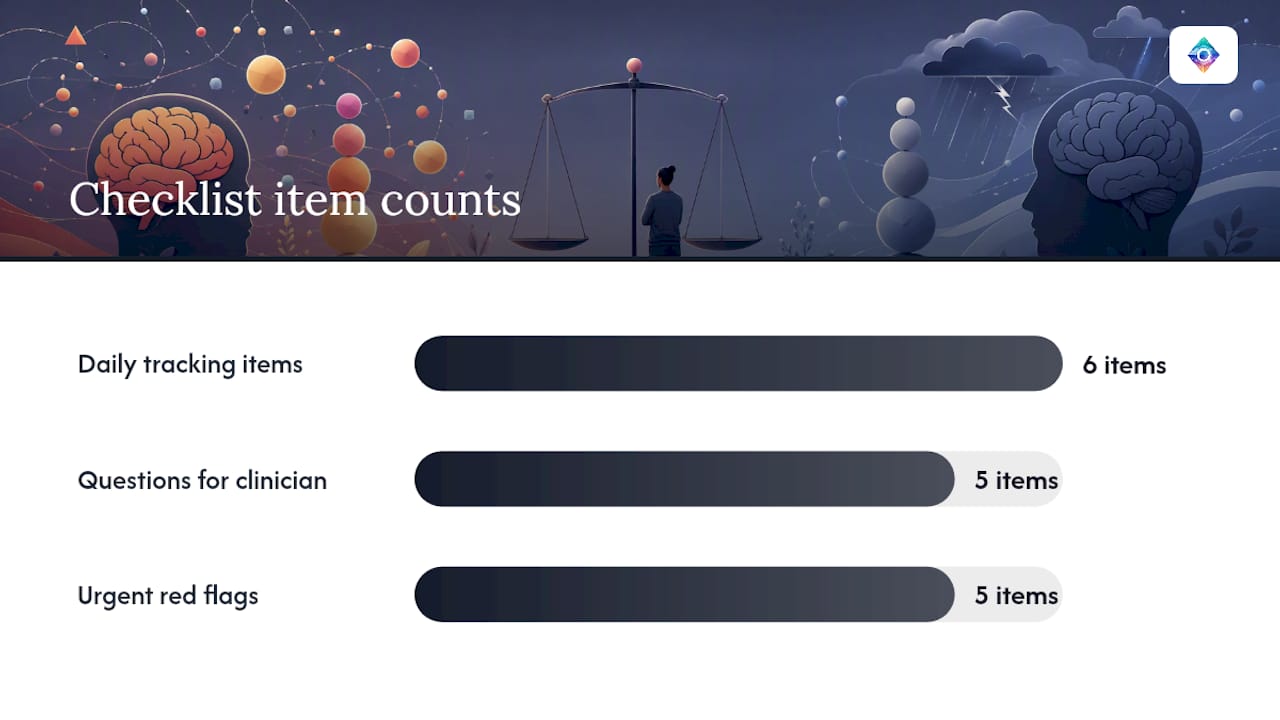
Daily tracking template (note these each day or every few days):
- Mood: Rate 1–10, note any distinct highs or lows
- Sleep: Hours slept, and whether you felt rested or still tired
- Energy: Low, normal, or elevated; any sudden surges
- Attention: How hard was it to focus today? Any tasks left unfinished?
- Substance use: Alcohol, cannabis, caffeine, anything else
- Medication: What you took and any noticeable effects
Questions to bring to your clinical visit:
- "Do my symptoms look more episodic or more persistent to you?"
- "Should we rule out bipolar disorder before considering stimulant medication?"
- "What's the sequencing plan if both conditions turn out to be present?"
- "What should I watch for that would signal a medication isn't working or is making things worse?"
- "How will we monitor for treatment-emergent mood changes?"
Urgent red flags that require immediate care:
- Severe suicidal ideation, especially with a plan or intent
- Psychotic symptoms (hearing voices, paranoid beliefs, losing touch with reality)
- Inability to sleep for multiple nights with no sense of fatigue
- Behavior that puts you or others at risk (reckless driving, financial decisions, aggression)
- Complete inability to care for yourself or your dependents
If any of these are present, contact a crisis line, go to an emergency department, or call emergency services. These are not situations to manage with a tracking log.
The confusion is understandable, and the path forward is clear
Sitting with uncertainty about whether what you're experiencing is ADHD, bipolar disorder, or both is genuinely disorienting. The symptom overlap is real, the diagnostic process takes time, and the stakes feel high. All of that is valid.
What the evidence consistently shows is that the most reliable path through that uncertainty is a structured longitudinal history, collateral input from people who know you well, and a clinician who takes the time to map your symptoms across your life rather than across a single appointment. The distinction between episodic mood shifts and persistent attentional traits is the core of this diagnosis, and it almost always becomes clearer when you look at the full arc rather than the present moment.
Treatment options for both conditions are well-established. Accurate diagnosis makes those options safer and more effective. The effort of building a clear symptom record before your appointment is not just preparation. It is part of the diagnostic process itself.
A structured self-assessment to prepare for your clinical visit
Knowing the differences between ADHD and bipolar disorder is one thing. Communicating your own symptom history clearly to a clinician is another. That's where Omniprism's free self-assessment offers something practical: an instant profile across 14 domains, including ADHD traits, mood patterns, sensory processing, and executive function, delivered in plain language with no data collection required.

The results aren't a diagnosis. They are a structured starting point you can bring to a clinician to speed up the intake process and make the conversation more specific. For families with children or teens, Omniprism also offers guided assessments for ages 7–10 and ages 11–13, with shareable outputs designed to support school and clinical conversations. If you want to understand how the assessment is built before you start, the methodology page explains the domain structure and scoring approach. Take the free assessment, print or export the results, and bring them to your next appointment.
Sources
The sources below are the primary references used in this article and the best places to go for official, up-to-date information.
- Differential diagnosis, comorbidity, and treatment of attention-deficit/hyperactivity disorder in relation to bipolar disorder or borderline personality disorder in adults
- Pharmacologic treatment of bipolar disorder and comorbid adult attention-deficit/hyperactivity disorder
- Bipolar disorder (NIMH)
The consistent emphasis across all of these sources on longitudinal history and collateral reporting reflects a well-established clinical consensus: a single appointment or rating scale is rarely sufficient. The most accurate diagnoses come from building a picture of how symptoms have evolved across years, not just weeks.
This article provides general educational information only and is not a substitute for professional medical advice. For diagnosis, treatment, or medication decisions, consult a qualified clinician or psychiatrist.