

The most reliable ADHD red flags are persistent inattention, hyperactivity-impulsivity, executive dysfunction, and impairment that shows up in more than one setting. If you're seeing these patterns consistently, three things matter right now: document specific examples with dates and settings, ask a teacher or primary care clinician for their observations, and consider a structured self-assessment to organize what you've noticed before a formal evaluation. One isolated incident isn't enough. Clinicians look for persistence across at least six months, onset before age 12, and clear functional impairment, not just a bad week.
Key Takeaways
The strongest ADHD red flags are persistent, cross-setting patterns of inattention, hyperactivity-impulsivity, or executive dysfunction that began before age 12 and cause clear functional impairment in daily life.
| Point | Details |
|---|---|
| Core red flags | Persistent inattention, hyperactivity-impulsivity, and executive dysfunction across home, school, or work. |
| DSM-5 thresholds | Children need 6+ symptoms; adults and teens 17+ need 5+; all must persist for at least 6 months. |
| Document across settings | Collect specific examples with dates from home and school before any clinical appointment. |
| Rule out other causes | Anxiety, trauma, and learning disorders can mimic ADHD; a full evaluation screens for these. |
| Omniprism as prep tool | The free Omniprism assessment profiles 14 domains and generates a clinician-ready summary to support your evaluation. |
Table of Contents
- What are the main ADHD red flags to watch for?
- How ADHD looks different at each age
- What clinicians actually check: DSM-5 thresholds
- When should you actually talk to a clinician?
- What to do after spotting red flags
- How self-assessments can help you prepare
- What it actually feels like to notice these signs
- A structured next step before your clinical appointment
- Sources
What are the main ADHD red flags to watch for?
The CDC groups ADHD into three presentations: predominantly inattentive, predominantly hyperactive-impulsive, and combined. Each has its own pattern of warning signs.
Inattention
- Often fails to finish schoolwork, chores, or tasks at work
- Loses things constantly (keys, homework, phone, tools)
- Easily distracted by unrelated thoughts or surroundings
- Skips details and makes careless mistakes
- Avoids tasks that require sustained mental effort
- Forgets daily routines even when they've been practiced for months
- Seems not to listen when spoken to directly
Hyperactivity and impulsivity
- Fidgets, squirms, or leaves seat when expected to stay still
- Runs or climbs in situations where it's clearly inappropriate (in young children)
- Talks excessively and interrupts conversations
- Blurts out answers before questions are finished
- Struggles to wait for a turn
- Acts without thinking through consequences
Executive function
- Chronic difficulty starting tasks, even ones the person wants to do
- Poor time management: consistently underestimates how long things take
- Trouble organizing materials, spaces, or multi-step plans
- Frequently misses deadlines despite genuine effort
Emotional and social impacts
- Intense emotional reactions that seem disproportionate to the situation
- Difficulty recovering from frustration or disappointment
- Strained friendships due to impulsive comments or difficulty listening
- Low self-esteem from repeated failures or criticism
Pro Tip: Compare the behavior to same-age peers, not to an ideal. A six-year-old who can't sit still for 20 minutes is normal. A six-year-old who can't sit still for two minutes and is falling behind peers in every setting is a different picture. The question is always: is this impairing function, and is it more than you'd expect for this child's age?
If you notice frequent accidents, self-harm, or substance use alongside these signs, treat those as urgent and contact a clinician immediately rather than waiting for a scheduled assessment.
How ADHD looks different at each age
Young children (under 6)
Hyperactivity and impulsivity dominate early. Toddlers and preschoolers are naturally energetic, which makes early identification genuinely hard. The key signal, as Healthychildren, is trajectory: most preschoolers grow into better self-control over time. Children who don't, and whose behavior consistently disrupts play, family routines, or preschool, are showing a pattern worth tracking.

School-age children (6–12)
This is when inattention becomes harder to ignore. Sitting through a 45-minute lesson, completing homework independently, and managing a backpack full of materials all demand sustained attention. A child who frequently forgets assignments, regularly loses their jacket, and struggles to follow multi-step instructions is showing early signs of ADHD in a way that's now measurable against clear expectations. The Omniprism children's assessment for ages 7–10 can help parents organize these observations before a clinical appointment.

Adolescents (13–17)
Motor hyperactivity often quiets down in teens, replaced by internal restlessness: a feeling of being driven, difficulty relaxing, or jumping between tasks. What rises instead is the academic and social cost. Missed assignments pile up, friendships strain, and risk-taking behaviors can increase. Teens may also develop masking strategies that hide symptoms from adults while exhausting themselves in the process.
Adults (18+)
Adults with ADHD tend to show chronic restlessness, disorganization, forgetfulness, and a pattern of incomplete projects rather than the overt hyperactivity visible in younger children.
Work performance suffers through missed deadlines and difficulty prioritizing. Relationships strain when a partner feels chronically unheard or when household responsibilities fall unevenly. Stress, poor sleep, and overstimulation tend to worsen all of these patterns. ADHD symptoms often begin in childhood and persist into adulthood, which means adults seeking answers should think back to whether these patterns existed before age 12.
What clinicians actually check: DSM-5 thresholds
Knowing the clinical criteria helps you understand what evidence to gather before an appointment.
| Criterion | Children (up to 18) | Adults and teens 17+ |
|---|---|---|
| Symptoms required | 6 or more in a domain | 5 or more in a domain |
| Duration | At least 6 months | At least 6 months |
| Onset | Several symptoms before age 12 | Several symptoms before age 12 |
| Settings | Present in 2 or more settings | Present in 2 or more settings |
| Impairment | Clear evidence of functional impairment | Clear evidence of functional impairment |
Per NIMH diagnostic guidance, these thresholds are age-adjusted because the same symptom count that signals disorder in an adult would be developmentally normal in a five-year-old. A clinician also needs to rule out other explanations: anxiety, trauma, sleep disorders, and learning disabilities can all produce ADHD-like behavior.
Pro Tip: Before your appointment, write down five to ten specific incidents with dates, the setting they happened in (home, school, work), and what the functional consequence was. "He forgot his homework again" is less useful than "He forgot homework on Tuesday and Thursday last week, and his teacher sent a note home both days." Concrete examples with context are what rating scales and clinical interviews are designed to capture.
When should you actually talk to a clinician?
Seek an assessment when the pattern is consistent across settings, has lasted at least several months, and is causing real-world consequences: failing grades, job performance issues, strained relationships, or safety concerns. A single difficult term at school or a stressful season at work doesn't meet that bar.
Who can diagnose ADHD varies by country, but typically includes pediatricians, child psychiatrists, psychologists, and developmental-behavioral pediatricians. The evaluation usually covers a detailed developmental history, standardized rating scales completed by parents and teachers, and a rule-out process for co-occurring conditions. CDC clinical care guidance recommends gathering multi-setting reports and screening for anxiety, depression, sleep disorders, and learning disabilities as part of any complete evaluation.
Steps to prepare for an assessment:
- Write down specific behavioral examples with dates and settings.
- Request a teacher questionnaire or written observations from school staff.
- List any co-occurring concerns: sleep problems, anxiety, reading difficulties, social struggles.
- Note when symptoms first appeared and whether they've changed over time.
- Bring any previous school reports, IEPs, or prior evaluations.
What to do after spotting red flags
While waiting for an appointment, or if access to a specialist is limited, several low-risk steps can help immediately.
Adjust the environment first. Reduce clutter, break tasks into smaller steps, use visual timers, and build predictable routines. These aren't workarounds; they're evidence-based strategies that reduce the cognitive load ADHD makes harder to manage. Talk to the school or employer about informal accommodations. Teachers can often adjust seating, provide written instructions, or allow extra time without a formal diagnosis in place.
For young children, behavior therapy and parent training are the first-line treatments recommended before medication is considered. For school-age children and teens, classroom accommodations and CBT-based strategies address both the behavioral and emotional dimensions. Adults often benefit from coaching, CBT, and, when appropriate, medication as part of a monitored plan.
Mayo Clinic's ADHD guidance is clear that ruling out other causes matters as much as identifying ADHD symptoms. Anxiety, learning disorders, and trauma can all look like ADHD. A thorough assessment distinguishes between them rather than treating the surface behavior.
If you're seeing self-harm, a sudden severe decline in functioning, or substance misuse, don't wait for a scheduled evaluation. Contact a clinician or crisis line directly.
How self-assessments can help you prepare
Self-assessments don't diagnose ADHD. Mood, sleep quality, and co-occurring conditions all influence how someone answers symptom questions on any given day, which means results shift. What they do well is help you organize observations, spot patterns across domains, and walk into a clinical appointment with structured information rather than a vague sense that something is off.
Useful applications for self-assessments include:
- Tracking whether symptoms appear consistently across weeks or only during high-stress periods
- Identifying which domains (attention, impulsivity, emotional regulation, executive function) seem most affected
- Generating a structured summary to share with a clinician or school professional
- Deciding whether the pattern you're seeing is significant enough to pursue formal evaluation
Omniprism's free neurodivergence self-assessment covers 14 domains including ADHD, autism, dyslexia, and sensory processing, with age-specific guided versions for children ages 7–10 and young people ages 11–13. Results are delivered instantly in plain language, with no data collection. For those who want a clinician-ready summary, an optional Specialist Briefing report is available as a one-time purchase.
What it actually feels like to notice these signs
Spotting these patterns in yourself or your child tends to bring a complicated mix: relief that there might be an explanation, guilt about what you missed, and urgency to do something now. All of that is normal. Getting an assessment isn't about assigning blame. It's about getting clearer information so strategies and support can actually fit the person in front of you. Gather your examples, talk to a teacher or your primary care provider, and treat that conversation as the first practical step rather than a verdict.
A structured next step before your clinical appointment
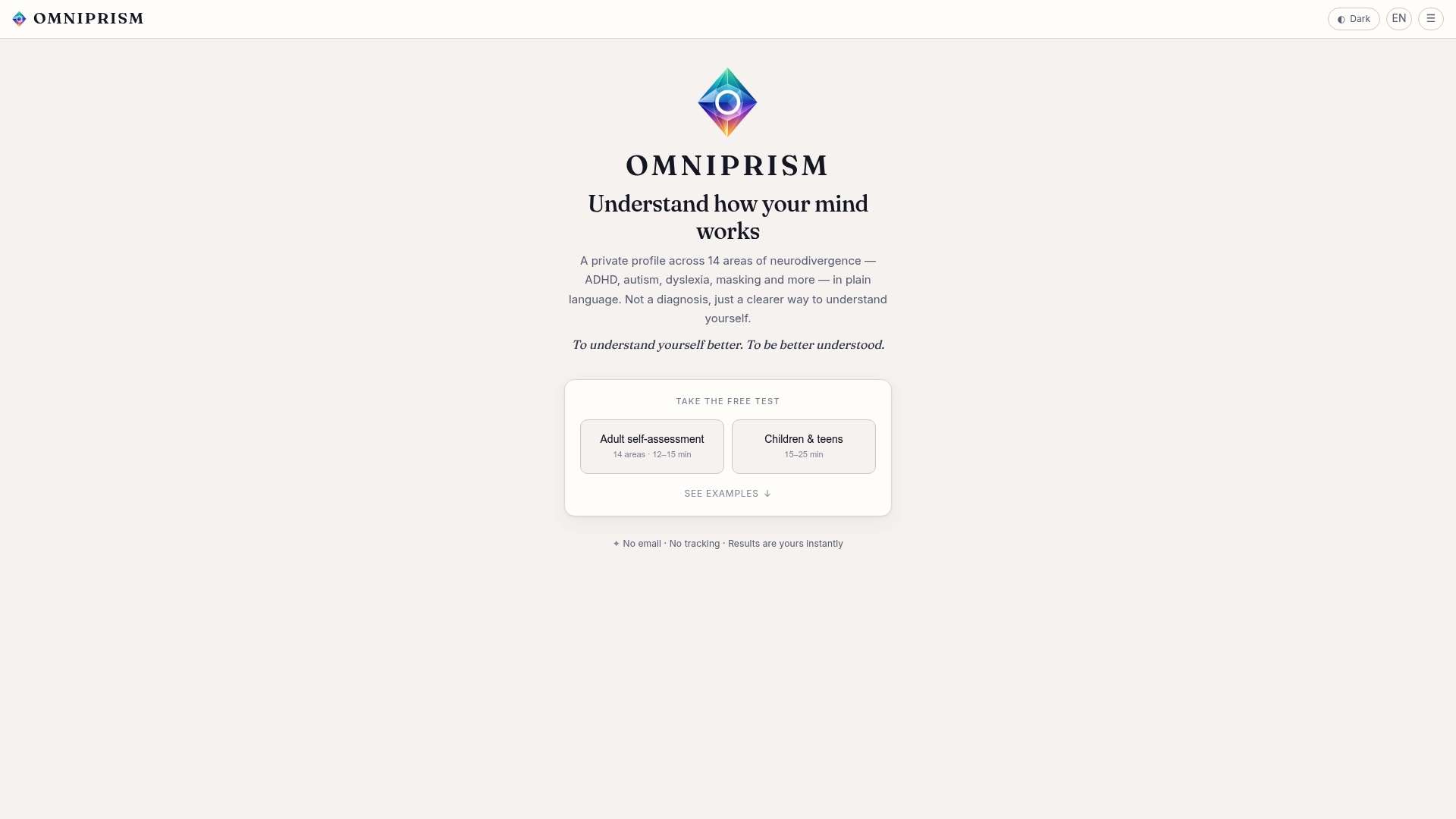
Omniprism's free self-assessment gives you an instant profile across 14 neurodivergent domains, including ADHD-specific indicators, in plain language with no data stored. It's not a diagnosis and shouldn't replace clinical evaluation, but it's a practical way to organize what you've observed and walk into an appointment with something concrete. Age-specific versions for children and teens mean the questions are calibrated to the right developmental stage. If you want a clinician-ready summary of the results, the optional Specialist Briefing is available after completing the free assessment. Start with the free tool, bring the output to your clinician, and use it as a conversation starter rather than a conclusion.
Sources
- Signs & symptoms | ADHD | CDC
- Attention-deficit/hyperactivity disorder: What you need to know | NIMH
- 18 Symptoms That Could Indicate Adult ADHD | Cleveland Clinic
- Healthychildren
This article is general information, not a substitute for advice from a qualified doctor. Consult a qualified healthcare professional about your own circumstances before acting on anything here.