

ADHD in women most often shows up as internalized inattentiveness, emotional dysregulation, and years of quiet masking rather than the fidgety, disruptive presentation most people picture. It's routinely missed or diagnosed decades late as a result. Effective treatment exists once you get there: medication, therapy, and structural accommodations all reduce impairment, and the first real step is a proper evaluation.
TL;DR:
- Women with ADHD often display internalized symptoms such as racing thoughts and emotional dysregulation, which are typically overlooked or misdiagnosed.
- Diagnosis in women is usually delayed due to masking behaviors, gender biases, and symptom presentation that differs from the male stereotype.
- Hormonal fluctuations during the menstrual cycle, pregnancy, and perimenopause can significantly influence ADHD symptom severity and treatment effectiveness.
- Diagnostic evaluations should include detailed childhood history, collateral reports, and exploration of masking strategies to avoid misdiagnosis.
- Combining medication with behavioral therapy and environmental accommodations offers the most effective management strategy for women with ADHD.
Table of Contents
- What Does ADHD Look Like in Women Across Different Ages?
- Why Are Women Diagnosed With ADHD So Much Later Than Men?
- What Mental Health and Life Impacts Come With Undiagnosed ADHD?
- How Do Hormones Affect ADHD Symptoms in Women?
- What Happens During an ADHD Diagnostic Evaluation?
- What Treatments Actually Work for ADHD in Women?
- What Can You Do Today to Manage ADHD Symptoms?
- Can a Self-Assessment Help Before Seeing a Clinician?
- What I Want Women to Understand About Late ADHD Diagnosis
- Ready to Understand Your Own ADHD Patterns?
- Where This Information Comes From
- Sources
What Does ADHD Look Like in Women Across Different Ages?
The stereotype of ADHD as a little boy bouncing off classroom walls has done real damage. It's not that girls and women don't have hyperactive symptoms. It's that those symptoms rarely look physical. A woman with ADHD is more likely to describe her mind as "loud," her thoughts as racing, or her mouth as unable to stop once she starts talking about something she loves. Clinicians at Duke's ADHD program describe this as hyperactivity turned inward, expressed as restlessness of thought rather than restlessness of the body, alongside a stronger lean toward inattentive-type symptoms like losing track of conversations, misplacing things constantly, and struggling to start tasks that feel boring.
Childhood is where the pattern usually starts and where it usually gets overlooked. A girl with ADHD might be the daydreamer at the back of the classroom, not the one sent to the principal's office. She reads under her desk instead of paying attention, forgets her homework at home instead of losing her temper, and gets labeled "spacey" or "a little disorganized" instead of flagged for evaluation. Because she isn't disrupting anyone, no one goes looking for a cause.
Adolescence often turns up the volume on distress even as the outward symptoms stay quiet. Hormonal shifts, social pressure, and academic demands collide, and many teenage girls start showing up in a pediatrician's office with anxiety or mood complaints, not ADHD complaints. She's not falling apart in class. She's crying in her room at night because she can't understand why finishing a simple assignment takes her four hours.
By early adulthood, the coping mechanisms that got her through school (staying up late to cram, relying on natural intelligence, leaning on a supportive teacher or parent) start to break down. College, a first job, or living independently for the first time removes the scaffolding. This is a common point where women first seek an evaluation, often after a friend, therapist, or a viral social media post makes them think "wait, that's me."
Midlife adds another layer entirely, one most articles about ADHD skip over completely. Common real-world signs at different stages include:
- Childhood: Daydreaming, losing homework, being called "a good student but disorganized," intense focus on a narrow set of interests
- Adolescence: Chronic lateness, emotional overwhelm around schoolwork, secretive coping (hiding unfinished work, over-apologizing)
- Early adulthood: Job-hopping, financial disorganization, feeling perpetually "behind," burnout that seems disproportionate to workload
- Parenting years: Struggling to manage household logistics despite genuine effort, forgetting appointments, feeling shame about disorganization in front of children
- Midlife: A sudden, unexplained worsening of focus and memory that doesn't match any prior pattern
A working mother juggling a job and two kids might function fine for years on sheer willpower and caffeine, then find herself unable to keep track of school forms, meal planning, and deadlines all at once, wondering what changed. Often nothing "changed" except that the compensatory systems she built finally hit their limit. Recognizing these patterns as connected, rather than as isolated personal failings, is usually the first step toward an actual diagnosis.
Why Are Women Diagnosed With ADHD So Much Later Than Men?
Masking is the practice of consciously or unconsciously hiding ADHD traits to appear more organized, attentive, or "put together" than you actually feel inside. It's exhausting. A woman might rewrite the same email five times to make sure it sounds coherent, color-code a planner she never quite follows, or nod along in meetings while mentally scrambling to catch a thread she lost two minutes ago. None of this shows up as a symptom to an outside observer. It shows up as fatigue, as irritability at home after holding it together all day, and eventually as burnout that gets misread as a personality problem rather than a neurological one.

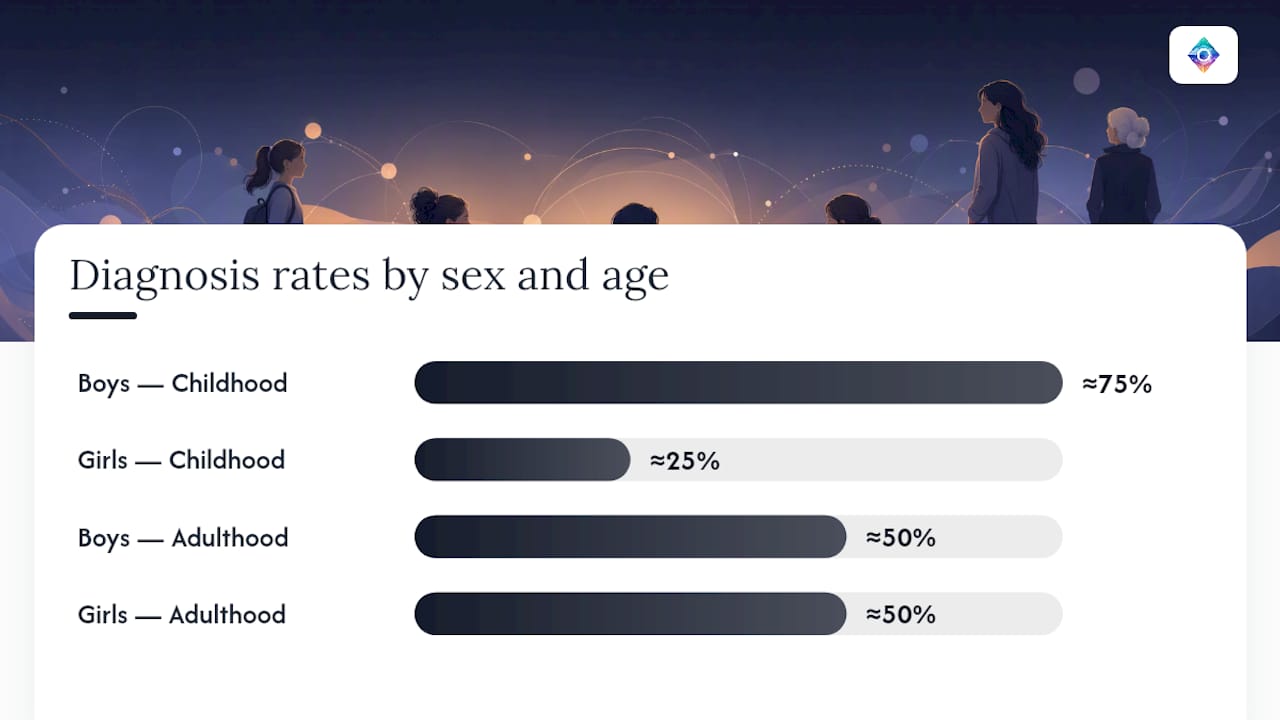
The diagnostic gap has a stark number behind it. Boys are diagnosed roughly three times as often as girls in childhood, yet that ratio nearly disappears in adulthood, closing to something much closer to 1 to 1. That gap isn't because girls develop ADHD later in life. It's because the diagnostic system, built around male-typical presentations, missed them the first time around.
Part of the problem sits with clinicians themselves. Many still operate on an outdated assumption that ADHD is primarily a male condition, which means a woman describing chronic disorganization or emotional overwhelm is far more likely to walk out with an anxiety or depression diagnosis than an ADHD referral. Parents and teachers reinforce the same bias without meaning to. A boy who can't sit still gets flagged fast because he disrupts the room. A girl who quietly zones out gets called "a dreamer" and moves on to the next grade unassessed.
That bias produces a predictable string of misdiagnoses. Common substitutes for an actual ADHD evaluation include:
- Generalized anxiety disorder, when the real driver is ADHD-related overwhelm
- Depression, when low mood is actually chronic burnout from masking
- Borderline personality traits, when emotional swings are ADHD-linked dysregulation
- "Just a highly sensitive person," when the underlying issue is an unmanaged attention disorder
Pro Tip: If you've cycled through two or more mental health diagnoses that never fully explained your symptoms, or treatment "worked" for anxiety or depression but something still felt unresolved, ask specifically about ADHD screening at your next appointment. Bring concrete examples rather than general complaints. Specialists at Duke recommend clinicians dig into a patient's compensatory strategies and history of masking rather than relying on a standard checklist, and you can help that process by walking in with your own timeline ready.
What Mental Health and Life Impacts Come With Undiagnosed ADHD?
Untreated ADHD in women rarely stays contained to attention problems alone. It tends to drag other conditions in with it, largely because the constant effort of coping without a diagnosis wears down mental health over time. A systematic review of ADHD in adult women found that women with the condition are frequently more impaired than their male counterparts and carry a higher rate of internalizing comorbidities like anxiety and depression, both of which can mask the underlying ADHD and delay proper treatment for years.
That overlap creates a diagnostic loop that's hard to escape without outside help. Anxiety gets treated. Depression gets treated. The ADHD underneath both keeps generating the very symptoms the other treatments are supposed to fix, so nothing quite resolves. Common comorbidities layered on top of female ADHD include:
- Anxiety disorders, often driven by chronic fear of forgetting or failing
- Depression, frequently tied to years of unexplained underachievement
- Disordered eating, sometimes linked to impulsivity or using food/restriction as a control mechanism
- Substance use, occasionally functioning as unofficial self-medication for restlessness or focus
Undiagnosed ADHD in women shows up most clearly in Duke's own clinical observations, where internalizing symptoms like anxiety and emotional dysregulation are described as both a consequence of unmanaged ADHD and a major reason it takes so long to get properly identified in the first place.
The functional toll extends well past mood. Careers stall out not because of ability but because deadlines, meetings, and follow-through management require executive function skills that go unsupported. Relationships absorb the strain when a partner feels like they're constantly reminding, nagging, or picking up slack, and the woman on the other side feels a private, corrosive shame she rarely says out loud. Academic underachievement follows a similar pattern: bright women who tested well but consistently underperformed relative to their intelligence, then spent years wondering if they were simply lazy.
There's also a newer, more tentative thread of research worth flagging honestly rather than overstating. Some emerging work has looked at possible associations between ADHD and certain reproductive health patterns, including complications during pregnancy. This research is still preliminary, and no woman should read it as a settled fact or a reason for alarm. It's a reason to mention ADHD history to an OB/GYN, not a diagnosis unto itself.
How Do Hormones Affect ADHD Symptoms in Women?
Estrogen and dopamine appear to move together in ways that directly affect ADHD symptom severity, and that relationship is the single most underdiscussed piece of the female ADHD picture. When estrogen drops, dopamine activity in the brain tends to drop with it, and since dopamine regulation is already compromised in ADHD, that dip tends to make focus, memory, and emotional control noticeably worse.
This interaction plays out on a recurring monthly cycle for most women of reproductive age, not just as a one-time developmental event. A review of hormonal influences on female ADHD points to puberty, the menstrual cycle, pregnancy and postpartum, and perimenopause as distinct windows where symptom severity shifts, often predictably enough that women can learn to anticipate their own worst weeks.
Recognizable patterns show up at each of these stages:
- Menstrual cycle: Many women report a sharp increase in forgetfulness, irritability, and executive dysfunction in the luteal phase, right before their period, when estrogen is at its lowest
- Pregnancy: Some women notice symptom improvement during pregnancy's high-estrogen phases, followed by a postpartum crash once hormone levels fall
- Perimenopause: Fluctuating and eventually declining estrogen frequently brings a resurgence or worsening of ADHD symptoms, sometimes after years of relative stability on the same medication dose
Individualized treatment plans need to account for a woman's hormonal status directly, since a stimulant dose that works well at one point in the menstrual cycle, or one hormonal life stage, may not perform the same way at another. Standardized dosing built around a static baseline doesn't reflect how fluid the underlying biology actually is.
The clinical takeaway here isn't dramatic, but it is practical: don't assume a medication that's "stopped working" has actually failed. Track your cycle alongside your symptoms for a couple of months before concluding anything, and bring that log to your prescriber. Small studies suggest that both stimulant and nonstimulant treatments can meaningfully help women managing executive function difficulties during perimenopause and beyond, though the research pool here is still thin and larger trials are overdue. Coordinated care between a psychiatrist, an OB/GYN, and a primary care provider tends to produce better outcomes than any one specialist working in isolation, particularly around pregnancy and the menopause transition, when medication decisions get more complicated.
What Happens During an ADHD Diagnostic Evaluation?
A quick online quiz can flag that something's worth investigating. It cannot diagnose you, and treating it as though it can is one of the more common mistakes women make on this path. Screening tools are a starting point; a full diagnostic evaluation is a longer, more structured process, and understanding the difference saves a lot of frustration.
Here's what an actual evaluation generally involves, step by step:
- A detailed developmental history. A clinician will ask about childhood behavior, school performance, and family patterns, since ADHD symptoms need to trace back before adulthood even if they were never named at the time.
- Standardized rating scales. You'll typically fill out validated questionnaires about attention, impulsivity, and emotional regulation, sometimes alongside a partner, parent, or close friend who can offer an outside perspective.
- Collateral reports. Input from someone who's known you a long time, a parent for childhood history or a partner for current functioning, helps fill in blind spots that masking tends to create.
- A clinical interview. Expect real conversation about your coping strategies, not just a checklist. This is where mentioning the effort behind your masking matters most.
- Rule-outs for overlapping conditions. A thorough clinician screens for anxiety, depression, thyroid issues, and sleep disorders, since these can mimic or compound ADHD symptoms.
For who to see: a primary care provider can start the conversation and refer you onward, but a psychiatrist, psychologist, or a clinic that specializes in adult ADHD (particularly one with experience in female presentations) will give you a more reliable outcome than a rushed 15 minute appointment.
Pro Tip: Before your appointment, write down three to five concrete examples of how your symptoms have affected your life over the past decade, one from school, one from work, one from relationships. Specific stories ("I missed three rent payments in one year despite having the money") land far better with a clinician than a vague "I've always been disorganized."
Seek help sooner rather than later if disorganization or emotional overwhelm is affecting your ability to work, parent, or maintain relationships, or if you notice thoughts of self-blame spiraling into something closer to hopelessness. That combination warrants a conversation with a professional now, not a wait-and-see approach.
What Treatments Actually Work for ADHD in Women?
Medication remains one of the most effective tools available, and public health guidance consistently supports combining it with behavioral therapy rather than relying on either alone. Stimulants (methylphenidate and amphetamine-based medications) are the most studied and typically the most effective category for core attention symptoms. Nonstimulant options like atomoxetine or certain blood pressure medications used off-label are alternatives for women who don't tolerate stimulants well or have contraindications.
Here's the honest caveat too many sources skip: sex-specific dosing research is thin. Most trials establishing standard doses weren't designed to account for hormonal fluctuation, meaning many women end up needing more individualized monitoring and dose adjustments than the standard prescribing guidelines assume, particularly around the menstrual cycle or perimenopause.
Medication alone rarely solves the whole picture, which is where structured non-drug approaches earn their place:
- Cognitive behavioral therapy adapted for ADHD helps address the shame and self-blame that build up after years of unexplained struggle, not just the attention symptoms themselves
- ADHD coaching focuses on building concrete systems (time management, task initiation) rather than processing emotions, and works well alongside therapy rather than instead of it
- Skills training groups teach specific executive function strategies in a peer environment, which can reduce the isolation many women feel after diagnosis
- Combined approaches (medication plus therapy plus coaching) consistently outperform any single intervention alone for women managing both ADHD and a comorbid condition
Workplace and school accommodations round out a realistic treatment plan. Extended deadlines, written instructions instead of verbal-only ones, noise-canceling headphones, and flexible scheduling are common, reasonable requests that don't require disclosing a full medical history to a manager or professor. Digital aids like task-timer apps, voice-to-text tools, and shared digital calendars fill in the executive function gaps that willpower alone can't fix.
Pregnancy and breastfeeding require a separate conversation entirely. Stopping medication abruptly isn't automatically the safest choice, and neither is continuing without medical guidance. This is a decision to make jointly with a psychiatrist and OB/GYN who can weigh the specific medication, dose, and trimester together, not something to decide alone based on general advice.
What Can You Do Today to Manage ADHD Symptoms?
Waiting for a diagnosis to start improving your daily life isn't necessary. Several practical adjustments reduce day-to-day friction starting immediately, whether or not you've seen a clinician yet.
- Externalize your memory. Stop relying on remembering things. Use a single physical or digital calendar for everything, set alarms for transitions (not just deadlines), and keep a running list visible where you'll actually see it, not buried in a notes app you forget to open.
- Break tasks into absurdly small steps. "Clean the kitchen" becomes "put three dishes in the sink." The smaller the first step, the easier it is to start, and starting is usually the actual barrier, not effort.
- Design your environment for your brain, not against it. Keep keys, wallet, and essentials in one visible spot by the door. Reduce visual clutter in spaces where you need to focus. Friction in the wrong direction (a messy desk, a hidden charger) costs more executive function than it looks like it should.
- Communicate proactively in relationships. Tell a partner or family member specifically what helps, "remind me once, not five times" or "text me instead of calling," rather than letting them guess and both of you getting frustrated.
- Build recovery time into your schedule. If you've been masking all day at work, plan for a genuine decompression window before tackling household tasks or parenting demands. Pretending the exhaustion isn't real just extends it.
Pro Tip: Pick one strategy from this list and commit to it for two weeks before adding another. Trying to overhaul every system at once is a classic ADHD trap, ambitious in the moment, abandoned within days.
Self-care here isn't a spa day. It's permission to stop pretending you're neurotypical for a few hours a day, which is often the single biggest relief women report after finally understanding what's been driving their exhaustion.
Can a Self-Assessment Help Before Seeing a Clinician?
A structured self-assessment can't diagnose ADHD, and no honest tool will claim otherwise. What it can do is organize scattered self-observations into a clear pattern you can actually bring somewhere useful, which matters more than it sounds like it should when you're the one who's spent years dismissing your own symptoms as personality quirks.

Omniprism's free self-assessment builds an instant profile across 14 cognitive domains, including ADHD, autism, dyslexia, masking tendencies, and sensory processing, without requiring weeks of symptom tracking or a waitlist for an initial consultation. For families, guided assessments designed for children walk parents through the same kind of structured reflection, adapted for younger presentations that often look nothing like the adult version of the condition.
The most practical use of these results isn't the score itself. It's the language it gives you. Instead of telling a doctor "I think something's wrong with my focus," you can point to specific domain patterns and timelines that mirror your lived experience. Readers who want a version formatted specifically for a clinical conversation can generate a Specialist Briefing report, which summarizes results in plain, structured language a psychiatrist or psychologist can review quickly.
What I Want Women to Understand About Late ADHD Diagnosis
Late diagnosis follows a predictable emotional arc, and almost nobody warns women about it in advance. First comes confusion, then a strange, disorienting relief when the pieces finally click into place. Grief tends to show up after that, quieter and harder to explain to people who expect you to just be glad you finally know. You're allowed to grieve the years you spent blaming yourself for something that was never a character flaw.
What actually helps is turning that grief into forward motion faster than most self-help advice suggests you should. Start collecting concrete examples of how symptoms have shaped your life, not to relive the pain, but to hand a clinician something specific to work with. Ask for the accommodations you need without over-explaining or apologizing for them. Combined treatment, medication paired with therapy or coaching, consistently outperforms either one alone. You don't need to have this fully figured out before you ask for help. You just need to start.
— Valerio
Ready to Understand Your Own ADHD Patterns?
Generic online quizzes hand you a single score and call it a day. Omniprism gives you a full picture across 14 cognitive domains in minutes, so you walk away with actual language for what you're experiencing instead of a vague "you might have ADHD" verdict.

Start with the free Neurodivergence Self-Assessment, which covers ADHD alongside autism, dyslexia, masking, and ten other domains without any data collection or account requirement. If you're assessing on behalf of a child or teen, guided versions built specifically for ages 7 to 10 and ages 11 to 13 walk families through age-appropriate questions instead of forcing a one-size-fits-all adult framework onto a child's experience.
None of this replaces a clinical diagnosis, and it isn't meant to. What it does is give you a structured starting point, and for readers who want that summarized specifically for a doctor's appointment, the optional Specialist Briefing report turns your results into a document built for that exact conversation. Take the free assessment today and see what it clarifies.
Where This Information Comes From
The clinical framing throughout this piece draws on Duke's Center for Girls & Women with ADHD, a leading academic resource on female-specific presentation and diagnostic bias. The systematic review published on PMC provides the evidence base on underdiagnosis and comorbidity rates in adult women. The Frontiers review on hormonal interplay informs the lifespan and hormone sections. The CDC's ADHD resource grounds the treatment overview, and additional PMC research on midlife treatment supports the perimenopause guidance.
This article is general information, not a substitute for advice from a qualified doctor. Consult a qualified healthcare professional about your own circumstances before acting on anything here.
Sources
- ADHD in Girls and Women: Key Facts | Duke Department of Psychiatry & Behavioral Sciences
- Miss. Diagnosis: A Systematic Review of ADHD in Adult Women — PMC
- Research advances and future directions in female ADHD: the lifelong interplay of hormonal fluctuations with mood, cognition, and disease — Frontiers