

The online ADHD self-assessment is free. The optional Specialist Briefing, a one-time paid clinician-facing report, runs a low-to-mid one-time fee depending on the provider. Omniprism offers both: a free instant profile across 14 neurodivergent domains and an optional Specialist Briefing you can purchase after completing the screen.
Who should buy the Specialist Briefing? Anyone with a clinician appointment already scheduled, or anyone who wants organized, documented evidence to hand a provider at intake.
- Free self-assessment: instant profile, no payment required, no account needed
- Optional Specialist Briefing: one-time purchase, downloadable PDF, designed for clinician use
- Both options available through Omniprism with no personal data stored
Pro Tip: Before your appointment, screenshot or download your free profile the moment you finish. Some platforms don't store results, so that instant screen may be your only copy.
Key Takeaways
A free online ADHD self-assessment gives you an instant profile across multiple neurodivergent domains; the optional one-time Specialist Briefing is worth buying if you have a clinician appointment scheduled.
| Point | Details |
|---|---|
| Free assessment | The online self-assessment is free, instant, and covers multiple neurodivergent domains with no account required. |
| Specialist Briefing cost | A one-time paid report; check the provider's current page for exact pricing, as fees vary by depth and platform. |
| Who should buy it | Adults or parents with a scheduled clinical intake, complex symptom histories, or heavy masking patterns. |
| Privacy | Platforms like Omniprism provide instant profiles without storing personally identifiable data; always verify the privacy policy. |
| Omniprism | Offers the free profile plus an optional Specialist Briefing PDF across 14 domains, with guided options for children and teens. |
Table of Contents
- What does a free online ADHD self-assessment actually measure?
- What does a Specialist Briefing contain, and why do clinicians find it useful?
- How much does a Specialist Briefing cost, and what affects the price?
- When do you get your results, and how long does the briefing take?
- How to use your results and briefing in a clinical appointment
- Who should buy the Specialist Briefing, and when is it worth skipping?
- Does the assessment store your personal data?
- Limitations: what an online screen cannot do
- Does insurance cover ADHD assessments or clinician reports?
- What does a full clinical ADHD assessment typically cost?
- Why organized reports change the clinical conversation
- Omniprism offers the free assessment and the Specialist Briefing in one place
- Sources
What does a free online ADHD self-assessment actually measure?
An online ADHD self-assessment is a structured questionnaire that produces an instant profile across multiple neurodivergent domains. It is not a clinical diagnosis. Think of it as a detailed snapshot of your cognitive and behavioral patterns, organized into plain language you can actually use.
A well-built screen typically covers:
- Attention patterns and distractibility
- Executive function (planning, task initiation, time awareness)
- Sleep and energy regulation
- Sensory reactivity and processing
- Masking behaviors and social camouflaging
- Emotional regulation and rejection sensitivity
The format is straightforward: answer a set of questions, receive an instant scored profile, and read a plain-language summary. Psychology Today's ADHD self-test follows a similar model, noting that results are informational and aggregated responses are stored without identifying individuals.
Pro Tip: If you're heading to a clinician soon, save or print your results immediately after finishing. Many privacy-first platforms don't retain your data, which means your profile disappears when you close the tab.
What does a Specialist Briefing contain, and why do clinicians find it useful?
A Specialist Briefing organizes your self-assessment data into clinician-friendly sections, so your provider spends less time asking basic intake questions and more time on what actually matters.
According to Psychology Today, many neurodiversity-affirming providers welcome organized self-assessment results at intake because they help articulate lifelong patterns that are otherwise hard to describe verbally. A structured report gives the clinician a roadmap before the appointment even begins.
A well-structured briefing typically includes:
- A summary of symptom patterns across domains
- A functional impact section (how traits affect daily life, work, relationships)
- Domain-by-domain scores or indicators
- A suggested list of questions for the clinician to explore
- Red-flag notes that may warrant priority attention
Research published in SAGE Journals found that patient involvement in reviewing draft assessment results improved accuracy and supported client empowerment during the diagnostic process. A Specialist Briefing extends that same collaborative logic: you shape the clinical narrative before you walk in the door.
A strengths-based assessment approach, as recommended in recent neuropsychology literature, also improves therapeutic alliance. The best briefings frame findings in terms of both challenges and cognitive strengths, not just deficits.
How much does a Specialist Briefing cost, and what affects the price?
The free self-assessment costs nothing. The Specialist Briefing is a one-time purchase. Check the provider's current pricing page for the exact figure, since fees vary by platform and report depth.
Factors that typically affect the price of a clinician-facing report:
- Report depth: A basic one-page briefing costs less than an expanded clinical briefing with domain scores and functional impact analysis
- Clinician review: Reports reviewed or annotated by a licensed clinician carry higher fees
- Turnaround speed: Expedited delivery windows sometimes add a premium
- Add-on consultations: Some platforms bundle a brief follow-up call with the report
- Platform positioning: A tool built for clinical use tends to price higher than a general wellness screen
| Feature | Free instant profile | Paid Specialist Briefing |
|---|---|---|
| Instant results | Yes | Yes (profile included) |
| Plain-language summary | Yes | Yes, expanded |
| Domain scores | Basic | Detailed, multi-domain |
| Clinician-formatted sections | No | Yes |
| Functional impact analysis | No | Yes |
| Downloadable PDF for provider | No | Yes |
Payment is typically accepted by credit card or PayPal. Insurance rarely covers a self-assessment tool directly, but some users submit the Specialist Briefing as supporting documentation when seeking reimbursement for clinician-administered services. Check your plan's mental health benefits before assuming coverage.
When do you get your results, and how long does the briefing take?
The free profile is instant. You finish the questionnaire, and the results appear immediately, no waiting, no email confirmation required.
The Specialist Briefing follows a short generation window after purchase:
- Complete the free self-assessment
- Purchase the Specialist Briefing on the same platform
- Report generates (typically same-day to within 24–72 hours, depending on the provider)
- Download the PDF directly from your confirmation or account page
- Forward or print for your clinician before the appointment
Pro Tip: If your appointment is within 48 hours, buy the briefing immediately after finishing the screen. Most platforms generate the report well within that window, but don't cut it close if you want time to read it yourself first.
How to use your results and briefing in a clinical appointment
Bring both the free instant profile and the Specialist Briefing PDF to your appointment. Together, they give your clinician a complete picture before the intake interview starts.
- Download and save both documents as soon as they're available
- Print or email the Specialist Briefing to your clinician ahead of the visit if the practice accepts pre-submitted materials
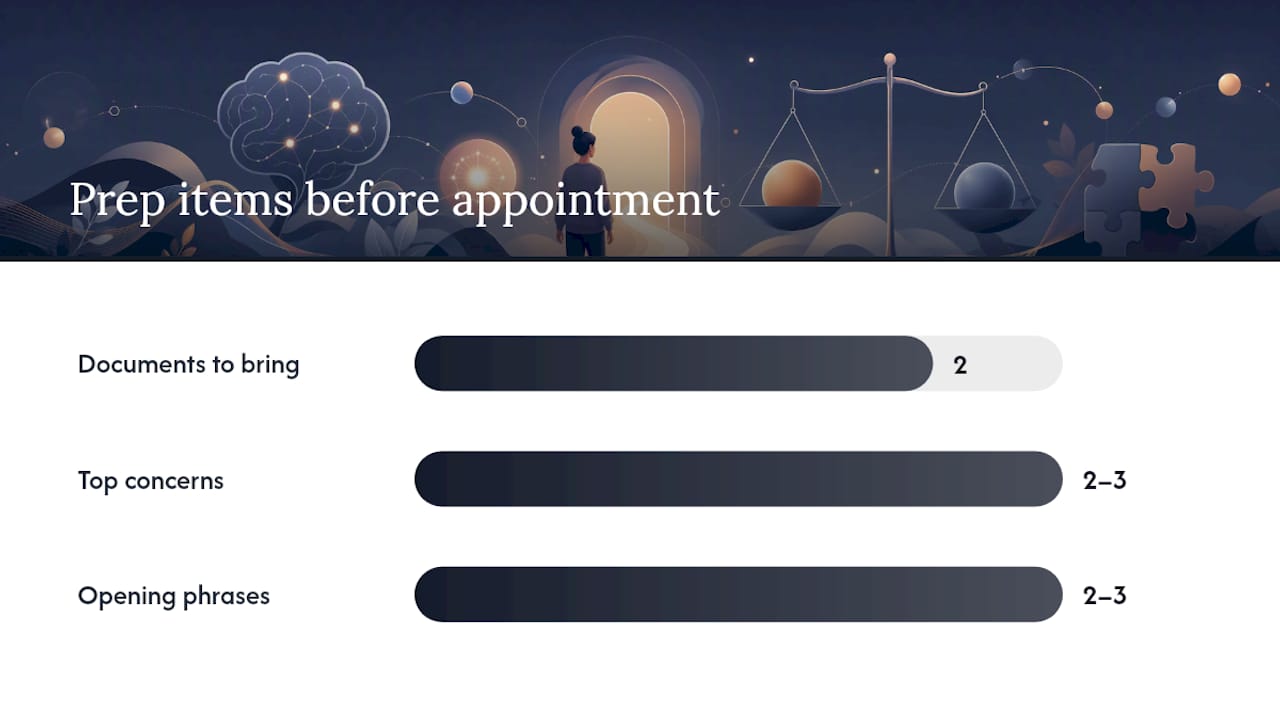
- Annotate your copy with specific examples: dates, situations, or patterns that match the report's findings
- Identify your top two or three concerns to prioritize if time runs short
- Prepare two or three short phrases to open the conversation
Useful phrases with a clinician:
- "I completed a structured self-assessment and brought the summary. Can we use it as a starting point?"
- "The report flagged executive function and masking as my strongest patterns. Does that match what you're seeing?"
- "I'd like to understand whether these patterns point toward ADHD, something else, or both."
Neurodiversity-affirming providers typically want to see organized, patient-provided data at intake. It speeds the diagnostic narrative and reduces the chance that key history gets lost in a 45-minute appointment.
Who should buy the Specialist Briefing, and when is it worth skipping?
Buy it if you:
- Have a clinical intake appointment scheduled and want to arrive prepared
- Have a complex or confusing symptom history that's hard to explain verbally
- Mask heavily and worry your presentation won't reflect your actual experience
- Are a parent preparing for a pediatric intake (Omniprism offers guided assessments for children ages 7–10 and a young person's assessment for ages 11–13)
- Want a strengths-based, documented profile to share with a school, employer, or support team
Skip it if:
- You're already in active specialty care with a recent full diagnostic workup on file
- Budget is tight and the appointment is non-urgent
- Your clinician has explicitly asked you not to pre-submit materials
Does the assessment store your personal data?
Many platforms, including Omniprism, provide instant profiles without tracking or storing personally identifiable information. That's a meaningful distinction from general wellness apps that retain behavioral data indefinitely.
Before sharing results with a clinician, run through this quick checklist:
- Does the platform's privacy policy state that no personal data is stored?
- Does the Specialist Briefing PDF include your name, email, or device identifiers?
- Can you export or delete your data if needed?
- Does the report contain only clinical content, or does it include metadata you'd rather not share?
Pro Tip: If you want to share only the clinical content, check whether the PDF includes any auto-populated personal fields. If it does, most PDF editors let you redact those fields before forwarding to a provider.
Review Omniprism's privacy policy directly for specifics on data handling and retention.
Limitations: what an online screen cannot do
Online screens and Specialist Briefings are not diagnostic instruments. A positive screen is not a diagnosis. Consult a qualified clinician for any formal ADHD evaluation.
Mental Health America states clearly that screening tools provide an initial indicator that further evaluation may be beneficial, not a clinical conclusion. Similarly, tools like the ASRS serve a different clinical role than formal diagnostic instruments such as structured diagnostic interviews, which require a trained clinician to administer.
If your screen suggests ADHD, the recommended next steps are:
- Schedule a clinical intake with a psychiatrist, psychologist, or licensed clinical social worker
- Bring your Specialist Briefing and annotated profile to that appointment
- Request a structured diagnostic interview as part of the evaluation
- Ask whether a full neuropsychological evaluation is warranted based on your history
Does insurance cover ADHD assessments or clinician reports?
Insurance coverage for ADHD-related services varies significantly by plan, provider network, and state. A few practical realities:
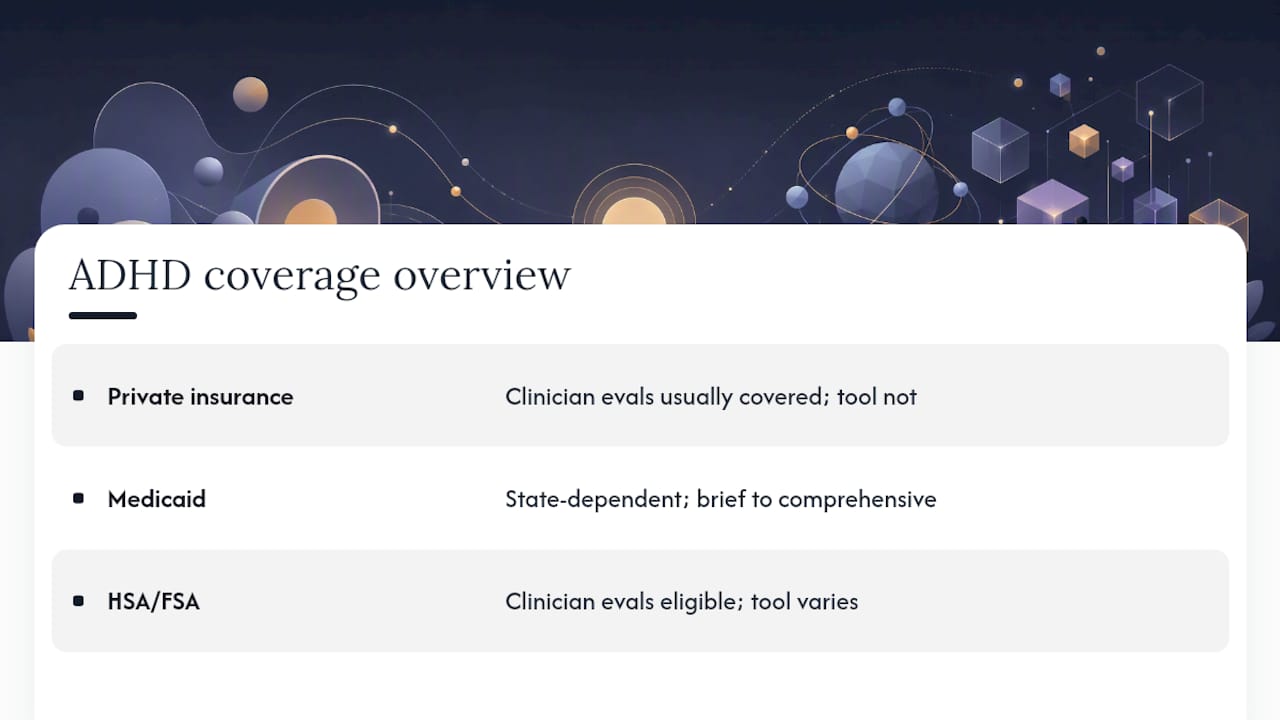
Most private insurance plans cover clinician-administered ADHD evaluations when ordered by a licensed provider and billed under a recognized diagnostic code. The self-assessment tool itself is typically not a covered service, since it's not clinician-administered. However, a Specialist Briefing can sometimes support a reimbursement claim for the clinical visit it informs.
Medicaid coverage for ADHD evaluations depends on the state and the type of evaluation requested. Some states cover comprehensive neuropsychological testing; others limit coverage to brief clinical interviews. Call your plan's member services line and ask specifically about mental health evaluation benefits and prior authorization requirements.
HSA and FSA accounts can often be used for clinician-administered ADHD evaluations, since those qualify as medical expenses. The self-assessment tool fee may or may not qualify depending on your plan administrator's interpretation.
What does a full clinical ADHD assessment typically cost?
A full clinician-administered ADHD evaluation in the U.S. runs considerably more than an online self-assessment. Costs vary by provider type, geographic market, and whether insurance applies.
A brief clinical interview with a psychiatrist or primary care physician tends to cost less than a comprehensive neuropsychological evaluation, which can include standardized cognitive testing, behavioral rating scales, and a multi-session protocol. Out-of-pocket costs for comprehensive evaluations can reach several hundred to over a thousand dollars without insurance, depending on the provider and region.
This is the context that makes the free self-assessment plus an optional low-cost Specialist Briefing genuinely useful: it's a structured, low-friction first step that can make the expensive clinical appointment more productive and more targeted.
Why organized reports change the clinical conversation
Structured reports improve clinical listening. When a patient walks in with a well-organized summary of their symptom history, domain scores, and functional impacts, the clinician can spend the appointment calibrating and probing rather than reconstructing a history from scratch.
The SAGE Journals research on collaborative feedback in assessment makes this concrete: patient involvement in reviewing results improves accuracy. That same principle applies when you bring a Specialist Briefing to intake. You're not replacing the clinician's judgment. You're giving them better raw material to work with.
The strengths-based framing matters too. A report that describes cognitive patterns in terms of both challenges and strengths shifts the clinical conversation away from deficit-labeling and toward a more complete picture of how someone actually functions. That's not just good for the therapeutic alliance. It tends to produce more accurate diagnostic impressions.
Use the report as a conversation tool, not a substitute for clinical evaluation.
Omniprism offers the free assessment and the Specialist Briefing in one place
Skipping the expensive clinical intake cold is one of the most common mistakes adults and parents make when pursuing an ADHD evaluation. Omniprism gives you a structured alternative: a free instant self-assessment across 14 neurodivergent domains, including ADHD, autism, dyslexia, masking, sensory processing, and more, followed by an optional one-time Specialist Briefing designed specifically for clinicians.
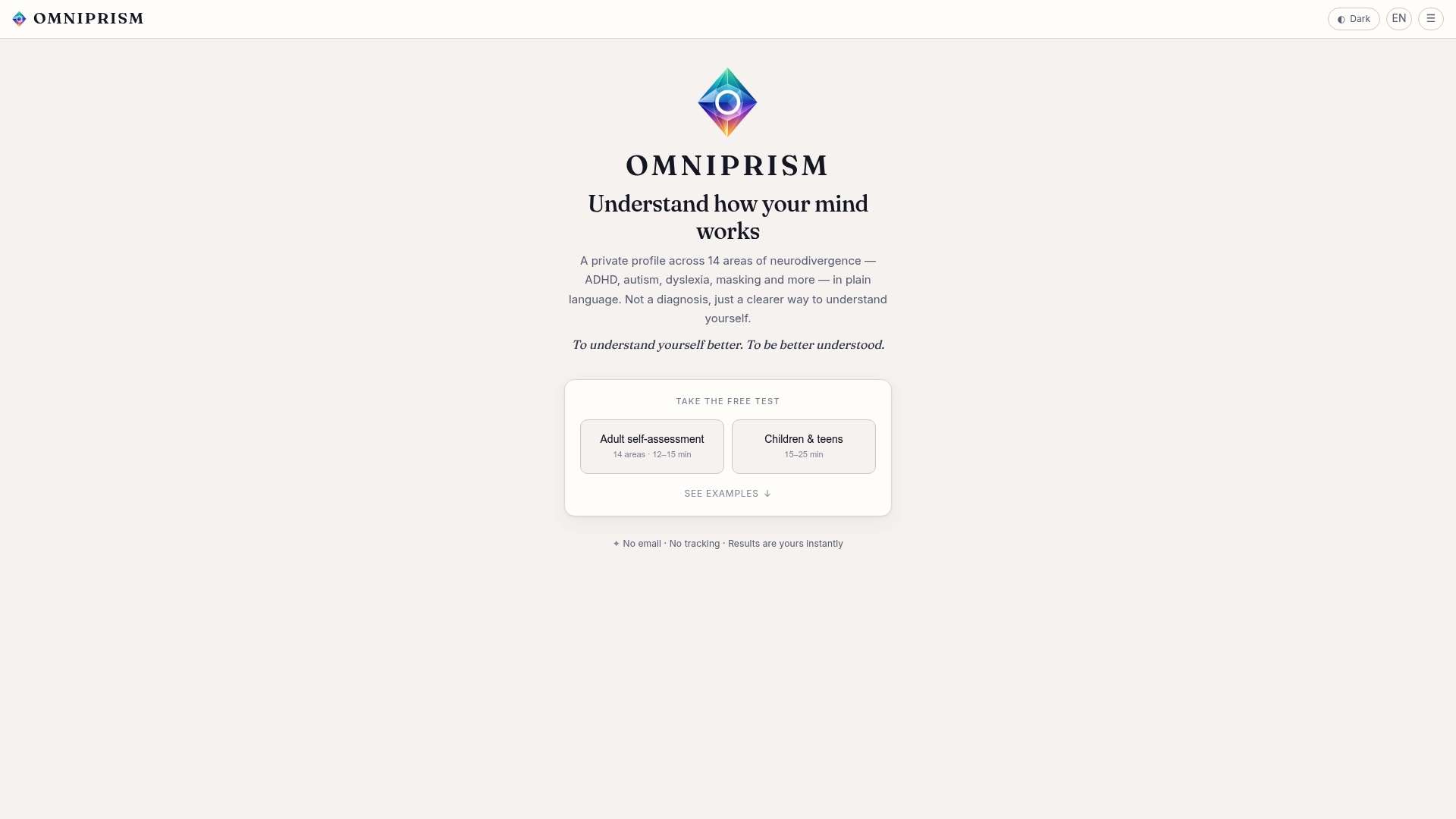
The free profile is available immediately, with no account, no tracking, and no personal data stored. The Specialist Briefing is a downloadable PDF that organizes your results into clinician-friendly sections: symptom patterns, domain scores, functional impacts, and suggested questions for your provider. For parents, guided assessments are available for children ages 7–10 and young people ages 11–13.
Take the free assessment at Omniprism, then purchase the Specialist Briefing if you have a clinical appointment coming up. Review the disclaimer and privacy pages on the site for current pricing, payment options, and data handling details.
Sources
The sources below support the claims in this article and are useful for follow-up reading or sharing with a clinician.
- ADHD Test – Mental Health America
- Neurodiversity Affirming Assessments for Autism and ADHD | Psychology Today
- Neuropsychology strengths-based assessment study | Springer
- Study on collaborative feedback improving assessment accuracy | SAGE Journals
Online screens are screening tools, not diagnostic instruments. Both Mental Health America and Psychology Today note that results should be shared with a qualified healthcare provider for reliable evaluation.